

SpaceX Secures $44 Billion Deal for Nvidia’s Vera Rubin AI Chips
Saturday, November 28, 2026
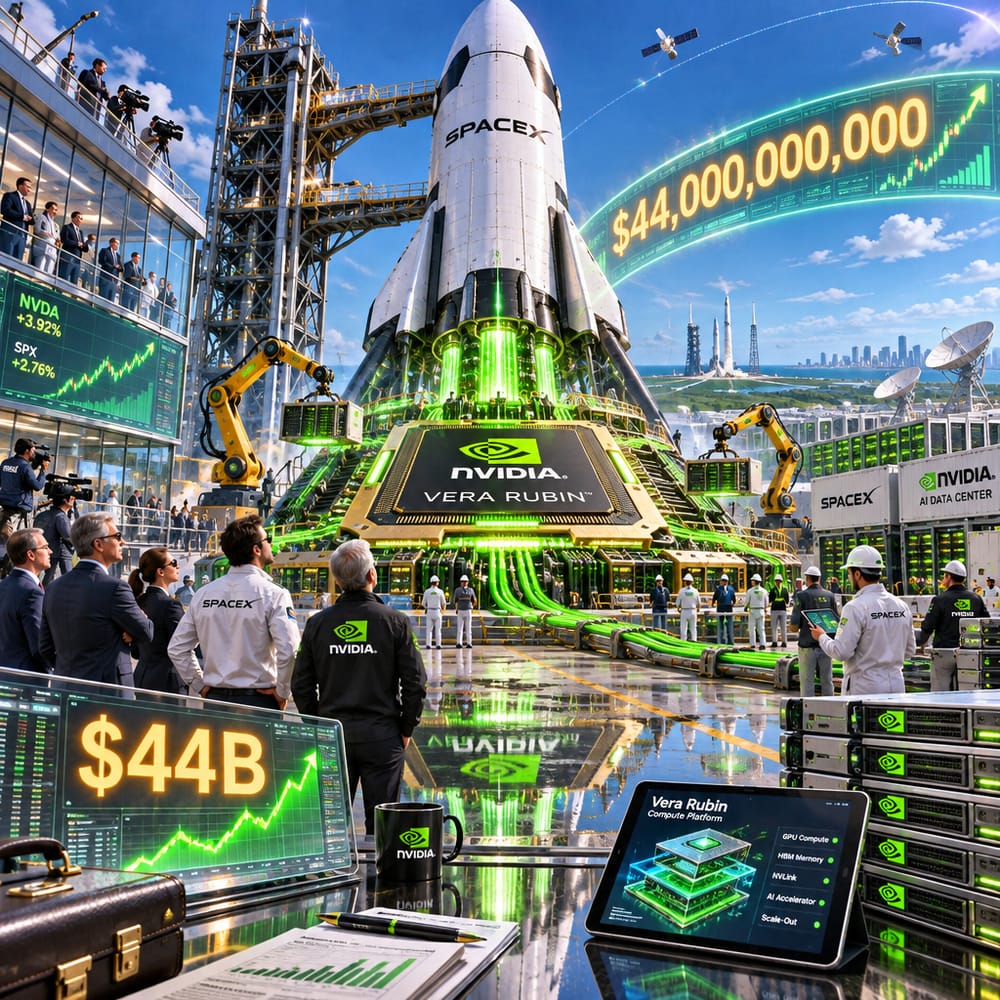
SPACEX TO THE MOON WITH NVIDIA'S $44 BILLION AI CHIP BOOST
In a jaw-dropping move that’s sure to send shockwaves through the tech world, SpaceX just secured a colossal $44 billion funding agreement to snatch up Nvidia's cutting-edge Vera Rubin AI compute platforms. Talk about shooting for the stars! And no, your eyes aren’t deceiving you—$44 billion is indeed the sticker price. Move over, Marty McFly, because we’re zooming into a future where artificial intelligence and space exploration collide in a way that’s straight out of a sci-fi blockbuster.
First, let’s break down the dough. This isn't just Elon Musk shaking the piggy bank. The deal’s structured like the fiscal gymnastics that only a company like SpaceX could pull off. Think of it like this: a mix of equity financing, where investors trade cash for shares, and a hefty chunk of new debt. Why? Because when you’re playing in the big leagues, you want both skin in the game and leverage to keep that rocket fuel burning.
So, what's this mega deal all about? SpaceX, which isn’t exactly known for playing it small, is aiming to supercharge its AI capabilities. Those shiny new Nvidia chips? They’re not just for show. They’re the hot-rod engines needed to process astronomical amounts of data—literally. Imagine harnessing those chips to sharpen satellite imagery, enhance autonomous flight operations, and even tweak the precision landing systems of rockets. It's like giving SpaceX a brain transplant, with artificial neurons firing at light speed.
But let’s not just gaze starry-eyed at SpaceX. Nvidia comes out of this deal looking like it just won the tech lottery. Sure, $44 billion is a nice number to have on your balance sheet, but there’s more to it. This agreement solidifies Nvidia's position as the king of the silicon hill when it comes to AI infrastructure. It’s a stampede-inducing validation that Nvidia's AI platforms aren't just a trend—they’re the backbone of future tech innovation.
Why this cosmic collaboration now? It’s simple: AI is the new arms race, and SpaceX wants to make sure it has the fastest processors in its corner. For Nvidia, it’s about scale. Strategic objectives? More like strategic power play. SpaceX is setting the stage for its next big chapter—maybe even a Mars mission that's thinking years, not decades, ahead. And Nvidia? Well, they’re just making sure they’re the ones building the golden computers of the AI age. Win-win.
But it’s not all sunshine and supercomputers. There are whispers among industry insiders about potential pitfalls. While the promise of AI is tantalizing, the stakes are sky-high. Integrating this technology on such a massive scale is like threading a needle in zero gravity—complex and fraught with potential hiccups. Not to mention, there's always a lurking question: Can SpaceX manage this giant leap without stumbling over its own ambitious feet?
Yet, even with the monumental challenges, the vision is clear. SpaceX aims to redefine what’s possible in space exploration, and Nvidia chips are the secret sauce set to make that happen. It’s a marriage of rocket science and the smartest chips money can buy—literally.
So, what’s next for these tech titans? Expect SpaceX to roll out some stunning new capabilities over the coming years. Think real-time space data analysis, more autonomous spacecraft, and even Martian habitats powered by AI. Meanwhile, Nvidia continues its reign, pumping out increasingly powerful chips that’ll find their way into everything from your smartphone to the most sophisticated space probes.
In the meantime, as SpaceX and Nvidia ride this AI rocket to new frontiers, the rest of us can only watch in anticipation. After all, in the world of tech revolutions, this is the kind of deal that could define a generation. Buckle up, because we're heading into uncharted territory where the sky isn’t the limit—it's just the beginning.
This article is for informational purposes only and is not investment advice. Always do your own research or consult a licensed financial professional before making investment decisions.
© Copyright 2024. All Rights Reserved.
© Copyright 2024. All Rights Reserved.