

SpaceX's Current Valuation and the $12 Trillion Speculation
Tuesday, September 29, 2026
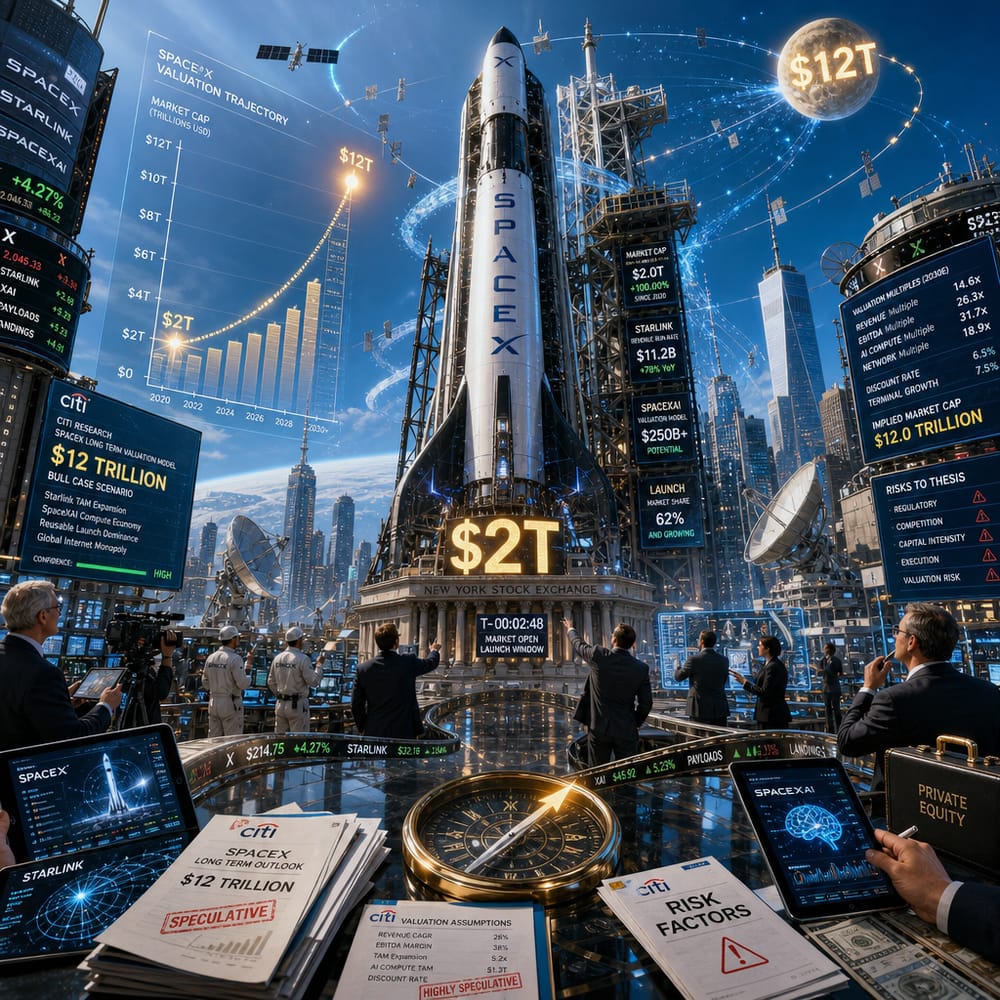
SPACEX'S VALUATION: BETWEEN THE MOON AND MARS
Is SpaceX the new golden ticket to the cosmos, or are we getting lost in space with these valuation figures? It's the $2 trillion question everyone’s asking. Well, maybe it’s more like a $12 trillion question, given some of Citi’s more celestial forecasts. But are these numbers grounded in reality, or are they floating in zero gravity like Elon Musk’s Tesla Roadster?
Right now, SpaceX’s market valuation hovers around a cool $2 trillion according to William Blair’s recent report. That’s the kind of number that would make most companies blush, and for good reason. After launching an impressive IPO, SpaceX didn’t just enter the Nasdaq-100; it soared past a $2 trillion market cap like one of its Falcon 9 rockets leaving Earth’s atmosphere. But buckle up, because there's turbulence ahead in the form of a speculative $12 trillion valuation whispered by Citi analysts. Are we on a one-way trip to dreamland, or is this a realistic plot point?
The $12 trillion figure feels more like science fiction than science fact right now. Citi’s forward-looking forecast depends on some ambitious benchmarks: Starship becoming the go-to for everything from moon vacations to Mars colonization, and SpaceXAI revolutionizing connectivity and AI. The vision here is tantalizing — trillion-dollar opportunities in the vast expanse of space. But, like betting on a dark horse with a rocket strapped to its back, it's speculation that's faster than light. No recent mainstream sources have taken a deep dive into this dreamscape, possibly because even they need a moment to catch their breath.
So, what's driving the $2 trillion valuation today? Let’s bring it back down to Earth. SpaceX is currently riding high on a $1.11 billion monthly compute contract via SpaceXAI. That's like booking two summer blockbusters a month and having them play in every theater across the globe. Add to that Starlink's impressive Q2 revenue of $4.29 billion, with roughly 12 million subscribers all peering up at the same sky. It's enough to make any stockholder starry-eyed.
But there’s a flip side to this story. A $23 billion revenue trailing over the last year is no small feat, but it’s a speck when compared to the cosmic Price/Sales ratio of 86x. That's a valuation sky-high and then some, assuming flawless execution and non-stop growth. We’re talking about a company still nursing a $4.82 billion net loss in the first half of 2026. In Wall Street terms, that’s not exactly landing the rocket back on the pad.
The excitement surrounding SpaceX isn't just about the numbers, though. It's about the narrative. SpaceX is not your grandfather’s aerospace company. It's got a charismatic leader, cutting-edge technology, and a vision for the future that’s as wide as the universe itself. The retail investor interest isn’t just about potential returns; it's about being part of something bigger. But before you bet your portfolio on the next Falcon Heavy launch, consider how limited the float is — only about 4% to 5% of shares are actively traded. This scarcity can drive prices northward, but don’t mistake scarcity for infallibility.
For the average investor, understanding SpaceX's valuation dynamics is crucial. Are you buying into a future where connectivity and aerospace lead to financial freedom, or are you betting on the possibility of a valuation crash-landing? The high-wire act for SpaceX investors is assuming profitability and growth will align perfectly like stars in a constellation. William Blair’s optimistic projection of $0.35 EPS is a start, but it’s just that — a start.
In the world of space exploration and stock speculation, anything is possible. Could SpaceX reach that $12 trillion figure? Maybe. But for now, it's a journey requiring more than just fuel; it needs impeccable execution and perhaps a bit of cosmic luck. Meanwhile, for those of us Earthlings with stock apps on our phones, the $2 trillion valuation is a reminder that even the stars have their price points. Whether SpaceX is a rocket-propelled investment or a slow-burn risk depends largely on the trajectory you believe it’s on. So keep your eyes on the sky, and maybe, just maybe, on your portfolio.
This article is for informational purposes only and is not investment advice. Always do your own research or consult a licensed financial professional before making investment decisions.
© Copyright 2024. All Rights Reserved.
© Copyright 2024. All Rights Reserved.