

SpaceX's Acquisition of Cursor: A $60 Billion AI Play
Tuesday, August 18, 2026
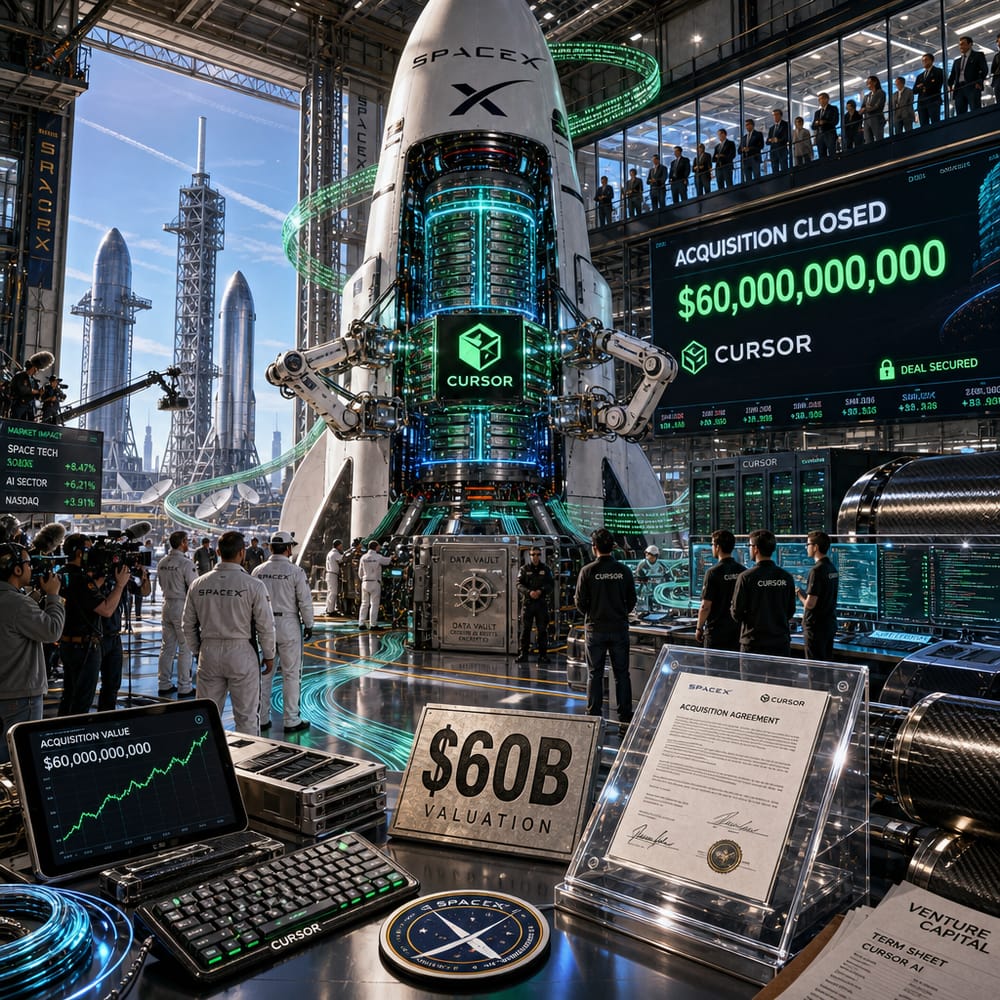
SPACEX'S ACQUISITION OF CURSOR: A $60 BILLION AI PLAY
In a move that could make even the boldest Silicon Valley mogul's eyes widen, SpaceX has gobbled up Cursor for a cool $60 billion. Forget about flashy rockets and interstellar voyages for a second—Elon Musk is now betting big on algorithms and neural networks. So, what's really going on here? Grab some popcorn; it's time to connect the cosmic dots.
First, let's set the scene: SpaceX buying Cursor isn't just any acquisition. This is like buying the entire candy store to enhance your bakery. With Cursor, an AI startup that's been turning heads faster than a Formula 1 car, SpaceX is making a statement as loud as a Falcon Heavy launch: It's not just about space anymore.
HOW DOES THIS FIT INTO SPACEX'S MASTER PLAN?
Musk has long been about breaking chains and redefining boundaries, whether in the atmosphere or the tech realm. This acquisition extends SpaceX's reach from the final frontier to the digital cosmos. AI isn't new to SpaceX. It already powers some of its cutting-edge projects, from autonomous drone ships to satellite navigation. But with Cursor in their pocket, SpaceX is essentially doubling down, perhaps even setting the stage for AI-developed space strategies that could range from optimizing space traffic to mining asteroids.
THE SYNERGIES: WHERE SPACE MEETS SOFTWARE
So, why Cursor? And why now? For starters, Cursor's team is a who's who of AI magic-makers, known for churning out software solutions that read like science fiction. We're talking algorithms that could predict cosmic phenomena, improve spacecraft diagnostics, or even enhance training simulations for astronauts. Combine that with SpaceX's hardware acumen, and you've got a cocktail potent enough to potentially alter the trajectory of space exploration.
It's easy to see the appeal: SpaceX's rockets are designed to withstand the rigors of space, but what if they were also powered by AI that learns from every flight? Imagine rockets that improve themselves with each trip, constantly learning, optimizing, and adapting. With AI at the helm, we're not too far off from a future where digital copilots are as crucial as the combustion engines that power these beasts.
IMPLICATIONS FOR THE AI WORLD
Now, let's talk ripple effects. This is no mere pebble tossed into the AI pool—it's a boulder. Cursor being swept up by SpaceX could trigger a chain reaction across the software universe. Competitors in the AI arena might need to rethink their strategies; after all, when a titan like SpaceX makes a move, it tends to get everyone’s attention.
Others in the AI space, from tech behemoths to nimble startups, may now vie for similar partnerships or acquisitions. The stakes have just been raised in the AI game, and this could spur innovation as companies scramble to keep up or carve out their unique niches.
Moreover, SpaceX's aggressive entry into AI could amplify discussions around regulations and ethics. With AI's capabilities expanding, the conversation around responsible development and use in high-stakes scenarios like space travel will become louder and more urgent.
WIDER MARKET WAVES
As the dust settles, keep an eye on the stock tickers. While SpaceX remains privately held, its sister companies—Tesla, Neuralink, etc.—could see varying effects based on market perception. Investors will be watching for correlations, synergies, and any signs that Musk's broader empire is pushing the limits of what's possible.
In conclusion, SpaceX's move to acquire Cursor transcends the typical headlines of mergers and acquisitions. It's a declaration of intent, a harbinger of future tech landscapes, and a potential catalyst for innovation, competition, and evolution in both AI and space exploration. As we fasten our seatbelts for what's next, one thing's for sure: the cosmos just got a little more crowded with possibilities.
This article is for informational purposes only and is not investment advice. Always do your own research or consult a licensed financial professional before making investment decisions.
© Copyright 2024. All Rights Reserved.
© Copyright 2024. All Rights Reserved.