

Softer-than-Expected September Jobs Report Sparks 'Bad News Is Good News' Rally Across U.S. Equities
Sunday, October 04, 2026
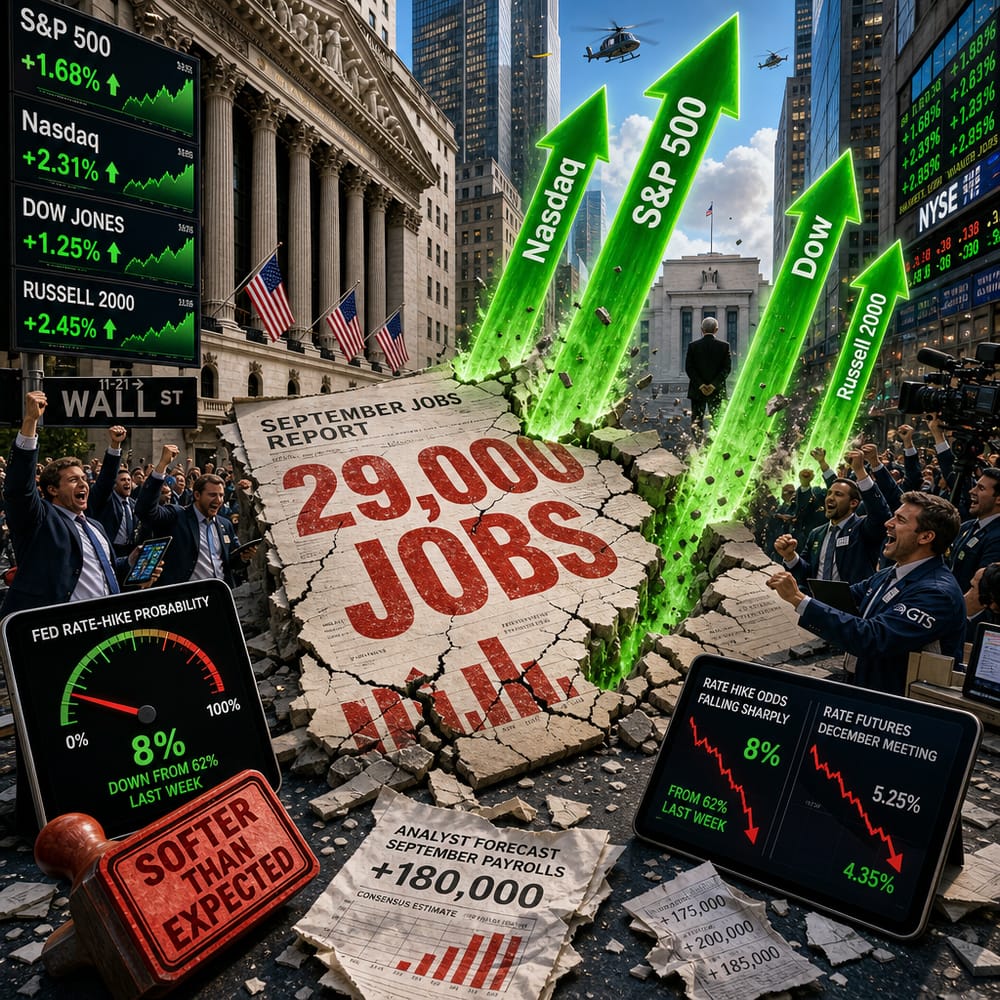
SOFTER-THAN-EXPECTED SEPTEMBER JOBS REPORT SPARKS 'BAD NEWS IS GOOD NEWS' RALLY ACROSS U.S. EQUITIES
If you had 'lackluster jobs report' on your stock market bingo card, congratulations, you're a winner. September's job numbers came in weaker than a soggy sandwich, with the U.S. economy adding just 29,000 jobs—far less than markets expected. But in a twist only Wall Street could love, this disappointing data sent equities skyrocketing. It's a classic case of "bad news is good news," and investors are grinning like cats who got the cream.
So, why the unexpected enthusiasm? Well, when the labor market looks less than robust, it tempers the Fed's enthusiasm for jacking up interest rates. Lower odds of rate hikes mean cheaper borrowing costs, which are akin to giving stocks a double shot of espresso.
WHAT DOES THE JOBS REPORT MEAN FOR FUTURE FED POLICY?
Imagine the Federal Reserve as a cautious driver, weighing the need to hit the gas or pump the brakes based on the economy's speed. A weak jobs report is the equivalent of a "slow down" sign, suggesting the economy might not need as much deceleration as the Fed previously thought. With only 29,000 jobs added, the unemployment rate nudged up to 4.2%, giving the Fed a reason to step back from its aggressive rate-hike plans.
For retail investors, this could mean that getting a mortgage or loan might remain affordable for a little while longer. The Fed's less hawkish stance is like a soothing balm to jittery markets, which have been sweating over borrowing costs like a cat on a hot tin roof.
HOW ARE DIFFERENT INDICES RESPONDING TO THE NEWS?
In response to the jobs data, major indices like the S&P 500, Nasdaq, and Dow Jones took off like sprinters at the sound of a starting pistol. The S&P 500, a reliable bellwether of the market, jumped as investors piled into stocks, capitalizing on the newfound hope that interest rates won't rise as quickly. Meanwhile, the tech-heavy Nasdaq rallied as investors bet on growth stocks to shine brighter with lower borrowing costs.
However, it's the small-cap Russell 2000 that really turned heads. Small caps, often more sensitive to domestic economic conditions, got a zestful boost. They thrive when there's a prospect of cheaper credit and a robust local economy. But hey, let's not pop the champagne just yet—it’s crucial to see if this enthusiasm is more than just a flash in the pan.
WHAT SECTORS ARE LEADING THE RALLY?
Tech stocks are dancing in delight, as usual. With the prospect of lower interest rates, high-growth sectors like technology get a double dose of optimism. Cheaper borrowing costs often mean that those capital-intensive projects in Silicon Valley don’t look so costly after all.
Financials also got a nod, with investors speculating that banks could benefit from the favorable interest rate environment. But here’s the kicker: even beaten-down sectors like consumer discretionary saw some love. With consumers potentially having a bit more cash to splash, thanks to manageable borrowing costs, retail stocks perked up.
CAN WE COUNT ON THIS RALLY?
The million-dollar question—or billion, if you're counting on a big portfolio bounce—is whether this rally can last. Investors are cautiously optimistic, but there’s still a veil of uncertainty fluttering over the markets. Bond yields, often the pesky counterweight to bullish stock sentiment, aren’t exactly waving white flags yet.
The divide between large caps and small caps is a narrative to watch. While the Russell 2000’s jump is heartening, small caps face more risk if economic conditions veer off course. A sustained rally will require a delicate balance—favorable interest rates, stable inflation, and a steady economic growth path.
As investors soak in the latest market drama, it’s clear that Wall Street has a peculiar talent for finding silver linings in what most would consider less-than-stellar economic news. Whether this rally is a harbinger of sustained market cheer or merely a temporary high is a story only time will tell. But for now, the bulls are having their day, and the dance continues.
This article is for informational purposes only and is not investment advice. Always do your own research or consult a licensed financial professional before making investment decisions.
© Copyright 2024. All Rights Reserved.
© Copyright 2024. All Rights Reserved.