

Soft FX Ripples Ahead of Jackson Hole
Thursday, August 27, 2026
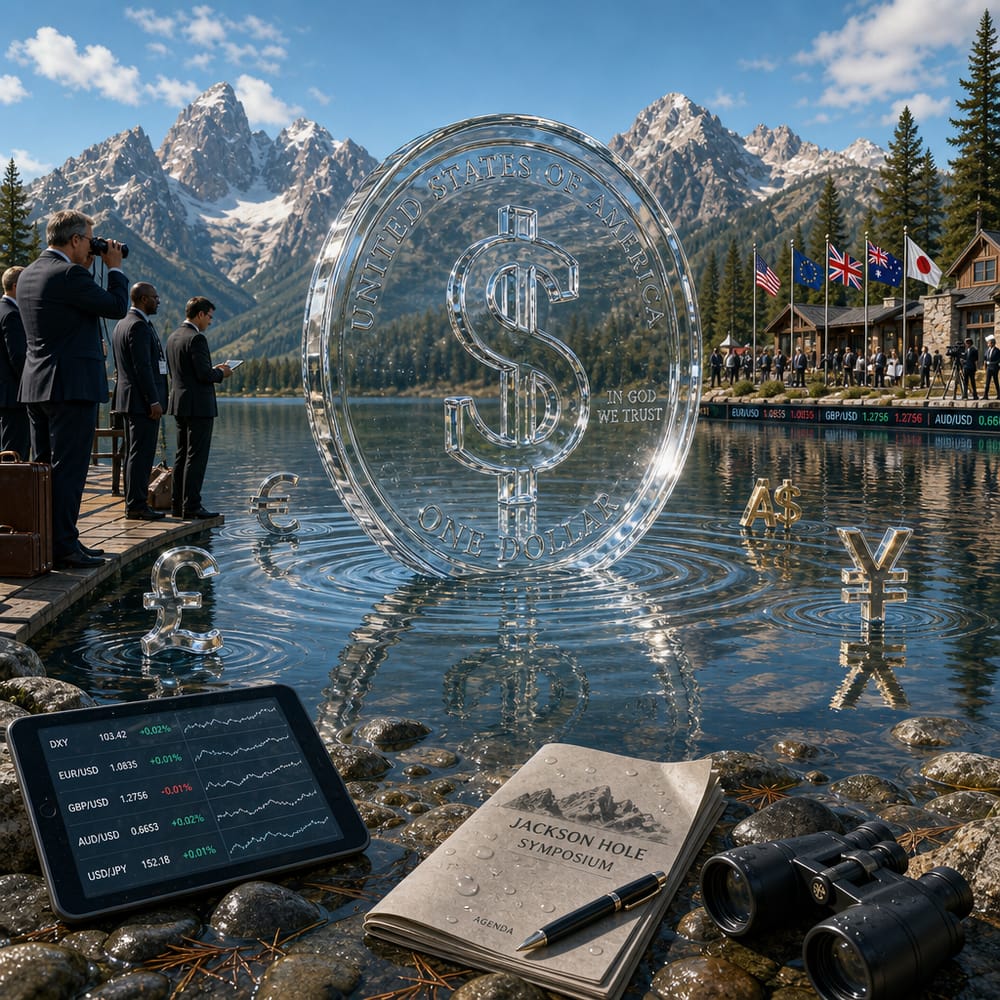
In the quiet, picturesque backdrop of Jackson Hole, Wyoming, where the peaks are as high as the stakes, the annual Federal Reserve symposium is about to take center stage. Picture a modern-day Bretton Woods, where policy wonks huddle under one roof to discuss economies and currencies. This year, the U.S. dollar is flexing its muscles with a steady stance, while the euro, pound, and Australian dollar are shuffling like nervous partygoers. Meanwhile, the yen stands as firm as a samurai, ready for whatever comes its way.
Why should you care? Well, this gathering is a smorgasbord of potential policy signals that could ripple across currency markets faster than Elon Musk's latest tweet. If you're holding USD, EUR, GBP, AUD, or JPY, or just like to dabble in currency trading, you might want to keep that phone handy.
THE CALM BEFORE THE STORM
Now, calm might seem like a good thing, but in currency markets, it's the anticipation of what's to come that often keeps traders on their toes. With the U.S. dollar showing stability, one could argue that the financial markets are holding their breath. But why all the hush-hush? It's because everyone’s waiting to see if the Fed will make a move.
Cleveland Fed's Beth Hammack has been vocal about tightening monetary policy, comparing inflation to that stubborn jar of pickles that just won't budge. The idea is that the Fed might just twist the lid a little tighter and raise interest rates. Higher rates typically mean a stronger dollar because investors get more bang for their buck (literally) when they put their money in U.S. assets.
But if you're in Europe or Down Under, you might raise an eyebrow at the slightly weaker euro and Australian dollar. Any whiff of a policy shift in Jackson Hole could send these currencies spinning. A stronger dollar tends to drag other currencies down like a lead weight in a swimming pool.
RISK AND REWARD
Now, what are the potential outcomes for currency markets post-Jackson Hole? Think of it as a game of blackjack — you're calculating risks, but also eyeing the reward. If the Fed signals a rate hike, the dollar could go on a tear, leaving other currencies eating its dust. This might be bad news for countries reliant on exports, as their goods become pricier abroad.
On the flip side, if the Fed decides to play coy and keeps rates as is, other currencies might get a reprieve. A stable dollar means central banks outside the U.S. might not have to scramble to adjust their own policies.
SHIFTING TIDES
Central banks across the globe are watching Jackson Hole like hawks. If the symposium's discussions hint at future U.S. policy tightening, other central banks might follow suit, leading to a global symphony of rate hikes. This could be a boon for the yen, which has been defying gravity on the strength of Japan's cautious monetary policy.
However, it's not just about interest rates. The symposium is also about the broader economic tango. With central banks wary of inflation and geopolitical tensions, discussions might spill over into trade, regulation, and digital currencies.
THE INVESTOR TAKEAWAY
So what's an investor to do? Keep your ear to the ground and your eyes on the prize. Currency markets can be volatile, but they also present opportunities. Think of the U.S. dollar as your steady rock and the euro, pound, and Australian dollar as the wildcard. If you're into speculation, this is your playground.
For those more risk-averse, consider diversifying your portfolio across multiple currencies to hedge against potential swings. The yen's stability might just offer a safe harbor amid a storm of uncertainty.
As we brace for the symposium, remember: currency markets, much like the weather, are influenced by a confluence of factors. With Jackson Hole on the horizon, expect things to heat up, and maybe even a few surprising gusts of wind. Keep those notifications on — you won't want to miss what could be the financial headline of the year.
This article is for informational purposes only and is not investment advice. Always do your own research or consult a licensed financial professional before making investment decisions.
© Copyright 2024. All Rights Reserved.
© Copyright 2024. All Rights Reserved.