

Small Caps Under Pressure: Russell 2000's Struggle in Risk-Off Environment
Sunday, November 22, 2026
SMALL CAPS UNDER PRESSURE: RUSSELL 2000'S STRUGGLE IN RISK-OFF ENVIRONMENT
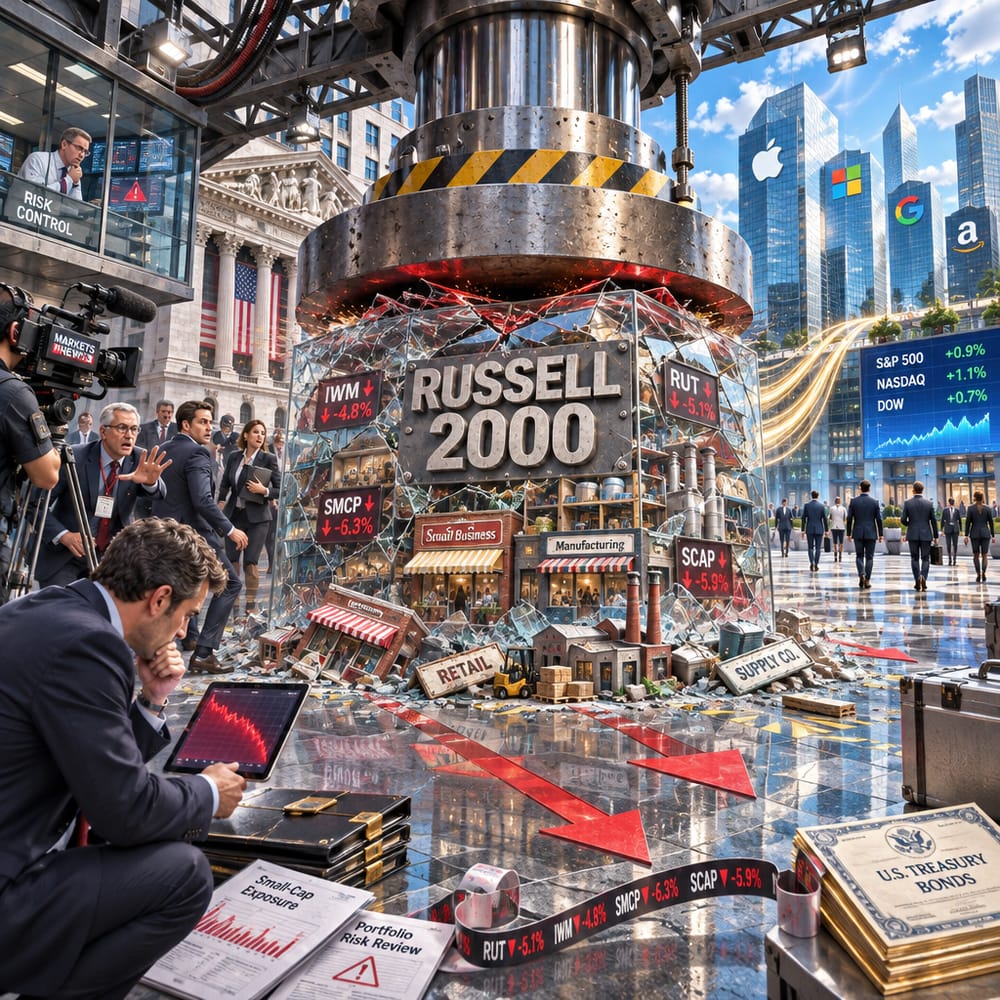
Picture this: the market's rollercoaster is headed downhill, and small-cap stocks are the kids holding on the tightest, eyes wide open, screaming all the way down. The Russell 2000 index, the bellwether for small-cap stocks, is feeling the squeeze. While the big boys in the S&P 500 and Dow are taking their bruises, the Russell 2000 is having its lunch money stolen in broad daylight. Why are these little guys taking such a beating, and what does it mean for the rest of us watching from the sidelines?
Let's dive into the murky waters where small caps swim. Traditionally, these stocks—comprising companies with smaller market capitalizations—are the canaries in the coal mine for economic health. When small caps underperform, it's a bit like your GPS warning you of a traffic jam ahead; it might mean trouble is brewing for the broader economy. So, what gives? Why are these stocks struggling more than a cat at bath time?
For starters, we're in what's known as a "risk-off" environment. Investors are looking at small caps and asking, "Do I really want to hold onto these risky assets when the economy is more unpredictable than a soap opera plot twist?" The question isn’t just rhetorical; it's a reflection of deeper concerns about economic growth and market volatility.
The Russell 2000 has historically been seen as more volatile than its larger cousins like the S&P 500 or Nasdaq. This volatility is great when the market is booming—small caps can soar like a kite in a strong wind. But when the wind shifts, that same kite is more likely to crash. Investors are seeing storm clouds on the horizon, with high-interest rates, geopolitical tensions, and economic uncertainty hanging overhead. In such times, holding onto small caps feels a bit like betting on a three-legged horse.
But it's not just about nerves. Technical indicators, the stock market's version of tea leaves, are also nudging investors towards caution. Many small caps are skating on thin ice, teetering close to their 52-week lows. This isn't just a financial analyst’s nightmare; it's a stark reminder of where sentiment lies. The underperformance of small caps is signaling that, despite some pockets of optimism, caution is the prevailing vibe on Wall Street.
So, what does this mean for future economic growth? When small caps are struggling, it often hints that all is not well in Main Street, USA. These companies typically have less access to capital than the giants in the S&P 500. They rely more on bank loans and credit—both of which have become harder to come by in the current high-interest landscape. If small caps can't find the cash they need to grow, it stifles their ability to hire, innovate, and expand. In short, what's bad for small caps can be bad for the broader economy.
Yet, before we pull the emergency brake, it's worth remembering that stock markets are notoriously forward-looking. The current turmoil could be setting the stage for a comeback. If the broader economic concerns start to ease—think inflation cooling, interest rates stabilizing, and geopolitical dramas calming down—small caps could roar back with a vengeance.
For retail investors peering into their retirement accounts and wondering if the Russell 2000 is simply a lost cause, remember this: every downturn has its upswing. The question isn't just about what's happening today but what tomorrow might bring. Small caps could be an investor’s golden ticket when the recovery train finally leaves the station. But, as with any investment, patience and a clear view of your financial goals are key.
The takeaway? The Russell 2000's current plight is a reflection of an uncertain economic landscape. It’s showing us that the market's mood is more fearful than festive, with investors shying away from smaller, riskier bets. But markets, much like the weather, can—and do—change. The key for investors will be to keep a sharp eye on those technical indicators and economic signs. And who knows? Today's risk-off could be tomorrow's opportunity. Until then, keep your seatbelt fastened, and enjoy the ride.
This article is for informational purposes only and is not investment advice. Always do your own research or consult a licensed financial professional before making investment decisions.
© Copyright 2024. All Rights Reserved.
© Copyright 2024. All Rights Reserved.