

Small-Caps Under Pressure: Russell 2000 Declines
Tuesday, November 17, 2026
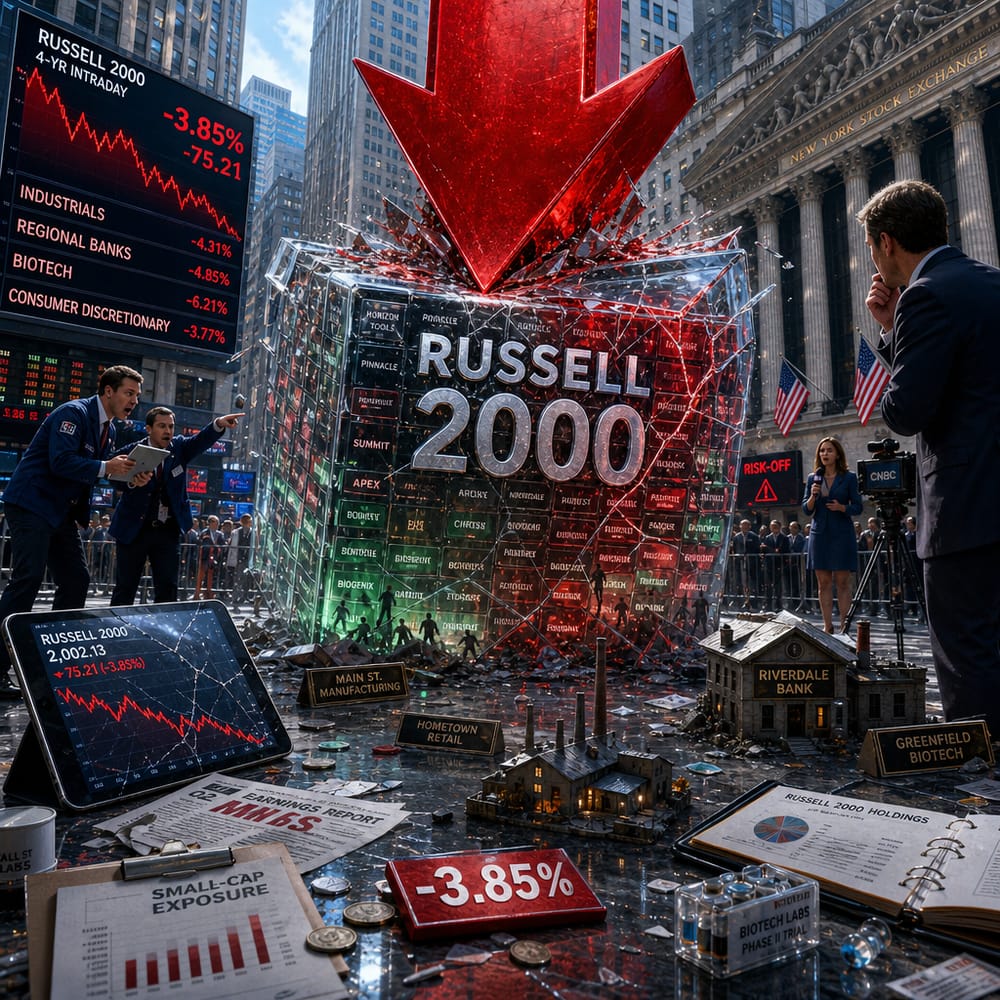
HEADLINE: Small-Caps Under Pressure: Russell 2000 Declines
You know it’s serious when the little guys start having a bad time. And right now, the Russell 2000, the index that gives you an ear-to-ground feel of America's small-cap stocks, is doing just that—it’s taking a tumble. While the big players like the S&P 500 and Dow Jones often hog the spotlight, the Russell 2000 is the underdog with a flair for forecasting broader economic ripples. And right now, that forecast is looking more like a storm than a sunny day.
WHAT'S EATING THE RUSSELL?
So, what’s causing the Russell 2000 to sag under the weight of its own ambition? Well, it’s a cocktail of financial woes. First, interest rates are doing their own impression of Spider-Man, climbing walls and making small caps nervous. Small companies often rely on borrowing to fuel their growth, and when borrowing costs are high, their profits can shrink faster than a wool sweater in a hot wash.
Next up, consumer sentiment is acting like it’s been invited to a scare-fest. Inflation is stretching those dollars like they’re made of taffy, pinching the pockets of consumers and the companies that depend on them. And when consumers close their wallets, small-cap companies feel the chill.
Then there are the geopolitical tensions and global economic slowdowns—a tired but persistent duo that makes investors jittery. With headlines buzzing about everything from bridge attacks in Ukraine to saber-rattling in the Strait of Hormuz, it’s no wonder caution is the flavor of the month. Investors are tucking their money into safer assets, leaving small caps to fend for themselves.
WHAT SMALL-CAPS SAY ABOUT THE BIG PICTURE
Now, why should you care if small caps are crying into their balance sheets? Because they’re often the canaries in the coal mine. When small-cap stocks start to buckle, it can signal deeper economic troubles. These companies are closer to the ground, more sensitive to economic shifts, and quicker to show cracks when the foundations start to shake.
The fact that the Russell 2000 is struggling tells us that economic growth might be wobbling. Small-caps are typically more focused on domestic markets, so their woes could mean that the U.S. economy isn’t as robust as we’d like to think. It’s like when you see a run in your stocking—sure, it’s small at first, but it’s usually a sign you’d better change before things get really embarrassing.
THE ECONOMIC IMPLICATIONS
Let's dive into the potential economic implications. With the Russell 2000 stumbling, it could be a forewarning of tougher times ahead. If small caps are facing tighter margins and waning demand, it might lead to job cuts, less innovation, and a slowdown in sectors that drive a lot of economic activity. Remember, small businesses employ a huge chunk of the workforce—they’re the not-so-little engine that could.
But don't grab the panic button just yet. This isn’t a prophecy of doom; it’s a signal to keep your eyes peeled. If the broader market starts to echo the woes of small caps, then we might be in for a bumpy ride. Conversely, if larger companies hold steady and consumers adjust to the new normal, the Russell 2000 could find its footing again.
NAVIGATING THE TURBULENCE
So, what’s an investor to do during these turbulent times? Diversify, my friend. It’s the tried-and-true method to hedge against market unpredictability. Keep a balanced portfolio—don’t put all your eggs in one economic basket. And if small caps are making you nervous, consider adding a splash of large caps or international stocks to smooth out the ride.
And let's not forget, the economy is cyclical. The current dip in small caps could present opportunities for the patient investor. If you’ve got the stomach for it, keep an eye out for small-cap stocks with strong fundamentals that might be undervalued in the current market shuffle.
In the end, the Russell 2000’s decline is more than just a number—it’s a narrative of economic sentiment, a tale of market dynamics, and a reminder that even little guys can have a big impact. So stay informed, stay flexible, and remember that what goes down can, indeed, come back up.
This article is for informational purposes only and is not investment advice. Always do your own research or consult a licensed financial professional before making investment decisions.
© Copyright 2024. All Rights Reserved.
© Copyright 2024. All Rights Reserved.