

Small-Cap Stocks Under Pressure Amid Market Divergence
Wednesday, August 19, 2026
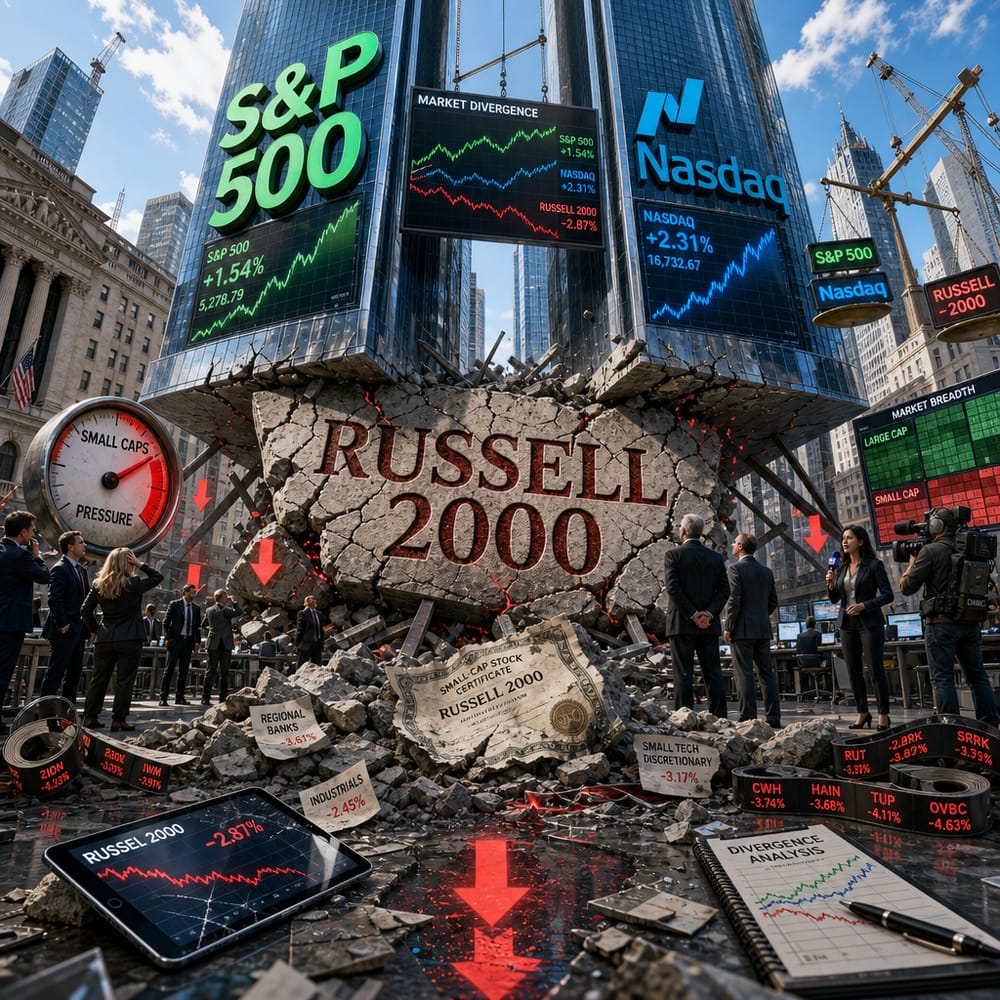
SMALL-CAP STOCKS UNDER PRESSURE AMID MARKET DIVERGENCE
If Wall Street were a cocktail party, the small-cap stocks would be the ones awkwardly lingering by the shrimp cocktail, while the larger indices like the S&P 500 and Nasdaq are the life of the bash, mingling with everyone and getting all the attention. With the Russell 2000, the index representing the smaller players in the stock market, underperforming its larger counterparts, it's time to ask: what's going on, and why does it matter?
Small-cap stocks are like the canaries in the coal mine of the economic world—often giving us early clues about what's really going on in the economy. Typically more sensitive to shifts in economic conditions, small-caps can serve as a barometer for investor risk appetite. So, when these stocks start lagging behind the big dogs, it's worth paying attention.
But first, let's tackle the main question: Why are small-cap stocks underperforming? In short, these companies are more buffeted by domestic economic woes than the global giants. When U.S. economic conditions look shaky, investors tend to flee small-caps for safer, more stable large-caps. And with recent concerns around higher interest rates, potential fiscal risks, and softer economic data, those jitters are very much real.
Higher interest rates are a double-edged sword for small-cap stocks. These companies often rely more on borrowing, so when rates rise, their costs go up. It's like trying to run a marathon with a backpack full of bricks. Meanwhile, larger companies, with their diversified revenue streams and international exposures, have the stamina to weather these hikes better.
Investors' risk appetite is also taking a hit. Think of it as everyone suddenly deciding they'd rather sip on a comforting hot cocoa than down a risky espresso shot. When people get nervous, they pull back from riskier investments—like those small-cap stocks—and look for the steady Eddies in the market.
But what does this divergence mean for the broader market? If the party's buzz is to be believed, it could hint at concerns over broader economic health. If small-caps are struggling, it suggests that economic growth might not be as robust as we'd like to believe. This could eventually seep into the broader market, putting pressure on the larger indices as well.
However, there's a silver lining for those willing to look. Historically, small-caps have often rebounded strongly after periods of underperformance. So, for the patient investor, this could be an opportunity to scoop up some bargains while everyone else is looking the other way.
Looking at the bigger picture, small-cap stocks' underperformance might also mean we need to adjust expectations. The economic landscape is shifting, with inflationary pressures and policy uncertainties playing major roles. Investors are recalibrating, weighing where to place their bets in a changing world. It’s a recalibration that might have small-caps out of favor for now, but history has shown they can come roaring back when the conditions are right.
So, what's the play if you're a retail investor? Keep your eyes peeled and your ears tuned to economic signals. Understand that while small-caps are having a tough time, they still hold value for those willing to ride out the storm. Diversifying across different sectors and keeping a close watch on economic indicators could be your best dance moves at this market party.
In essence, the plight of the small-cap stocks is a story of market dynamics and economic signaling. It’s a tale worth telling because it reveals the broader market's vulnerabilities and strengths. Just don’t be too quick to count them out; small-caps have a knack for staging a comeback.
And with that, keep your cocktail glass filled and your investment strategy sharp. The market is nothing if not a wild ride, and for the daring, there's always the next party to crash.
This article is for informational purposes only and is not investment advice. Always do your own research or consult a licensed financial professional before making investment decisions.
© Copyright 2024. All Rights Reserved.
© Copyright 2024. All Rights Reserved.