

Small-Cap Slump: Russell 2000 Falls Sharply as Stocks Brace for Fed
Saturday, August 29, 2026
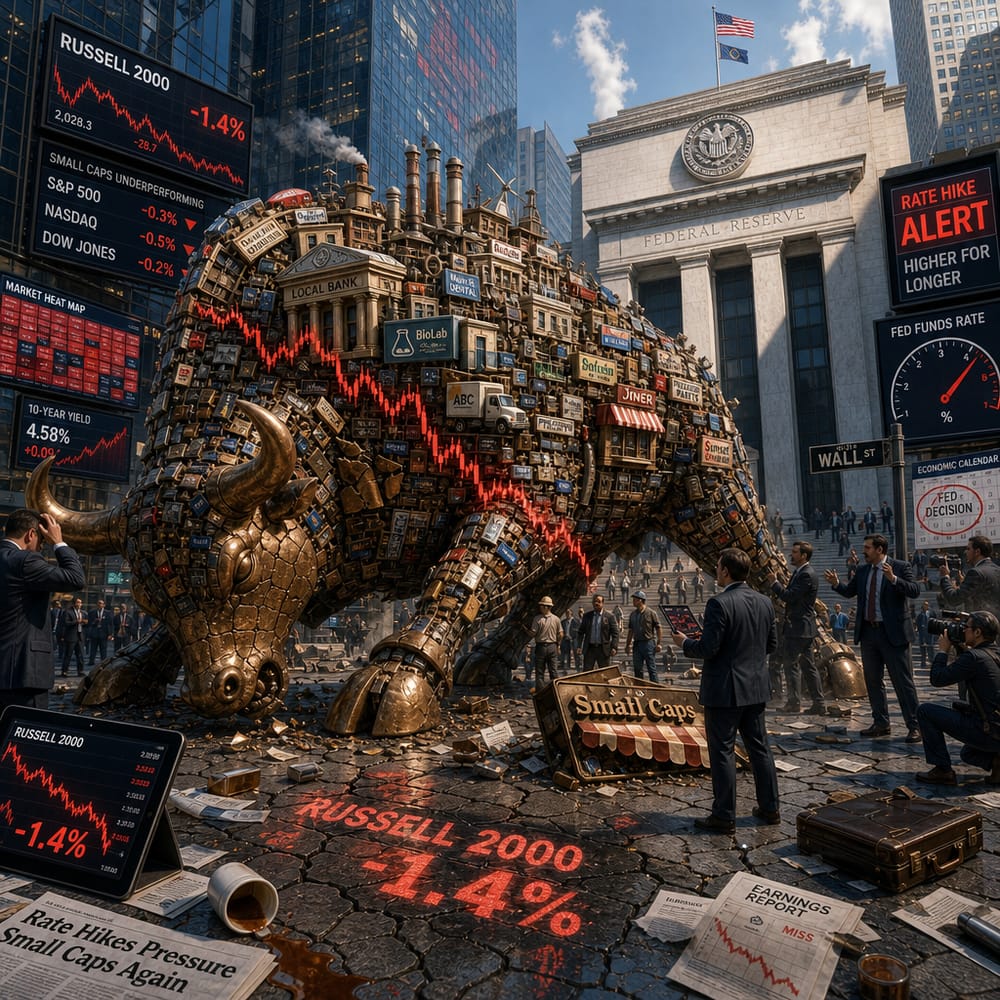
SMALL-CAP SLUMP: RUSSELL 2000 FALLS SHARPLY AS STOCKS BRACE FOR FED
Fasten your seatbelts, folks. The stock market rollercoaster is back in motion, and it’s the small caps that are feeling the whiplash the most. On Friday, the Russell 2000 index, the yardstick for small-cap U.S. stocks, nosedived 1.4%. It was like watching your favorite underdog trip at the last hurdle while the big players, the S&P 500 and Dow, merely shrugged. So, why are these small guys more sensitive to the Federal Reserve's interest rate maneuvers than their big siblings?
The reason lies in their DNA. Small-cap companies are the economy's front-line troops; they’re the first to feel an economic chill and the first to perk up when the sun shines. But when the Fed eyeballs interest rate hikes like a hawk, these companies quake in their boots. With more modest cash reserves and typically higher borrowing needs, they're the ones who’ll feel the squeeze when rates rise, and borrowing costs go through the roof.
Let’s peek inside the Russell 2000 and see where the most nervous sectors are. Spoiler: It's not all doom and gloom, but it’s close. Financials, consumer discretionary, and industrials are among the more jittery bunch. These sectors often lean heavily on borrowing to fuel growth or have customers who borrow to spend. So, when they hear the Fed whisper "rate hikes," it's like a horror movie come to life.
Investors are playing defense, reshuffling portfolios like a croupier at a Vegas blackjack table. Many are parking their money in larger, more stable companies that tend to be better equipped to handle economic turbulence. Others are redistributing funds into bonds or cash — the equivalent of stuffing money under the mattress until the storm passes.
So, what’s a retail investor, scrolling this on their lunch break, to do? It’s time to adapt, folks. The potential for rate hikes paints a not-so-rosy picture for small caps in the immediate future. But there’s also opportunity hidden in the chaos. When the economy veers towards recovery, small caps can offer juicy returns thanks to their agile nature and potential for explosive growth.
Investors might want to consider a tilt towards sectors less susceptible to rate hikes, like utilities and consumer staples, which historically weather the economic storms more gracefully. Alternatively, if you’re one with a more adventurous spirit, keeping an eye on small-cap stocks that have robust balance sheets and low debt levels could turn out to be a rewarding venture.
The Fed’s not being much of a chatterbox lately, with Chairman Kevin Warsh holding his cards close to his chest at the Jackson Hole symposium. Warsh is keeping mum on the exact timing of any rate hikes, leaving investors piecing together clues like a financial Sherlock Holmes. Inflation remains the Fed’s arch-nemesis, and while they haven’t dropped the rate hike bomb yet, the market’s got an itchy trigger finger, waiting for any sign of a decision.
In these times of uncertainty, knowledge is power. Stay tuned to market signals and Fed communications. It’s a game of chess, really, and making the right moves based on the Fed’s playbook can make all the difference.
The fall in the Russell 2000 isn't just a bearish signal for small caps; it’s an important bellwether for the broader economy. When these nimble players bolt for cover, it hints at caution across the market. While the immediate sensation might be one of shock and awe, savvy investors know this is part of the economic cycle's ebb and flow, albeit a rocky patch.
So, keep your eyes peeled and your strategies flexible. With every scare and slump, there comes opportunity, ready to be seized by those prepared to take the leap. Investing is as much about timing and temperament as it is about technical analysis. As the market pivots in reaction to the Fed’s unpredictable moves, there’s one thing you can be certain of: It’s never boring.
This article is for informational purposes only and is not investment advice. Always do your own research or consult a licensed financial professional before making investment decisions.
© Copyright 2024. All Rights Reserved.
© Copyright 2024. All Rights Reserved.