

Small-Cap Shock: Russell 2000 Drop Amid AI Jitters
Wednesday, November 18, 2026
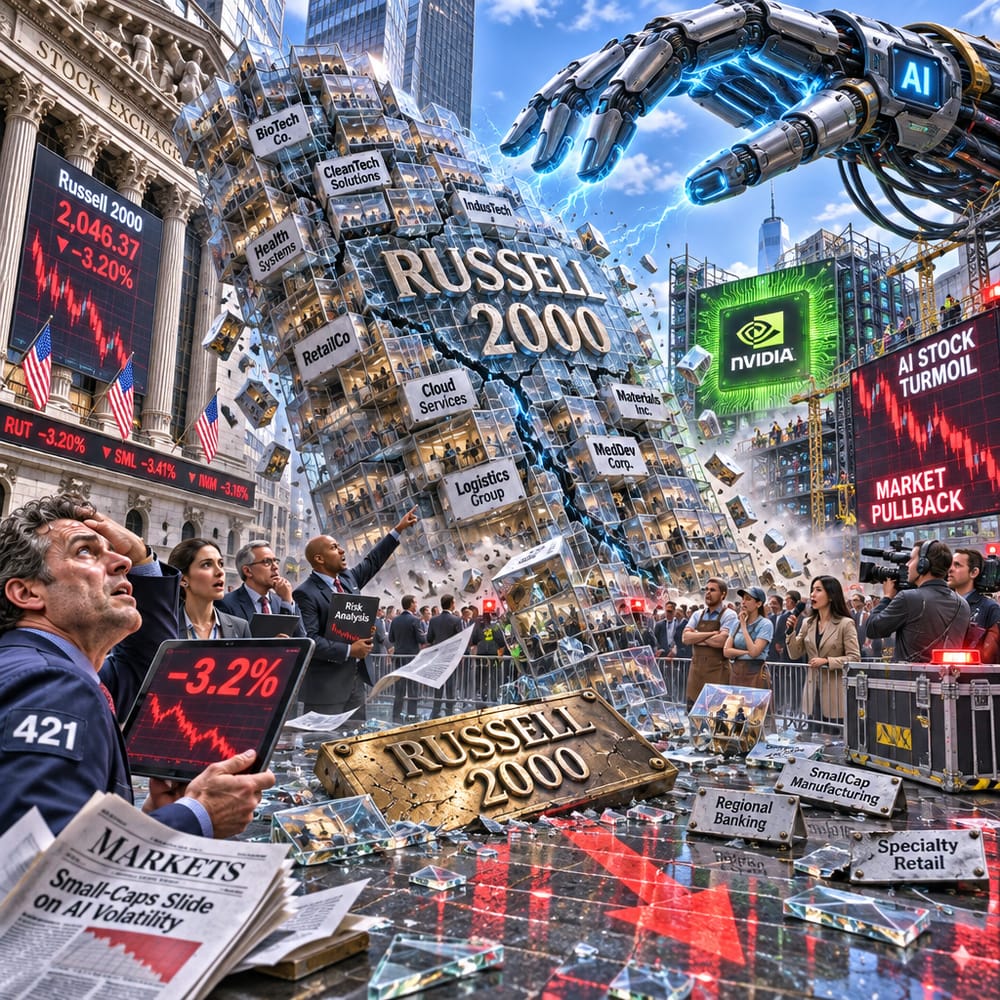
SMALL-CAP SHOCK: RUSSELL 2000 DROP AMID AI JITTERS
Call it the AI apocalypse or just a bad day on Wall Street, but the Russell 2000 index just took a nosedive, dropping a hefty 3.2%. If you're wondering why your portfolio suddenly feels like it's on the Titanic, you can thank our little friend, the artificial intelligence sector, for the splash.
AI STUMBLES, TAKES RUSSELL 2000 DOWN WITH IT
Picture this: tiny David (the Russell 2000) gets clobbered because Goliath (AI-related stocks) tripped over its own feet. AI stocks, which have been the darling of investors looking to hitch a ride on the tech comet, just hit a snag. And when they stumbled, they triggered an avalanche that buried the entire small-cap world.
Nvidia, one of the key players in AI, saw its shares backflip after earnings. Despite strong numbers, investor confidence wavered with leadership in flux and tech sector volatility running high. Colette Kress, Nvidia's interim CEO, finds herself balancing on a tightrope while the tech world awaits the next step after Jensen Huang's dramatic exit. Meanwhile, the Russell 2000, full of small-cap companies (think of them as the get-rich-quick hopefuls of the stock market), wasn't equipped to handle the fallout.
WHY SMALL-CAPS WERE THE COLLATERAL DAMAGE
The problem with small-cap stocks is they’re like the economy’s canaries in the coal mine—delightfully plucky but highly sensitive to changes in air pressure, or in this case, market sentiment. Volatility in a major sector like AI can be like tossing a live grenade into their trench, and this time, the blast radius was considerable.
Small-cap stocks thrive on optimism and a healthy risk appetite. They are the underdogs with potential for high returns but are often first to feel the pinch when a sector like AI faces uncertainty. What happens to the Russell 2000 when AI catches a cold? The whole index sneezes, or in this case, takes a steep dive.
WHAT THIS MEANS FOR INVESTORS
Investors eyeing the Russell 2000 with dreams of small-cap stardom might now feel like they’re watching a horror flick unfold. The plunge highlights just how interconnected our modern economy is. Even if you're holding a company making artisanal kale chips, if the markets have a hissy fit over AI, your stock could be in for a rough ride.
This AI-induced drama acts as a loud reminder of the risks lurking in tech-heavy portfolios. We love the innovation, the rapid growth, the flashy headlines, but when the sector trips, the reverberations are felt everywhere, especially on the smaller exchanges.
SECTORS THAT COULD FOLLOW THE DOMINO FALL
If this was just a problem of the tech world's own making, we could write it off as an isolated incident. But brace yourself: the aftershocks could hit other sectors. Companies that rely on AI for efficiency or supply chain innovation may find themselves scrambling. Healthcare, finance, manufacturing—sectors that have integrated AI into their core operations—could face turbulence as they reassess their tech dependencies.
Investor confidence doesn't operate in a vacuum. A tech sell-off, even in a corner as specific as AI, can lead to broader market jitters. The current climate is reminiscent of digital gold rush days, where a single sector's struggles can ripple outward, causing collateral damage across many fronts.
BACK TO BASICS FOR SOME; OTHERS DOUBLE DOWN
So, where do we go from here? Some investors may decide it’s time to play it safe, shifting focus back to less volatile sectors like consumer staples or utilities, your bread-and-butter stocks. Others, however, might see this as a buying opportunity—after all, there's no reward without risk.
In the grand scheme, this AI hiccup is a reminder of the market's unpredictability and the need for diversified investment strategies. As the dust settles, investors may find the Russell 2000 finds its equilibrium, but not without leaving a trail of lessons on market volatility.
While the AI saga continues to unfold, remember to buckle up. This rollercoaster isn’t stopping anytime soon. Keep an eye on your portfolio, steer clear of panic selling, and enjoy the ride. After all, investing isn't just about the highs—it's about how well you handle the lows.
This article is for informational purposes only and is not investment advice. Always do your own research or consult a licensed financial professional before making investment decisions.
© Copyright 2024. All Rights Reserved.
© Copyright 2024. All Rights Reserved.