

Small-Cap Divergence: Russell 2000 Lags While Large-Caps Lead in August
Sunday, August 30, 2026
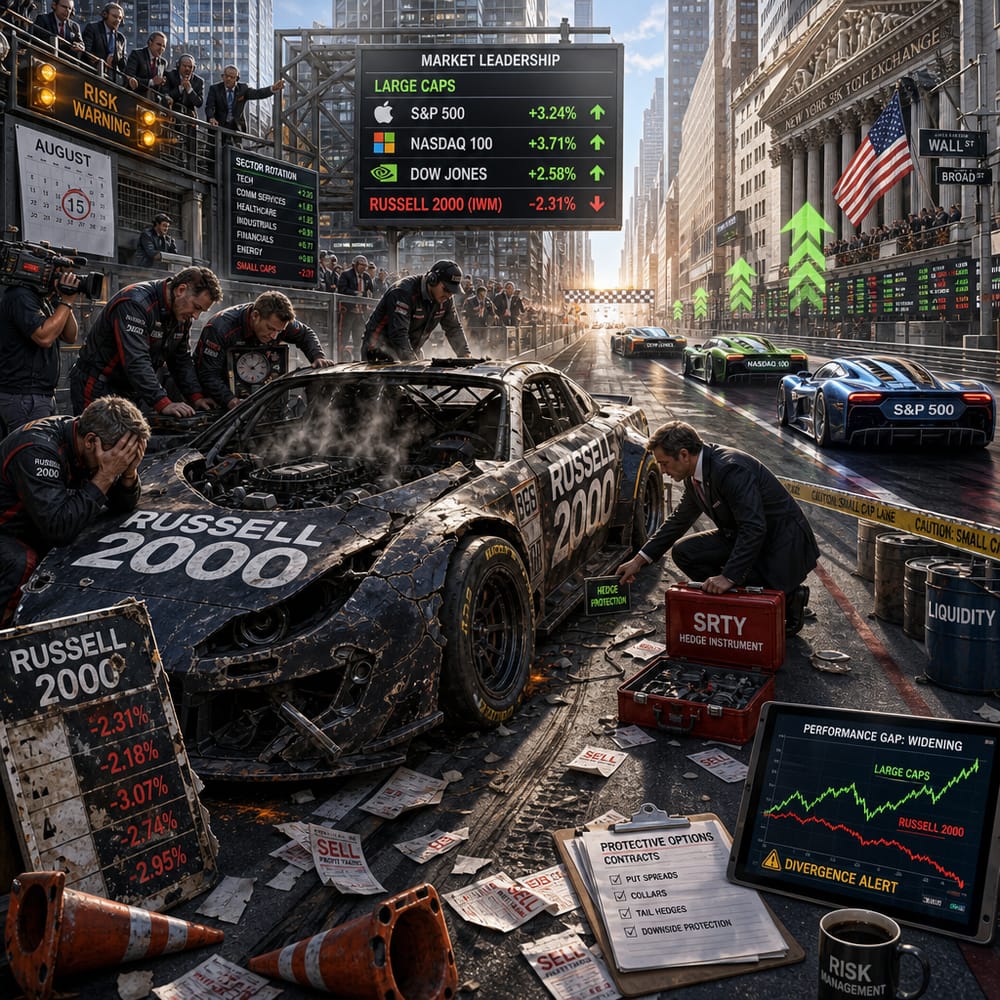
SMALL-CAP DIVERGENCE: THE RUSSELL 2000 LAGS WHILE LARGE-CAPS LEAD IN AUGUST
If August were a stock market reality show, it would be “The Great Divide.” On one side, you have the Russell 2000—our small-cap hero—moving slower than molasses. On the other, the large-cap indices like the S&P 500 and the mighty Nasdaq are scaling new heights, leaving their smaller cousin in the dust. So, what gives? What's the deal with small caps lagging while their bigger siblings sprint ahead like they've had one too many espressos?
Small-caps, those darlings of the Russell 2000, have recently been about as popular with investors as last season’s iPhone. While the tech sector in the S&P 500 is cracking open the champagne, thanks to AI stars like Nvidia and Microsoft dancing their way to double-digit gains, small caps are lurking in the shadows, nursing their wounds.
WHY ARE INVESTORS HEDGING AGAINST SMALL-CAPS?
To understand why investors are giving the cold shoulder to small-cap stocks, let's dig into the investor psyche. Risk appetite is a fickle beast, and in recent times, inflation fears have been sky-high. With Treasury yields spiking to new highs, investors are understandably jittery. Small caps tend to be more sensitive to economic downturns—they're like the canary in the coal mine when things go south. As a result, investors are hedging their bets, pouring money into the sturdier, if less exciting, large-cap stocks.
Inflation isn't the only boogeyman lurking in the shadows—geopolitical tensions, trade war jitters, and the U.S. Treasury Department's efforts to rejig debt purchases add a layer of complexity. When the financial skies turn stormy, investors reach for their safety nets. Enter the ProShares UltraPro Short Russell 2000 (SRTY), a tool that allows investors to bet against small-cap stocks, providing a hedge against market turbulence.
WHAT DOES THIS MEAN FOR FUTURE SMALL-CAP PERFORMANCE?
While small caps might be stuck in the mud now, don’t count them out just yet. Historically, these stocks have been the comeback kings, often outperforming their larger counterparts when the economy hits the gas pedal. They’re scrappy, and when economic conditions improve, they can offer substantial returns. But that's the silver lining investors are waiting for.
So, what’s the prognosis? The divergence we're seeing could be a temporary blip—or it could signal a more prolonged separation between small and large caps. Much depends on the broader economic landscape. Will inflation cool down? Will geopolitical tensions ease, allowing investors to breathe a little easier? If the answer is yes, the Russell 2000 might just shake off its lethargy and join the party.
But wait—there’s a plot twist. Even as small caps struggle, the broader markets are enjoying a rare moment of tech-driven prosperity. While the AI frenzy has buoyed large-caps, small-caps could benefit from a trickle-down effect if tech and innovation infiltrate smaller, more nimble companies. Could this be the lifeline small caps need to claw their way back?
The market watchers are keeping a close eye. If we see a shift in economic sentiment or a cooling of inflation, the Russell 2000 might just flip the script. For now, though, the small-cap saga remains a story of underperformance—and intrigued investors are left wondering if and when the tide will turn.
WATCHING THE HORIZON
Navigating the choppy waters of the stock market is never dull. For small-cap stocks, the stakes are high, and the road is uncertain. But if history has taught us anything, it’s that markets are cyclical. The underdogs of today can be the champions of tomorrow.
So, dear reader, as you scroll through your feeds, keep an eye on the Russell 2000. It may be down, but it's certainly not out. Whether you're a cautious hedger or a bold risk-taker, remember that the market is a living entity—full of surprises and endless possibilities. Buckle up, because when it comes to investing, the only certainty is uncertainty. And maybe, just maybe, that’s what makes it all so thrilling.
This article is for informational purposes only and is not investment advice. Always do your own research or consult a licensed financial professional before making investment decisions.
© Copyright 2024. All Rights Reserved.
© Copyright 2024. All Rights Reserved.