

September Weakness Hidden Behind the S&P’s Façade: 75% of Stocks Fall
Wednesday, September 30, 2026
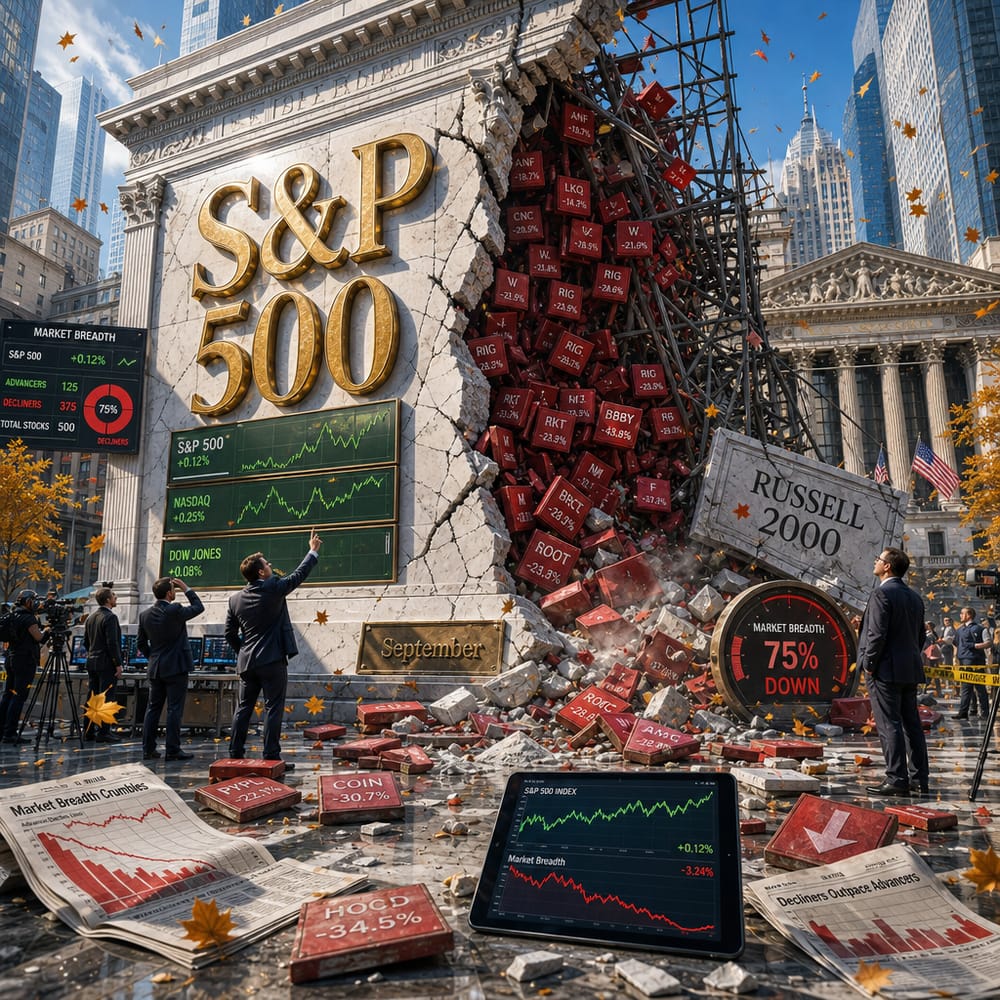
THE S&P 500'S SURFACE PERFORMANCE: A MIRAGE HIDING MARKET WEAKNESS
If you think the S&P 500 is a rock-solid fortress, it's time to peek behind the castle walls. The revered index might be flexing its muscles at first glance, but underneath the sturdy exterior lies a frail foundation. In September, while the S&P strutted with an air of invincibility, a staggering 75% of its stocks fell. This drop reveals a tale of hidden frailty—a tale every investor needs to understand.
This intriguing phenomenon is called weak market breadth. It sounds complex but simply means that while a few big-name stocks are heroically holding the fort, most of the index's stocks are limping, unable to keep up. Imagine a parade where only the band leaders march in step while the rest stumble behind. Sure, the front of the line looks impressive, but the rest? Not so much.
So, what does this weak breadth spell for investors? It’s a red flag that the strength of the S&P 500 isn't as broad-based as it appears. It's like seeing a beautifully iced cake only to cut into it and find it hollow. For those relying solely on the surface level index performance, this divergence could mean roller coaster volatility. In investing terms, it’s the equivalent of riding shotgun with a driver who insists on ignoring every warning light on the dashboard.
The S&P’s top-heavy nature is no accident; it’s the result of a few large-cap stocks—think tech giants and mega-caps—doing most of the heavy lifting. These are the darlings of Wall Street, capturing headlines and driving much of the index's performance. Case in point, Meta’s stock surged recently, riding high on AI developments. But while these titans dance, the smaller siblings in the S&P family sit on the sidelines nursing losses.
But why does this top-heavy structure matter? Simply put, when a few companies carry the weight of the index, there’s an increased vulnerability to any hiccups they might face. If a tech darling misses a quarterly report or a regulatory wave crashes against a pharmaceutical giant, the entire index could falter, even if other sectors perform just fine. Investors need to realize that when the floor beneath the market weakens, what's standing above is just waiting for the wrong gust of wind.
The Russell 2000, a bellwether for small-cap stocks, paints a bleaker picture. It’s been reflective of broader economic anxieties, facing struggles where its larger counterparts haven't. This is a critical reminder that not all stocks are created equal, and their performances can indicate very different things about the economic landscape.
So, how should the everyday investor navigate this tricky terrain? Diversification remains a golden rule. Don't place all your bets on the giants leading the pack. Balance your portfolio with mid-cap and small-cap stocks. These may not have the glitz of Apple or Tesla, but they offer a safety net if the big names falter. Also, keeping a close eye on market breadth indicators can provide insights into the market's underlying health, offering clues about potential corrections.
In a market world driven by headlines and big-name stocks, it's easy to be lured by the glitter and overlook the gold. The underlying market weakness should serve as a wake-up call—a reminder that just because the visor on the S&P 500 is down, doesn’t mean the engine underneath is humming smoothly.
In conclusion, don’t let the polished picture of the S&P 500 fool you. Beneath its glossy finish lies a market fraught with challenges. Investors who fail to look beyond the surface might find themselves caught in a financial storm, holding a portfolio that's as unstable as a house of cards. So, stay sharp, stay diversified, and remember—it's often the silent signals that shout the loudest warnings.
This article is for informational purposes only and is not investment advice. Always do your own research or consult a licensed financial professional before making investment decisions.
© Copyright 2024. All Rights Reserved.
© Copyright 2024. All Rights Reserved.