

Semiconductor Stocks Slip Amid Nasdaq Dip
Friday, August 28, 2026
SEMICONDUCTOR STOCKS SLIP AMID NASDAQ DIP
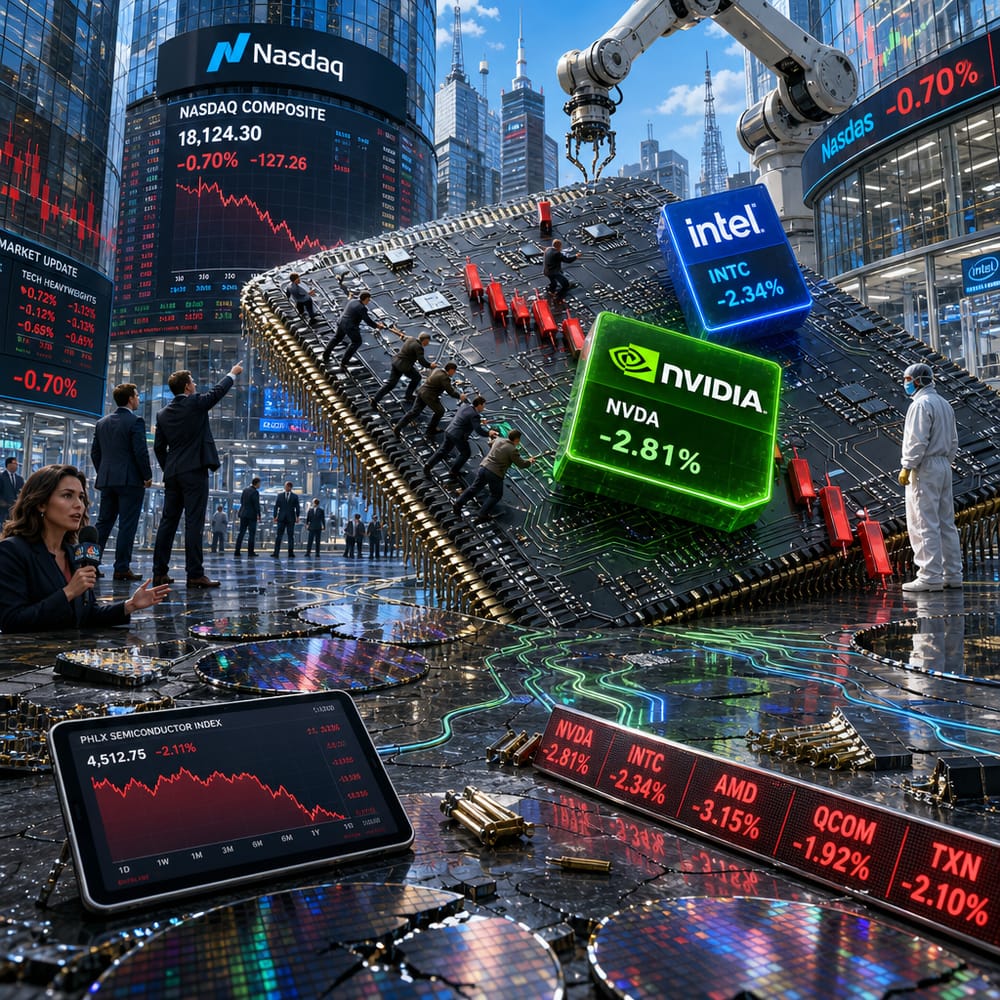
If you thought semiconductor stocks were the invincible superheroes of the market, think again. Even Nvidia and Intel found themselves stuck in a rut this past August 28th. As the Nasdaq Composite slipped 0.7%, dragging these tech titans with it, investors were left scratching their heads and clutching their portfolios just a little tighter.
So, what gives? Why are these giants suddenly looking more Clark Kent than Superman? Let’s dive into the labyrinth of investor sentiment and market reactions to find out.
WHAT’S UP WITH TECH STOCKS?
First, let’s address the giant in the room. Semiconductors aren't just another tech asset—they're the foundation that makes your smartphones smart and your electric cars go vroom. When these stocks start wobbling, it makes waves across the entire tech landscape.
Investors are nervously eyeing the Federal Reserve's recent signals, thanks to Chairman Kevin Warsh's words at the Jackson Hole symposium. Warsh hinted that the Fed might still have work to do combating inflation. Translation? Higher interest rates could be around the corner, which often spells trouble for tech stocks that rely on cheap money to fuel their innovation engines.
THE NASDAQ COMPOSITE: CAUGHT IN THE CROSSFIRE
With the Nasdaq feeling the heat, a ripple effect is inevitable. Nvidia and Intel—two companies often touted as bellwethers for tech—felt the weight of broader market pressures. But this decline isn't just about interest rates; it's a mirror reflecting investor jitters about sector rotations and economic slowdowns.
When semiconductors suffer, it sends a signal that the tech-heavy Nasdaq might not be the safe haven many hoped for. And let's face it, with geopolitical tensions and the constant murmur of a looming recession, it's not surprising that investors are skittish.
INVESTORS: WHAT'S THE GAME PLAN?
Now, let's zoom in on the folks at the heart of this story: the investors. They're in a quandary, torn between sticking with beloved semiconductors or jumping ship to safer waters. It's not just about numbers; it's about psychology. After all, nobody wants to be the last one holding onto a sinking stock.
Some investors are eyeing those dividend-paying cash cows as midterms approach, hoping for a bit of stability in turbulent times. Others are still hanging tight, convinced that the semiconductor slump is just a temporary cloud in an otherwise sunny sky.
But here's the crux: semiconductors have long been the canaries in the coal mine for tech. Their performance often signals broader market trends. So, the real question is, are we witnessing the start of a larger tech downturn, or is this just a blip on the radar?
WHAT DOES THE FUTURE HOLD?
With AI becoming the buzzword du jour, the sustainability of the AI trade is being closely scrutinized. Next week could be revealing. If semiconductors bounce back, it might reignite confidence in the AI sector and the Nasdaq as a whole.
However, if the slide continues, we might see a more significant sector rotation as investors flee to safety, leaving tech stocks to fend for themselves.
SO, WHAT SHOULD YOU DO?
Now that we’ve laid out the market’s current mood, what’s a retail investor to do? Don’t hit the panic button just yet—this isn't the first time semiconductor stocks have stumbled, and it won’t be the last. They’re still a crucial part of tech infrastructure, and the long-term growth potential remains promising.
Keep a close eye on Fed announcements and economic data, as these will likely dictate the market's next move. Diversify your portfolio, and don't put all your eggs in the tech basket. And above all, stay informed and agile—after all, the market loves to keep us on our toes.
In a world where the only constant is change, remember that yesterday's slip could be tomorrow's buying opportunity. So hold onto your hats, because if there's one thing the stock market never is, it's boring.
This article is for informational purposes only and is not investment advice. Always do your own research or consult a licensed financial professional before making investment decisions.
© Copyright 2024. All Rights Reserved.
© Copyright 2024. All Rights Reserved.