

Semiconductor Selloff Sparks Global Shock
Thursday, August 20, 2026
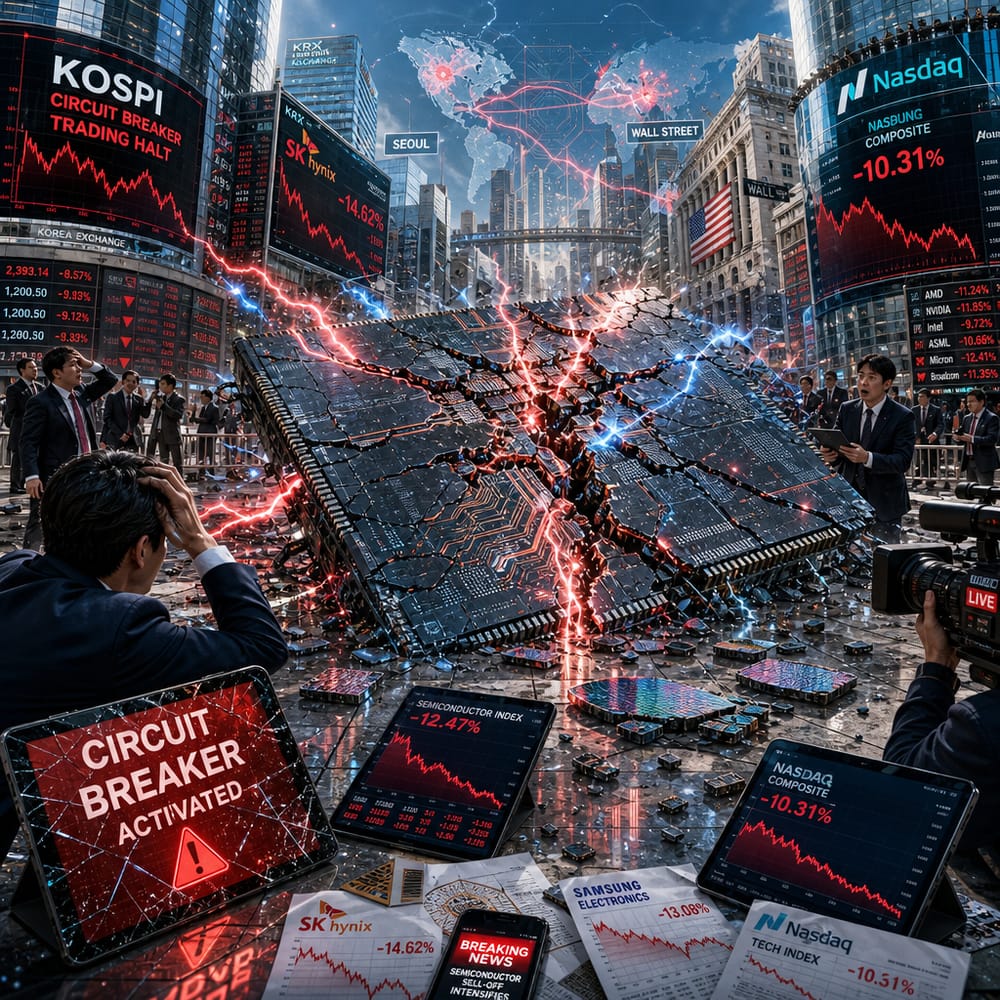
SEMICONDUCTOR SELLOFF SPARKS GLOBAL SHOCK
When the clock struck "market pandemonium," investors couldn’t have foreseen the level of chaos that followed. In an unexpected twist, the semiconductor sector, the backbone of our digital age, found itself in the eye of a financial storm. South Korea's KOSPI index was the first casualty, halting trading as heavyweights like SK Hynix and Samsung Electronics took a nosedive. What’s going on, and why does it feel like the world just hit the pause button on microchips?
Let’s wind back a bit. The root of this turmoil is the U.S. Treasury yields taking a relentless climb upwards. For those who skipped the finance class, Treasury yields are essentially the interest rate the U.S. government pays to borrow money via bonds, and they’ve been on a tear like they just had a triple espresso. Rising yields usually mean investors are expecting higher inflation or economic uncertainty. This time, it's doubly painful for tech stocks, including semiconductors, which are particularly sensitive to such moves.
Picture this: when U.S. Treasury yields rise, it’s like the economic equivalent of a mean gust of wind on a house of cards. It makes borrowing more expensive and pushes investors to reassess the value of stocks, especially those in tech. Why? Because tech companies often rely on borrowing to fuel innovation and growth, and investors start craving something safer, like government bonds, over riskier stocks.
So, what does this macroeconomic hurricane mean for our friends at SK Hynix and Samsung? Well, their shares took a gut punch, declining considerably as the KOSPI index sputtered. In the semiconductor world, these companies are near-royalty; any disruption in their stock prices sends ripples (no, make that tidal waves) through the global market. It's like finding out your favorite band just broke up right before launching an epic world tour. The implications are massive.
The semiconductor industry isn't just about your smartphone chips anymore; we're talking artificial intelligence, memory solutions, and more. These sectors need steady investment and innovation to thrive, and suddenly, the cost to do so has shot up. That's a buzzkill for companies and investors alike.
But before you hit the panic button on your portfolio, let's examine the bigger picture. This selloff is part of a broader "risk-off" shift in investor sentiment. Essentially, the market is retreating to its safe zone, wary of the looming dragon of uncertainty. The semiconductor selloff is merely the loudest alarm bell in a room full of ringing phones.
So, how should investors navigate these stormy seas? First, take a deep breath. This isn't the first time the market has thrown a tantrum over Treasury yields, and it won’t be the last. Diversification remains your best friend. It’s like having a balanced diet; sure, chocolate is great, but you can’t live on it alone.
Consider balancing your tech-heavy holdings with some investments in sectors that typically do better when yields rise, like financials or industrials. Also, keep an eye on market signals for when to dive back into tech once the storm settles. And let's not forget the allure of international markets; diversification can also mean geographical.
As the financial fog begins to lift, remember this: volatility is a part of the investment game. It’s like surfing—sometimes the waves are smooth, and sometimes you wipe out. The trick is to get back on the board and keep riding.
The semiconductor saga serves as a potent reminder of how interconnected global markets are. When macroeconomic pressures mount, it’s not just a local problem; it's a global one, with ripples reaching every corner of the world.
So, while the immediate future might look a bit like a cliffhanger in an action movie, there’s no need to run for the exits just yet. Keep your wits sharp, your strategies flexible, and your eyes on the horizon. Because as we've learned time and again, the market, much like the sea, has a way of calming down after the storm.
This article is for informational purposes only and is not investment advice. Always do your own research or consult a licensed financial professional before making investment decisions.
© Copyright 2024. All Rights Reserved.
© Copyright 2024. All Rights Reserved.