

Semiconductor Sector Faces AI Sentiment Challenges
Saturday, October 10, 2026
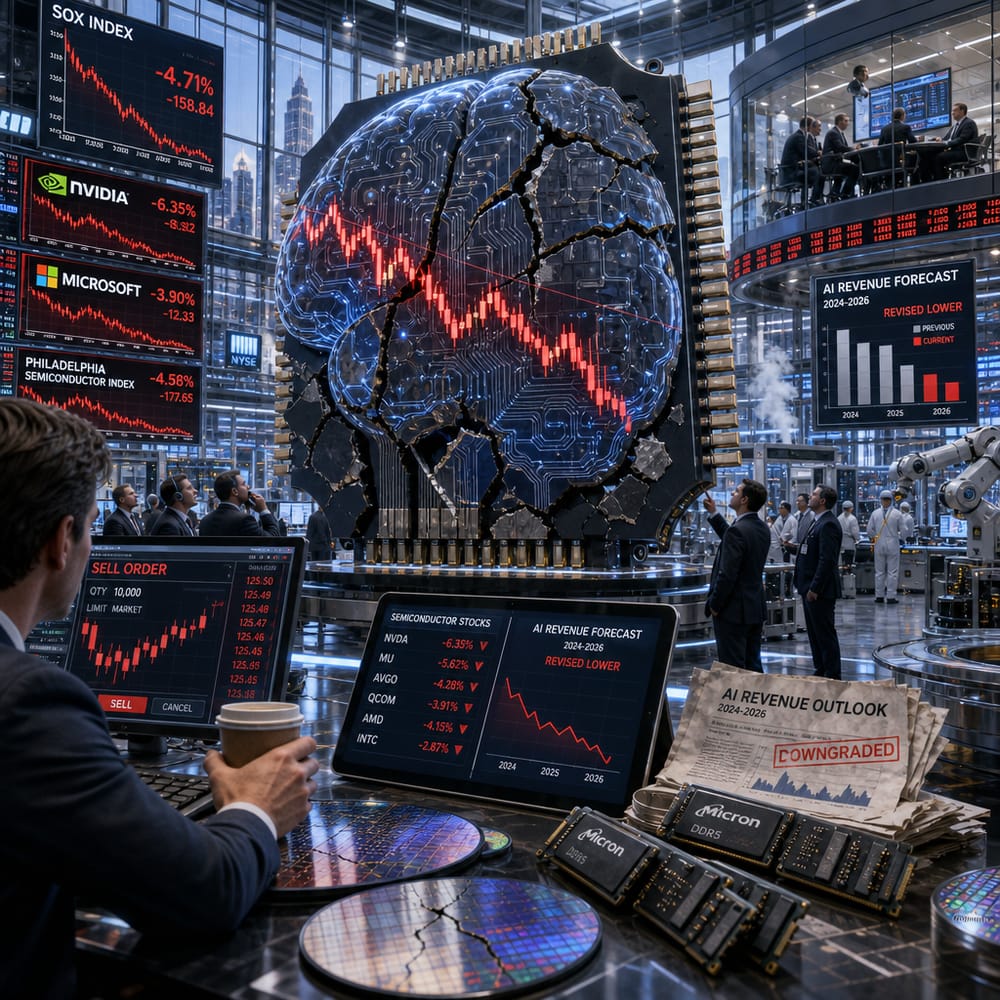
THE SEMICONDUCTOR SENTIMENT SWING: AI HICCUPS AND STOCKS STUMBLE
Sometimes, the stock market is like a soap opera—full of drama, unexpected plot twists, and the occasional diva tantrum. Right now, the semiconductor sector is playing the role of the sulking starlet, all because its AI revenue forecasts were as exciting as a soggy sandwich. Cue the investor swoons and stock sell-offs.
The sector, notably Nvidia and Microsoft, had us all dreaming of an AI-driven utopia where chips rain money like confetti. But reality, being the unkind party crasher it is, turned down the music when AI revenue forecasts failed to meet the sky-high expectations. Stocks, as moody as ever, didn't take the news well.
IMPACT OF AI REVENUE FORECASTS
Imagine being at a concert and the band decides to play an acoustic set instead of their chart-toppers. The semiconductor market felt a bit like that when AI revenue forecasts didn't live up to the hype. Investors, who had envisioned profits soaring on a rocket ship called AI, suddenly found themselves in a slow boat powered by paddle wheels.
Nvidia, that beloved titan of the semiconductor world, saw its stock take a hit. With AI being one of its major growth areas, any whisper of weakness in forecasts can send chills down investors' spines. Microsoft, too, found itself uncomfortably bundled into this narrative, suffering alongside as its own AI ambitions were painted with the same brush.
SHORT-TERM AND LONG-TERM IMPLICATIONS
In the short term, let's be honest, it's panic mode. Stocks tumble, investors fret, and analysts churn out revised projections like they're going out of style. The Philadelphia Semiconductor Index, a temperature gauge for the industry, has been looking a bit feverish, reflecting the anxiety rippling through the sector.
But let's zoom out for a second. In the long-term, this could be nothing more than growing pains. The AI revolution isn't being canceled, just rescheduled for a later, more feasible date. Smart investors might see this as an opportunity to buy low, betting on a future where AI does live up to its potential—eventually. Patience, as they say, is a virtue, especially when your portfolio is taking a nap.
THE STOCKS FEELING THE PRESSURE
Nvidia is front and center in this drama, its stock price as jittery as a caffeinated squirrel. It's not just the AI forecasts that have investors twitchy; it's the realization that they might have been too quick to count their robotic chickens before they hatched. Microsoft, while primarily a software company, has also leaned heavily into AI, and its stock reflected the same nervousness.
Micron, another player in the semiconductor sandbox, isn't immune either. Although not as directly tied to AI's whims as Nvidia or Microsoft, sentiment across the sector tends to spread like gossip. When one gets a cold, the rest are reaching for tissues.
THE PATH TO RECOVERY
So, where do we go from here? If you're an investor staring down a portfolio that's taken a hit, there's a silver lining: semiconductor demand, in general, is not going anywhere. The world is only getting more digital by the day, and semiconductors are the unsung heroes making it all happen.
Expect the sector to recalibrate. Companies will revise their strategies, adjust their timelines, and, hopefully, provide a more grounded outlook on AI profits. Investors, in turn, will likely learn to temper their expectations, aiming for cautious optimism rather than blind exuberance.
In summary, while the semiconductor sector might be experiencing a bout of AI-induced indigestion, it's not time to abandon ship just yet. Consider it a reminder that while the future is bright, it might take a little longer to get there than we'd hoped. So buckle up, keep a steady hand, and remember: the stock market loves a comeback story.
This article is for informational purposes only and is not investment advice. Always do your own research or consult a licensed financial professional before making investment decisions.
© Copyright 2024. All Rights Reserved.
© Copyright 2024. All Rights Reserved.