

Samsung's $4.3 Billion HBM Packaging Plant
Thursday, August 27, 2026
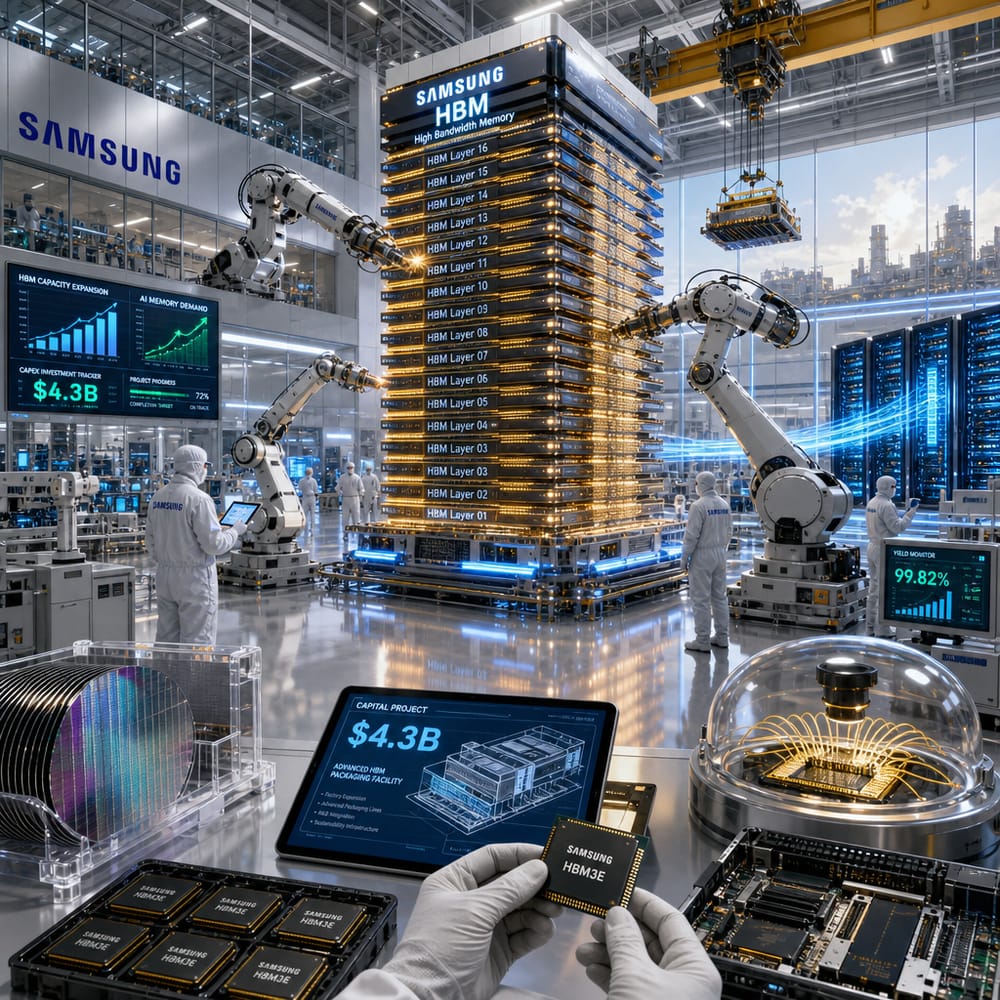
SAMSUNG'S MULTIBILLION-DOLLAR BET ON AI: THE FUTURE IS NOW
Buckle up, folks. Samsung Electronics is laying down a breathtaking $4.3 billion bet on the future, and it's all about cranking up their advanced packaging and HBM (high-bandwidth memory) game. This investment isn't just a chunk of change; it's Samsung's love letter to the burgeoning AI revolution, and they’re making sure everyone knows about it.
Imagine it: a supercharged facility that's all about tackling the bottlenecks in AI-driven memory. That's what Samsung has in mind. The strategic goal here is as clear as a new screen display. They’re positioning themselves to meet the insatiable demand for high-capacity memory solutions driven by AI applications. As artificial intelligence continues to infiltrate everything from your smartphone to your smart fridge, there’s a scramble for better, faster, and more efficient memory solutions. And Samsung is aiming to be the leader of the pack.
So, what does this mean for Samsung in the ruthless memory market? Well, they're already a big fish, but this move is like giving that fish a jetpack. High-bandwidth memory isn't just a fancy buzzword; it's the backbone of AI. As AI systems get smarter and more intricate, they need to shuffle tons of data back and forth at lightning speeds. That’s where HBM comes in, making Samsung's new facility a potential game-changer. By stepping up its advanced packaging efforts, Samsung is not just keeping pace with rivals like Nvidia and Micron—it's looking to lap them.
And speaking of Nvidia, they're not just watching from the sidelines. Nvidia recently sent shockwaves through the Nasdaq with their stellar earnings and an optimistic revenue outlook that sent chip stocks soaring. Samsung’s new venture might just be the shot in the arm needed to boost its standing in this increasingly competitive race. As AI’s demand for sophisticated memory tech grows, so does the spotlight on companies that can deliver. Samsung’s advanced facility could be just what it takes to secure a bigger slice of the pie.
Now, let's zoom out and consider the broader implications for AI technology itself. AI has been on a tear, with its tentacles reaching into every facet of daily life—from the apps on your phone to the smart systems in factories. But this expansion isn’t without its hurdles, and one of the biggest is memory. As AI models become more complex, they require more robust memory solutions that can handle vast amounts of data at breakneck speeds. Samsung's focus on high-bandwidth memory aims to alleviate these bottlenecks, thereby potentially accelerating AI development and deployment across industries.
This move might also have ripples in places you wouldn’t expect. From the stock market, which has its eye glued to tech developments, to the energy sector adjusting to the AI explosion, everyone’s playing their part. Natural gas stocks, for instance, are already seeing a lift as AI data centers demand more power. The interconnectedness of these sectors shows just how pivotal Samsung’s new facility could be in shaping the future tech landscape.
In the end, Samsung’s decision to drop billions on advanced memory packaging isn’t just about staying competitive in a hot market—it's about leading the charge into the future. As AI continues to redefine what's possible, the companies ready to support its infrastructure will be the ones rewriting the rules. With this strategic expansion, Samsung's not just sitting at the AI table; they're shuffling the deck and dealing themselves a strong hand.
So, retail investors, keep your eyes peeled. Samsung's move isn't just a corporate headline; it's a glimpse into the future of tech, where memory and AI are the new dynamic duo. And as they say in the business world, fortune favors the bold. In this high-stakes game, Samsung's playing to win.
This article is for informational purposes only and is not investment advice. Always do your own research or consult a licensed financial professional before making investment decisions.
© Copyright 2024. All Rights Reserved.
© Copyright 2024. All Rights Reserved.