

S&P Relief Rally Amid Entwined Bond Relief
Wednesday, August 19, 2026
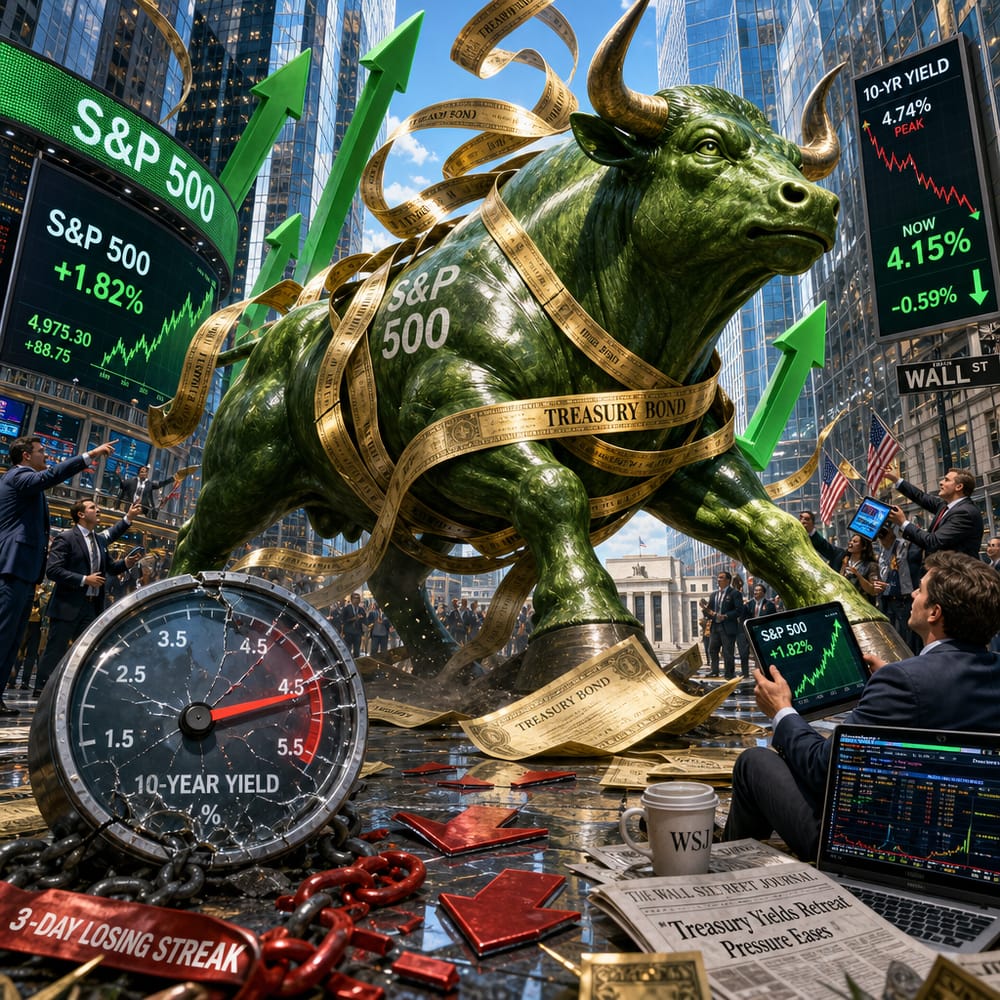
S&P 500's Resilience, or Just a Dance with Treasury Yields?
Picture this: the curtain rises on Wall Street and the S&P 500 is strutting back onto the stage, trying to shake off a three-day losing streak. The audience, aka investors, is watching with a mix of hope and skepticism, as the drama of rising Treasury yields appears to take a brief intermission. But is this a genuine revival or just a temporary encore?
To understand this financial ballet, we need to get acquainted with the lead performers: the S&P 500 and Treasury yields. The S&P 500, a barometer of American equities, doesn't just float in its own bubble. It's tethered to the ebbs and flows of Treasury yields. Think of these yields as the ground beneath the stock market's feet—when they rise too high, they can trip up stocks, and when they settle down, stocks can regain their footing.
Recently, the Treasury market has been like a jittery tap dancer, with yields climbing higher and higher. That's because when yields rise, borrowing costs increase, and suddenly everyone from corporations to your neighbor looking for a new mortgage feels the pinch. But just as our nerves were about to fray, relief appeared on the horizon. The word on the street is that a combination of government intervention and a cooler-than-expected inflation report has put a temporary lid on those climbing yields.
Enter Jim Cramer, the market's unofficial hype man, declaring that the Treasury's expanded bond buybacks—essentially the government's way of buying its own debt to keep interest rates in check—might just preserve this stock rally. It's like the Fed handing the market a pair of comfortable shoes, hoping it can now keep dancing without tripping.
So, what caused this easing of bond market pressures? There are a few suspects. First, the bond buybacks themselves. By scooping up bonds, the government has increased demand, which helps keep yields from spiraling upwards. Second, recent inflation data didn't come in as hot as feared, easing concerns that the Fed might slam the brakes on the economy with aggressive rate hikes. And finally, the international stage played its part too—an unexpected détente in trade tensions between the U.S. and Canada, where President Trump announced a last-minute deal to pause tariffs, calmed some trade-related fretfulness.
Now, what does this mean for the stock market going forward? Well, if yields stay in check and don't dance right off the stage again, stocks could continue their rebound. Investors might feel emboldened to take on more risk, leading to more capital flowing back into equities. Sectors that are sensitive to interest rates, like technology and utilities, could particularly benefit as they rely on cheap capital to fuel growth.
However, let’s not pop the champagne just yet. The bond market is a complex beast, and yields could very well resume their ascent if inflation rears its ugly head again or if geopolitical concerns, like those around Iran and oil prices, start to rattle nerves.
In the end, this interplay between bond yields and stock prices is like a never-ending series of pas de deux. As investors, it's crucial to keep an eye on these leading indicators. The S&P 500's recent rally is a reminder that stocks and bonds are part of the same performance, each reacting to the other's moves. So, while today's rally might have us applauding, one must always be ready for the next act in this unpredictable market play.
Stay sharp, stay nimble, and remember: in the theater of finance, the only constant is change.
This article is for informational purposes only and is not investment advice. Always do your own research or consult a licensed financial professional before making investment decisions.
© Copyright 2024. All Rights Reserved.
© Copyright 2024. All Rights Reserved.