

S&P 500's Longest Losing Streak Since June
Wednesday, November 18, 2026
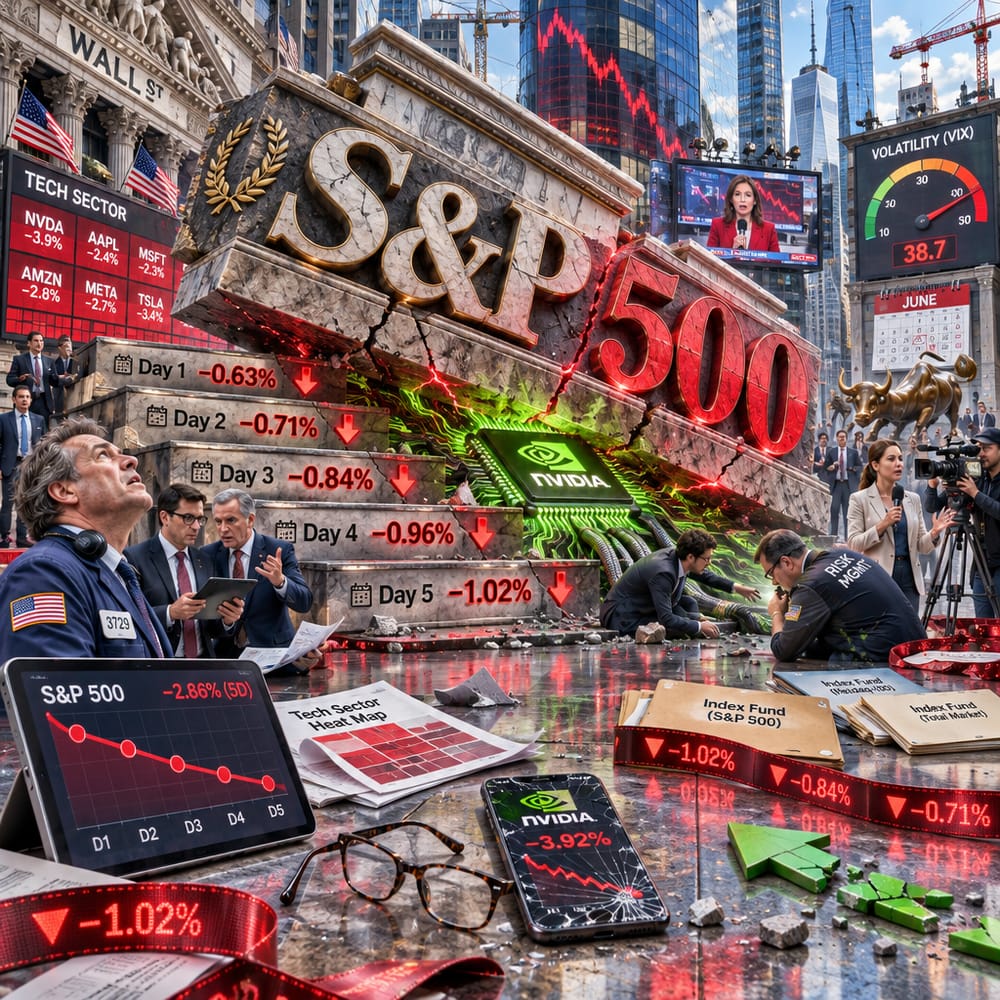
MARKET MAYHEM: IS NVIDIA THE BAD APPLE OR JUST A BUMP IN THE ROAD?
Grab your popcorn, folks, because the S&P 500 is trying its best impersonation of a dramatic Netflix series. The index just logged its fifth consecutive losing day, making it the longest downhill slide since June. The prime suspect in this financial thriller? Nvidia, the tech giant with more plot twists than an M. Night Shyamalan movie.
The S&P 500 is the stock market's version of a report card, showing us how 500 of the biggest companies in the U.S. are performing. And right now, it's not exactly acing the test. But why is the whole market feeling like it’s got a bad case of the Mondays? Let’s dive into the drama.
ALL EYES ON NVIDIA
Enter Nvidia, our star player in this Wall Street saga. The chipmaker dropped a bombshell when its CEO, Jensen Huang, unexpectedly resigned amidst some eyebrow-raising personal revelations. Add in a rollercoaster earnings report, and it's a wonder Nvidia didn’t just implode right then and there.
Here's the thing: Nvidia's latest earnings report was actually a blockbuster—revenues and profits soared past expectations. But investors, like suspicious partners in a soap opera, chose to focus on the uncertainty left by Huang's exit. The result? A 2.9% drop in Nvidia's stock, dragging down the tech sector and the broader market with it.
In the world of stocks, perceptions can be stronger than facts. Nvidia's uncertainty created a ripple effect, causing investors to hit the brakes on tech stocks, which make up a hefty chunk of the S&P 500.
TECH SECTOR TURMOIL
Tech stocks have been the darlings of the market, but they're also proving to be high-maintenance. With Nvidia's hiccup, the tech sector took a gulp of reality, impacting not just Nvidia but also companies caught in its orbit, like CoreWeave and Iren. These companies saw their stock values dip, showing just how interconnected the tech sector can be—it's like one giant, tangled web of semiconductors and software.
But is this the beginning of a broader market correction, or just a tech-sector tantrum? The market corrections are like a reality check, reminding everyone that stocks can’t just keep going up forever. Yet, right now, it seems more like tech stocks are just having a moment rather than leading to a full-blown economic saga.
THE BROADER MARKET PICTURE
Outside the tech bubble, other sectors seem to be holding their ground or even thriving. Cybersecurity stocks, for instance, are rallying as companies beef up their digital defenses in an AI-driven world. Meanwhile, Anthropic, another AI-powered wonder, is gearing up for a historic IPO, underscoring that not every tech story is a tearjerker.
Investors should remember that dips, even dramatic ones like Nvidia's, are part of the market's natural ebb and flow. It's like the weather—sometimes it’s sunny, sometimes it rains. And a little rain can be good for growth.
WHAT'S NEXT?
For the savvy retail investor, the key is not to panic. Look at the market like a chess game, not a slot machine. Nvidia might be down now, but it still holds strong cards for the future with its cutting-edge AI and gaming technologies. The same can be said for the broader tech sector, which isn’t going out of style anytime soon.
The S&P 500’s losing streak is a reminder that the stock market is as unpredictable as a toddler with a paint set. But, just like with toddlers, the chaos doesn't last forever.
So, what should you, the everyday investor, do? Stay informed, diversify your portfolio, and keep an eye on the long game. Remember, in the wild world of investing, patience is more than a virtue—it’s a strategy. And always, always read the market's room like you're playing poker with your future on the line.
In the words of Nvidia's interim CEO, Colette Kress, let’s move forward. This market drama might have more episodes to come, but as with all good stories, it's the ending that counts. For now, sit tight, keep scrolling, invest wisely, and maybe keep some popcorn handy.
This article is for informational purposes only and is not investment advice. Always do your own research or consult a licensed financial professional before making investment decisions.
© Copyright 2024. All Rights Reserved.
© Copyright 2024. All Rights Reserved.