

S&P 500 & Nasdaq Near Record Highs Amid Earnings Season
Wednesday, October 14, 2026
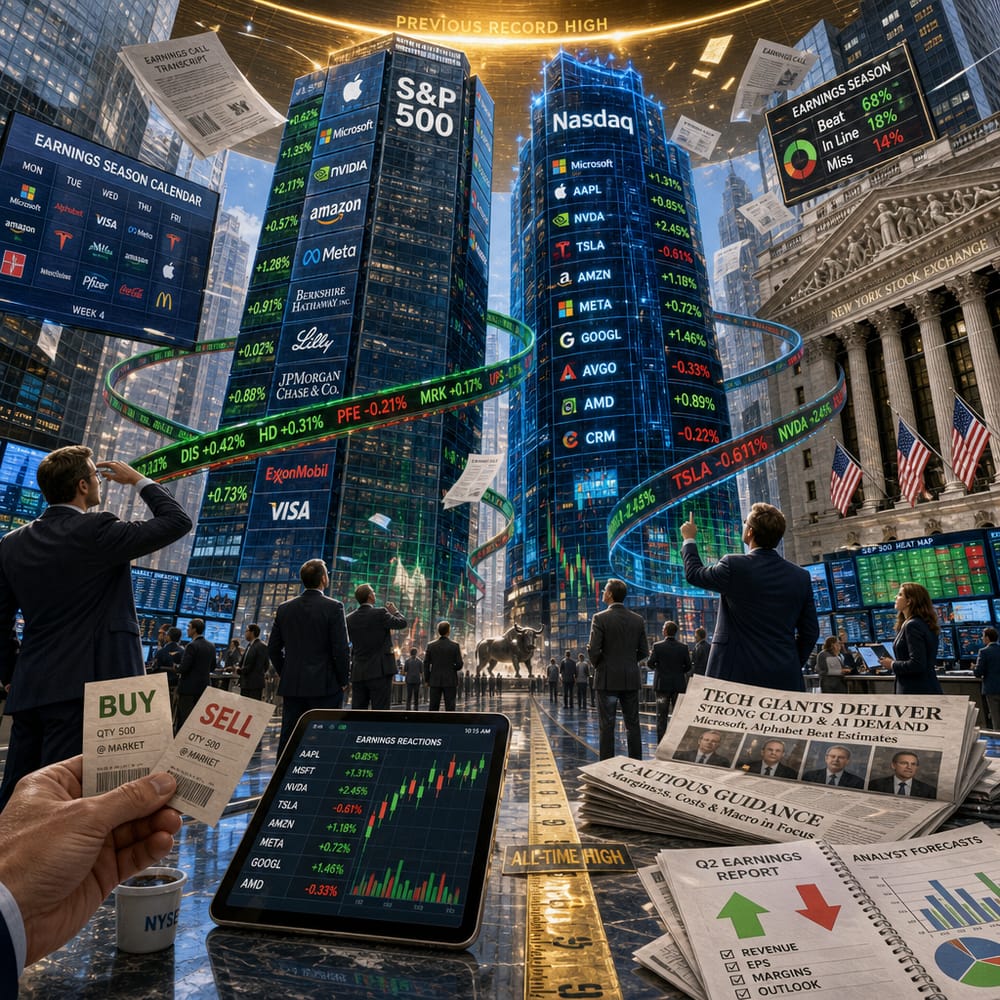
RECORD HIGH: WHY THE S&P 500 AND NASDAQ ARE RIDING THE OPTIMISM WAVE
Hold onto your hats, fellow investors, because the stock market is doing its best Evel Knievel impression, defying gravity and logic by flirting with all-time highs. The S&P 500 and the Nasdaq are strutting their stuff near record peaks, even as some traders scratch their heads and wonder if they should be bracing for a fall. So what's keeping these indices on their high-wire act, and what could possibly knock them off?
THE POWER OF POSITIVE THINKING (AND EARNINGS SEASON)
First, let's talk about what’s keeping the S&P 500 and Nasdaq in the stratosphere. It's earnings season, folks — that magical time of the year when companies reveal whether they're swimming in cash or struggling to keep their heads above water. The results so far have been something of a mixed bag, but enough companies have posted strong performances to keep investor spirits high.
Take ASML, the semiconductor guru from the Netherlands. They not only beat expectations but also hinted at a tech-hungry future with sky-high customer demand. Stockholders loved it, pushing shares up by 3%. It’s these kinds of stories that keep the bulls charging — companies showing resilience or, better yet, growth in an economy that’s doing its best impression of a reality TV show with constant cliffhangers, plot twists, and gasp-inducing moments.
IT'S ALL ABOUT EXPECTATIONS
But hey, not all companies have it easy. Bank of America, for example, faced a $1.2 billion slap on the wrist for some financial shenanigans. And yet, the market shrugged. Why? Because this season’s unofficial theme is "higher expectations." Companies not only need to perform well; they need to outperform the lofty hopes investors have pinned on them. It's like a high-stakes circus act where doing a triple somersault will only get applause if you stick the landing on one foot.
The market’s resilience, then, is partly down to this delicate dance of expectations. Investors are willing to look the other way on a misstep here or there if they believe the overall narrative — one of growth, technological innovation, and robust demand — remains intact. However, the tolerance for disappointment is thin; one big stumble could send the whole tightrope act tumbling.
THE RISK FACTOR
So far, so bullish. But hold your horses, because there are a couple of elephants in the room, and they're not known for their grace on tightropes. Let's talk about risks.
Global geopolitics is a powder keg. From the ongoing saga in Ukraine to the oil price drama courtesy of the Middle East’s political chaos, there are plenty of potential disruptions lurking. Any serious escalation or shock could send markets into a tailspin faster than you can say "risk-off."
Then there’s the economic outlook. Inflation reports are like horror movie trailers, with investors bracing for the latest jump scare. Rising costs, coupled with high interest rates, can gnaw away at consumer spending and corporate profits. If inflation remains stubbornly high, it might force the Federal Reserve to keep interest rates elevated for longer, putting the brakes on economic growth — and nobody wants to invest in a stalled economy.
THE FINAL ACT
So, what’s the bottom line here? The S&P 500 and Nasdaq are riding high, boosted by a cocktail of positive earnings and investor optimism. It's a reminder of the market's uncanny ability to look past the immediate chaos and focus on future potential. But every high-wire act has its risks, and for investors, the challenge is to stay informed and nimble.
Keep an eye on the earnings reports, pay attention to geopolitical developments, and don't overlook economic indicators. Because while the market might be soaring today, tomorrow might bring a gust of wind that turns this high-flying act into a freefall. But hey, that's the thrill of investing, right? It’s not for the faint of heart, but if you can hang on, the view is spectacular.
This article is for informational purposes only and is not investment advice. Always do your own research or consult a licensed financial professional before making investment decisions.
© Copyright 2024. All Rights Reserved.
© Copyright 2024. All Rights Reserved.