

S&P 500 Holds Steady Amid Rising Fear
Friday, September 25, 2026
S&P 500 Holds Steady Amid Rising Fear
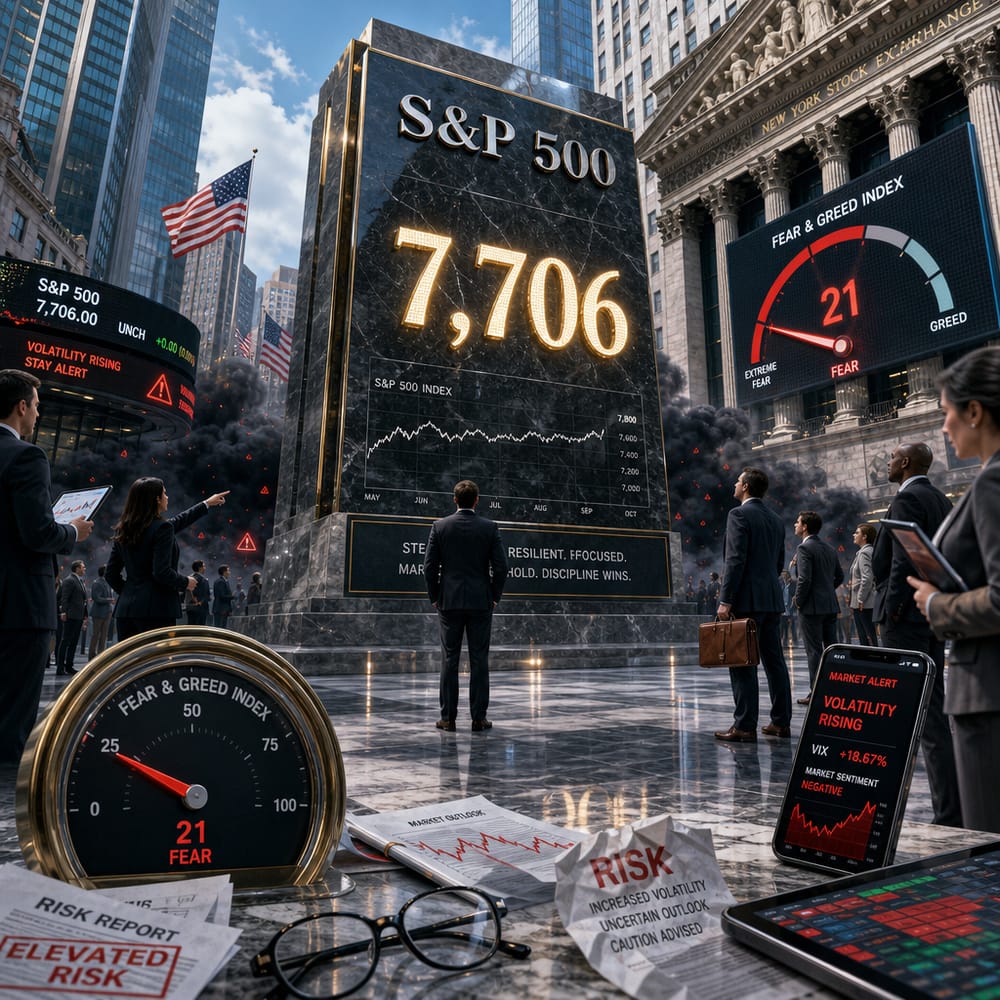
Imagine standing at the edge of a cliff, peering over into the abyss. That’s how the market feels these days: precariously balanced, seemingly stable, but with a gnawing sense that something's lurking just below the surface. The S&P 500 might be holding its ground near 7,706, but don't let that fool you. The Fear & Greed Index—a clever little gauge designed to capture market sentiment—is lurching towards the ‘Fear’ end of the spectrum. And history tells us that when sentiment shifts, the market tends to follow suit, sometimes in dramatic fashion.
So, what’s behind this creeping unease? For starters, rising Treasury yields are making investors jittery. When yields climb, they drag borrowing costs up with them, inflating everything from mortgages to credit cards. This isn't just a Wall Street problem. It ripples out everywhere—into our homes, our wallets, and yes, our stock portfolios. The benchmark 10-year Treasury note recently hit heights not seen since George W. Bush's presidency, and when rates climb like that, it usually yanks stocks back down to earth.
But wait, there's more! How about the ongoing saga of geopolitical tension, with Iran offering to reopen the Strait of Hormuz and get back to the negotiation table with the U.S. While that diplomatic back-and-forth doesn't directly affect stocks, it does sprinkle a bit more uncertainty into the mix—something markets loathe more than Brussels sprouts.
Now, let's tie this back to our pal, the S&P 500. On the surface, all seems serene. But if market sentiment continues to sour, it could stir up volatility like a blender turned on high. Think back to 2008, when market sentiment was as icy as a polar vortex. The S&P 500 appeared relatively resilient until it wasn’t, leading to one of the most gut-wrenching financial downturns in recent history. We're not saying that's about to happen again, but it’s a reminder that sentiment and reality can diverge, sometimes until they snap back together in a hurry.
So, how should you, the savvy retail investor, navigate this sentimental rollercoaster? First, don't panic. Remember that markets are as fickle as a cat at a dog show. Instead, consider your portfolio's balance. Are you diversified enough to weather a storm? This might be a good time to revisit your asset allocation, ensuring you’re spread across various sectors and geographies.
Look at sectors that might benefit from current trends. With oil prices taking a temporary dip, as tensions in the Middle East hint at resolving, energy stocks might wobble. However, tech stocks, especially those in artificial intelligence and enterprise software, are bustling with activity—Microsoft's latest move in the AI space is an intriguing development to keep an eye on.
Don't forget about bonds. With yields as high as a kite, they’re becoming more attractive, offering decent income opportunities without the anxiety of stock market swings. It might be time to tuck some away in your portfolio as a buffer.
Lastly, keep your ear to the ground and your eyes on the news. Whether it’s shifts in international diplomacy, like Iran’s overtures to the U.S., or domestic data reflecting economic health or malaise, staying informed is your best defense against the unknown.
In the end, whether this sentiment shift leads to a gentle market correction or a full-blown tempest, being prepared and informed will help you navigate the storm. Remember, the market is a long game, not a sprint, and those who can hold steady amidst the fear often come out ahead. So, grab your popcorn, brace yourself for the ride, and remember that market ebbs and flows are as old as the market itself.
This article is for informational purposes only and is not investment advice. Always do your own research or consult a licensed financial professional before making investment decisions.
© Copyright 2024. All Rights Reserved.
© Copyright 2024. All Rights Reserved.