

S&P 500 and Nasdaq Remain Flat Amid Underlying Risk Appetite
Wednesday, October 14, 2026
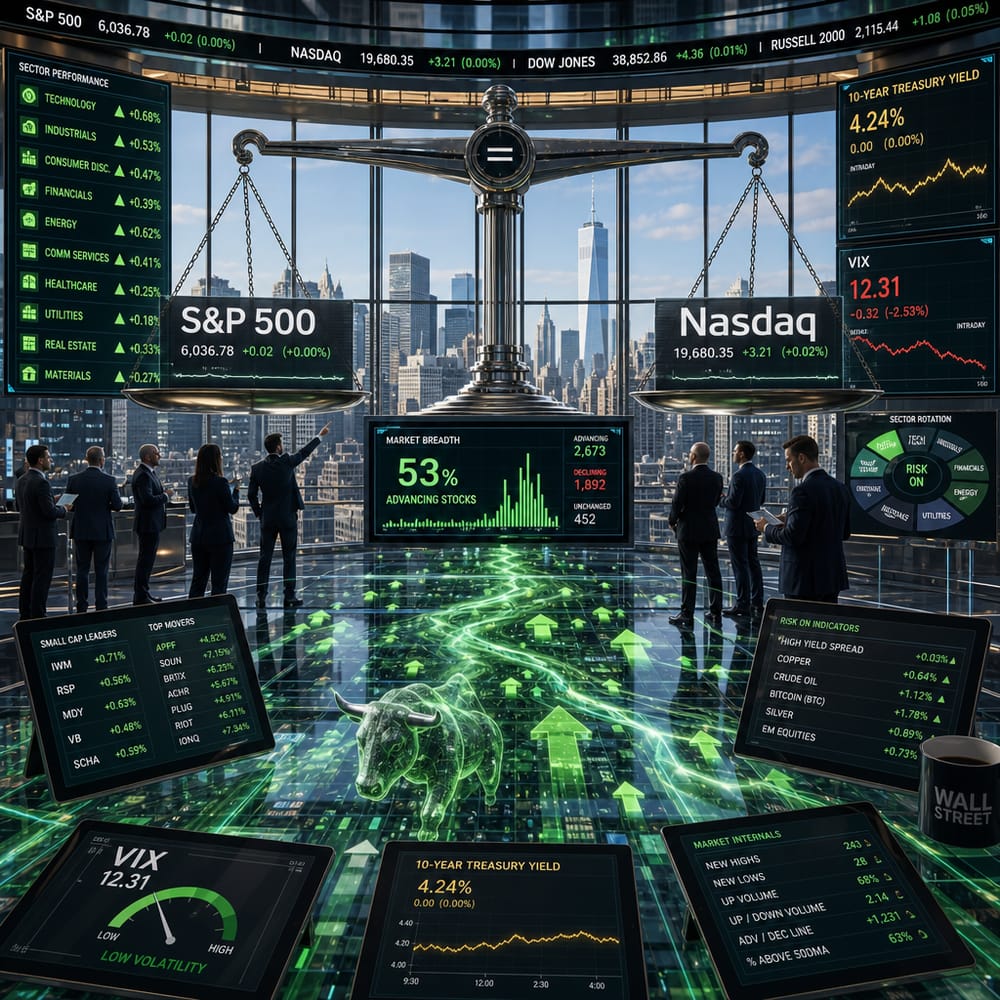
S&P 500 AND NASDAQ: TREADING WATER BUT SWIMMING STRONG
It's a bird! It's a plane! Nope, it's just the S&P 500 and the Nasdaq, idling in neutral as they cruise above the skyline of the financial district. Despite their perplexing stagnation, market insiders are whispering about an underlying force buzzing beneath the surface. Spoiler alert: It’s not just another Wall Street conspiracy.
In the cryptic world of stock market indices, headlines scream that the S&P 500 and Nasdaq are flatlining like a pancake on a Sunday morning. But a deeper dive reveals a dynamic subtext: a 'risk-on' sentiment is quietly starting to reveal itself. When you peel back the layers, you’ll find more than half (53%) of stocks have been partying like it's 1999, showing upward momentum and dragging market breadth along with them.
WHY ARE THE INDICES FLAT?
Sure, the indices are playing coy, but why aren’t they reflecting the broader market cheerfulness? Here's the scoop: major indices like the S&P 500 and Nasdaq are weighted by market cap. This means the heavy hitters like Apple, Microsoft, and Amazon can sway the index with little more than a sneeze. When these tech behemoths decide to take a breather, they weigh down the entire index, masking the buoyancy of smaller, rising stocks.
SECTOR BUZZ: WHO'S LEADING THE CHARGE?
Don't be fooled by the cool indifference of the tech titans; other sectors are more than eager to pick up the slack. Welcome to the dance floor are financials, energy, and industrials. As oil prices nudge upwards amidst geopolitical tensions and supply chain puzzles, energy stocks are fueling up. Financials, on the other hand, are riding the rollercoaster of elevated interest rates and banking on the hope that they can manage the ride without tossing their cookies.
Even amidst this turbulent financial backdrop, with Bank of America wrestling with a hefty $1.2 billion Treasury fine and JPMorgan Chase licking its wounds from an earnings miss, the sector still finds room to flex its muscles.
YIELDING TO PRESSURE: THE IMPACT OF ELEVATED YIELDS
Speaking of interest rates, the 10-year Treasury yield is hovering around levels that would make even the most stoic bond trader twitch. Elevated yields usually mean investors are demanding higher returns to compensate for the risk of inflation eating away at future cash flows. While this often sends stock investors running for cover, the current yield landscape is more like a nagging headache than a full-blown migraine for the market.
Higher yields have a way of pulling equity valuations down to earth, but the market seems to be taking it in stride—for now. The jury's still out on how long this cool acceptance can last before the heat of high yields starts boiling over, sending risk-takers scrambling back to the safety of bonds.
THE GREAT INDEX DIVORCE: HEADLINES VS. REALITY
So, why does this divergence between flat indices and underlying market vigor matter? It's a classic case of headline indices versus street-level market reality. While the big indices aren't exactly setting off fireworks, the underlying action tells a story of resilience, selective buying, and even a touch of optimism.
Investors are playing it smart, rotating between sectors like a well-oiled machine, seeking opportunities where they find them. It's a sign of a market that may not be roaring, but isn't ready to roll over and play dead either.
THE FINAL WORD
In this topsy-turvy market, the indices might be lounging around, but don't let that fool you into thinking nothing is happening. The underlying market is humming with life, showcasing an appetite for risk even as it carefully navigates the choppy waters of elevated yields and macroeconomic uncertainties.
So, if you're an investor eyeing the horizon, don't just take the S&P 500 and Nasdaq at face value. Look deeper, and you might find opportunity lurking where the headlines dare not tread. As always, keep your cool, your wits sharp, and your eye on the sectors making moves.
This article is for informational purposes only and is not investment advice. Always do your own research or consult a licensed financial professional before making investment decisions.
© Copyright 2024. All Rights Reserved.
© Copyright 2024. All Rights Reserved.