

Russell 2000 Oversold: Technicals Suggest Continued Small-Cap Weakness
Sunday, November 22, 2026
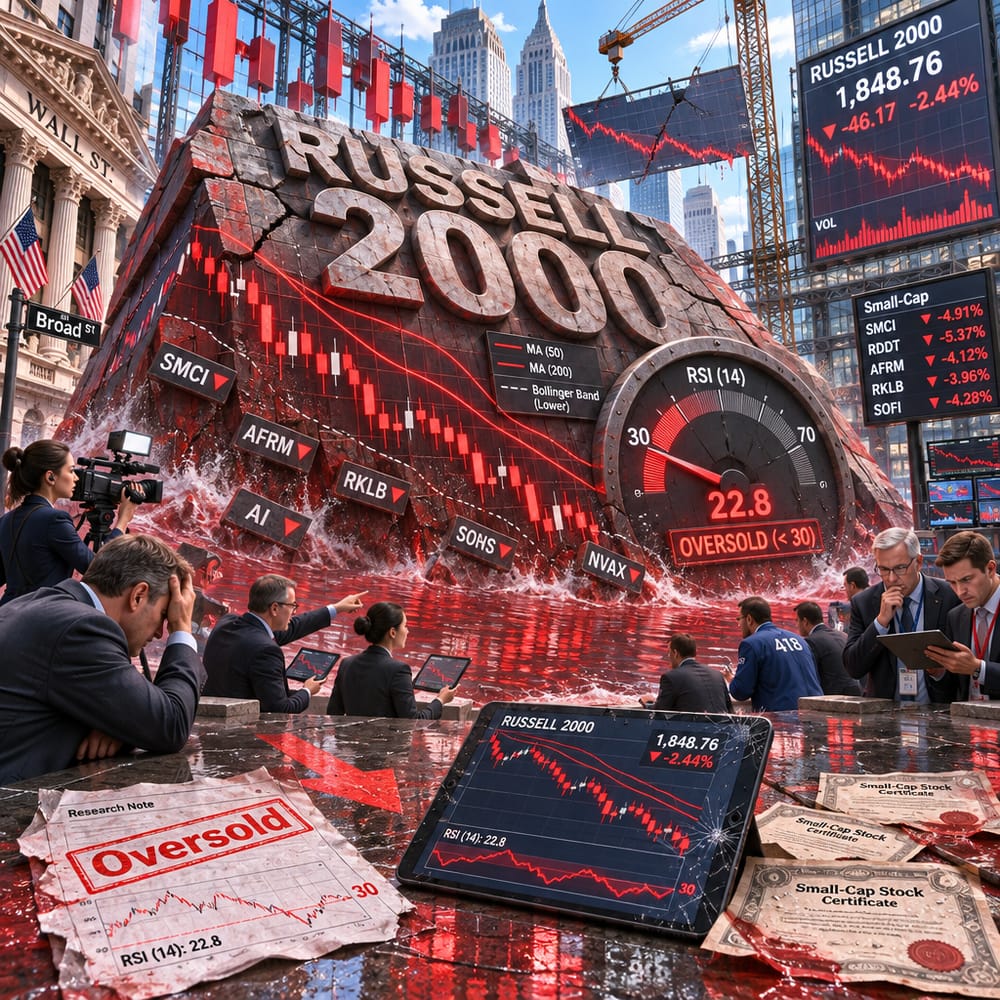
RUSSELL 2000: SMALL-CAPS, BIG SIGNS OF TROUBLE
If you feel like the market's been a bit like trying to make a soufflé in an earthquake, you're not wrong—especially if you're watching the Russell 2000. You know, that index that tracks the little guys? The hometown heroes? Technically speaking, it's not just shaky; it's downright oversold. But what does that mean, and why should you care? Well, pull up a chair, and let's decode this market enigma.
THE TECHNICAL TEA
First things first, let's talk technical indicators—the mystical charts and numbers traders adore. The Russell 2000, which is like the pulse of small-cap stocks, has been flashing some serious warning signs. The RSI, or Relative Strength Index, is a tool that basically measures whether a stock or index is overbought (too hot) or oversold (too cold). If it's over 70, it's too hot; below 30, it's too cold. As of now, the Russell 2000's RSI is doing the limbo under 30. Cue the alarm bells: It's oversold.
What's the big deal with that? An oversold signal usually suggests that stocks might bounce back because, theoretically, they’ve been beaten down too much. But here's the rub—just because something's oversold doesn't mean it's about to skyrocket. The Russell's currently looking more like a plane without a pilot—cruising low with no immediate signs of altitude change.
THE SMALL-CAP SAGA
Why should small-cap investors care? Well, small-cap stocks are often seen as the Robin to the S&P 500's Batman—sidekick but indispensable. They’re riskier, sure, but they also offer serious growth potential. However, when small-caps struggle, it's often viewed as a harbinger of economic strife. Think of small-caps as your economic canaries in the coal mine; if they're keeling over, it might be time to pay attention.
Right now, the Russell 2000 is telling us that these small fries are feeling the squeeze. And for investors, it's a double-edged sword. On one hand, oversold conditions might suggest a buying opportunity. On the other, it's a bit like buying a ticket on the Titanic after it's hit the iceberg—are you sure you know where this is going?
THE BROADER ECONOMIC BREADCRUMBS
So, how does this all trickle up, or down, to the broader economy? Small-cap stocks are usually more sensitive to domestic economic conditions. When they're struggling, it’s often interpreted as a sign that the underlying economy isn’t firing on all cylinders. These companies don't have the international reach and diversification that bigger firms do, so they serve as a more direct reflection of the American economic landscape.
If you're wondering about the economy’s health, small-caps might be your crystal ball. And right now, they’re showing a bit of fog. With the Russell 2000 under pressure, it throws up red flags about everything from consumer confidence to business investment.
WHAT'S A RETAIL INVESTOR TO DO?
If you're a retail investor, navigating this kind of market can feel like trying to paddle upstream in a river of molasses. Here's the strategy: tread carefully but confidently. These are times to evaluate the fundamentals—what you actually own, and why you own it. Staying informed and diversified is the secret sauce to not getting caught in a tailspin.
Keep an eye on whether any fiscal or monetary policies might give small-caps a shot in the arm. A positive turn in the economic dialogue or a fresh package of stimulus could be the lifebuoy these stocks need. Meanwhile, patience and a well-considered portfolio might just be your best investment allies.
In conclusion, while the Russell 2000 is flashing oversold signals like a frantic lighthouse, it’s not the time to panic—but it is the time to pay attention. Remember, markets are as much about the story they tell as the numbers they show. And right now, that story is one part mystery, one part cautionary tale. So, watch closely, invest wisely, and, as always, buckle up.
This article is for informational purposes only and is not investment advice. Always do your own research or consult a licensed financial professional before making investment decisions.
© Copyright 2024. All Rights Reserved.
© Copyright 2024. All Rights Reserved.