

Russell 2000 Bounces After Early Weakness
Thursday, August 13, 2026
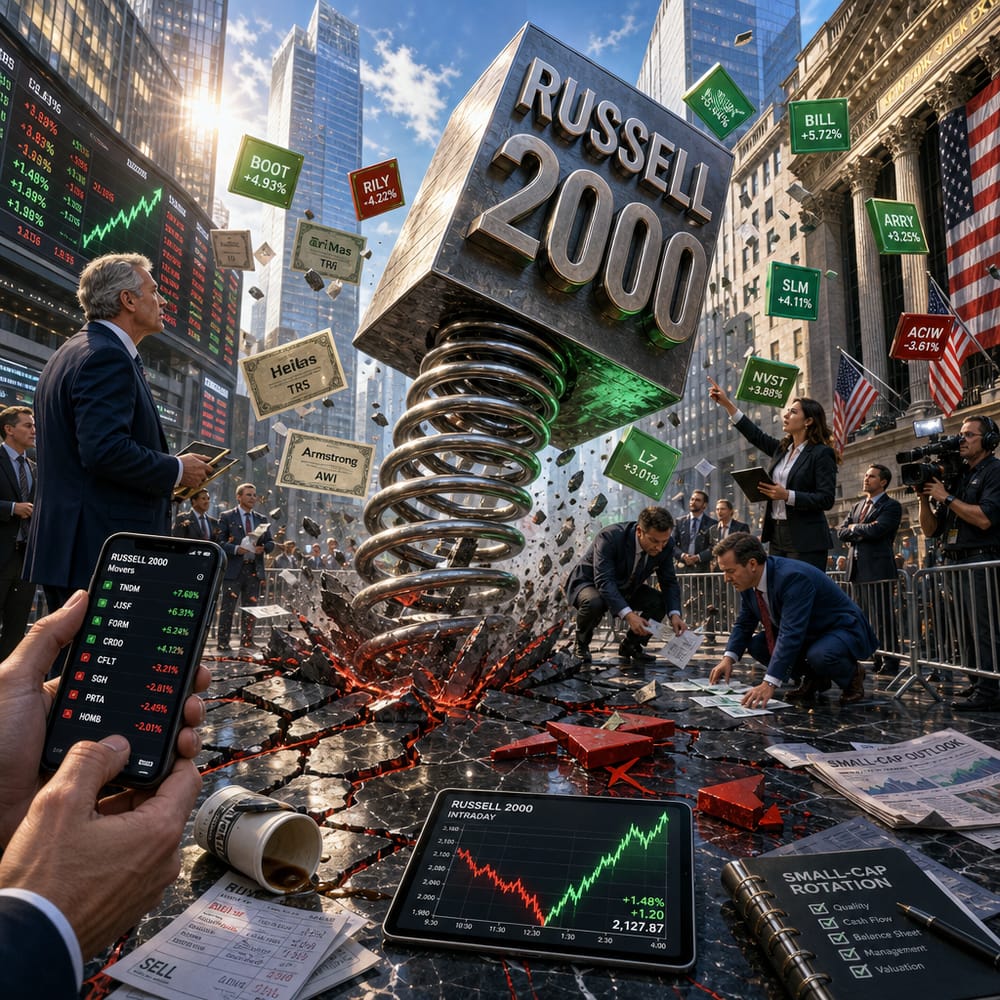
HERE COMES THE RUSSELL 2000 RODEO: SMALL-CAPS STRUGGLE AND STRIDE
Buckle up, market riders, because we're diving headfirst into the rollercoaster ride that is the Russell 2000 index. You might want to hang on tight. Just when you thought the small-cap stock index was down for the count, it’s bouncing back like a worn-out boomerang, refusing to stay out of the game for long. But what’s behind this jumpy recovery, and why should you, the average retail investor, care? Let’s cut through the noise and explore.
THE VOLATILITY VORTEX
Picture this: the Russell 2000, that plucky index made up of small-cap companies, is trying to find its mojo again amid a flurry of mixed market signals. What’s been throwing it around like a rag doll? Well, a cocktail of factors, my dear Watson. For starters, interest rates have been doing the cha-cha, and every whisper from the Federal Reserve about possible future hikes has investors skittish. Higher interest rates aren’t exactly a love letter to small-caps, which tend to rely more on borrowing to fuel their growth.
And let’s not forget the macroeconomic uncertainty that’s been hanging around like an uninvited guest. Trade tensions, geopolitical shenanigans, and the latest inflation stats all contribute to an environment where investors are alternately running for cover and cautiously peeking out. Small-cap stocks, with their inherently higher risk due to less diversified business models, get tossed around like popcorn in a storm.
A CANARY IN THE COAL MINE?
So why are we zeroing in on the small-caps? The answer is simple: they're the market’s version of that canary in the coal mine. When the Russell 2000 moves, it can be a signal of broader risk sentiment in the market. If investors are tiptoeing back into the small-cap arena, it might mean they’re ready to dip their toes into riskier waters, suggesting an uptick in overall market confidence.
This selective rotation into small-caps could hint at investors hunting for bargains among beaten-down stocks, possibly anticipating that these underdogs will outgrow their big-cap cousins in an economic rebound. It's as if the investors are saying, "Hey, these little guys have potential!"
BIGGER TRENDS AT PLAY
Now, before you go all-in on small-caps thinking they’re the golden ticket, take a breath. While small-cap performance does offer clues on risk appetite, it's crucial to see how this dance aligns with broader market trends. Right now, the market is a complex tapestry woven with threads of AI growth, fluctuating oil prices, and shifting global demand.
For instance, while tech giants are still the belle of the ball, the AI boom has been pegged as vulnerable, particularly to competition from international players. Any hiccup there could ripple across sectors, making the market's next moves a tad unpredictable. Meanwhile, cooling wholesale prices and jittery oil rates are keeping investors on their toes, playing into the larger narrative of market volatility.
WHAT’S AN INVESTOR TO DO?
If you're an investor, sitting back with some popcorn might sound tempting, but there’s a better strategy. Diversifying your portfolio to include a mix of small and large-cap stocks can help you ride out the bumps. Keep an eye on those macroeconomic indicators that send shockwaves through the market waters, and don’t let a single index or sector dictate your investment strategy.
The Russell 2000’s antics might be a handy compass, pointing toward the prevailing winds of investor sentiment, but it’s not the only guide you should rely on. Think of it as a piece in a much larger puzzle.
In the end, the Russell 2000's choppy recovery is like an unpredictable dance partner: it keeps you guessing, and sometimes, just sometimes, it leads you to surprising new highs. Whether it's a sign of clouds clearing or just a temporary uptick, only time will tell. But hey, who doesn't love a good market mystery?
This article is for informational purposes only and is not investment advice. Always do your own research or consult a licensed financial professional before making investment decisions.
© Copyright 2024. All Rights Reserved.
© Copyright 2024. All Rights Reserved.