

Renewed Policy Divergence: Fed vs. ECB’s Impact on Dollar Pairs
Wednesday, August 19, 2026
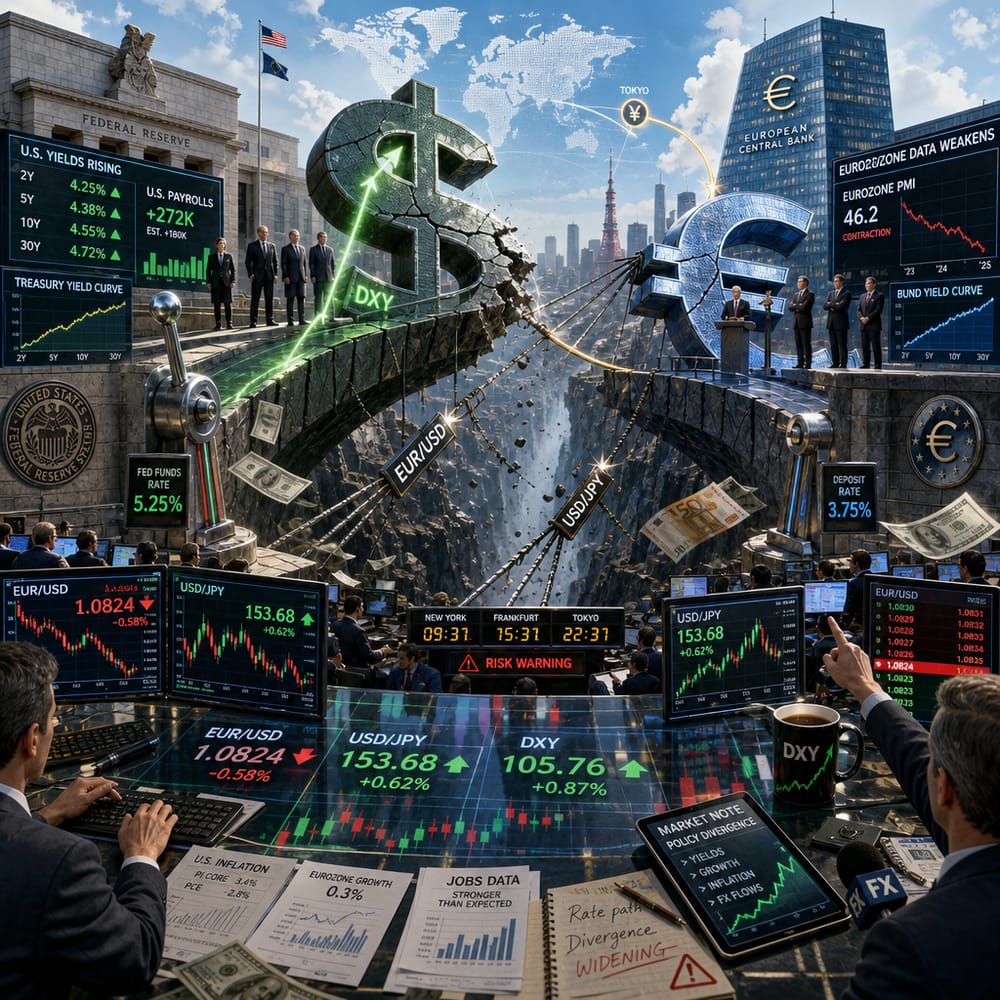
IS THE FEDERAL RESERVE PLAYING CHESS WHILE THE ECB PLAYS CHECKERS?
Central bankers are in a showdown more intense than a high-stakes poker game. The Federal Reserve and the European Central Bank (ECB) are diverging in their economic strategies, leaving traders scratching their heads and currency pairs spinning like they're on a rollercoaster. But what does this mean for us everyday investors? Buckle up, because we're diving into the world of central bank policies and their ripple effects on the dollar and beyond.
Picture this: the U.S. economy is humming along like a well-oiled machine, bolstered by robust consumer spending and a labor market that seems to have hit the jackpot. The Fed has all but hit the pause button on interest rate hikes, giving the green light to a wait-and-see approach. Across the pond, however, the ECB finds itself stuck between a rock and a hard place, grappling with inflation that just won’t quit. Their response? Tightening the screws with interest rate hikes faster than you can say "Mario Draghi."
This divergence in strategies has traders on edge, as they try to make sense of what it all means for key currency pairs like EUR/USD and USD/JPY. Spoiler alert: it’s not as simple as flipping a coin.
TRADER POSITIONING AND MARKET MOVES
Traders are always looking for the next big move, and this policy divergence between Uncle Sam and the Eurozone is like catnip to them. With the Fed's dovish stance, market players are betting on a weaker dollar, driving enthusiasm in the futures markets. You can almost hear the sound of traders adjusting their strategy, hedging their bets on yield differentials that now have a spotlight brighter than a Hollywood premiere.
Swaps-implied rate expectations—a fancy way of saying what the market thinks future interest rates will be—show traders are positioning for a softer dollar. The dollar index (DXY), which measures the dollar against a basket of currencies, is starting to show signs of wobbling. Why? The yield differentials are narrowing, giving the euro a little more swagger. But don't count the dollar out just yet; the markets have been known to switch directions as fast as a Formula 1 car.
SO, WHAT DOES THIS MEAN FOR THE DOLLAR?
If the Fed continues to run on cruise control with its interest rates, we could see the dollar lose some of its shine. A weaker dollar generally spells good news for U.S. exporters—imagine American goods looking like a bargain on the international stage. However, there's a flip side. A less attractive dollar could dampen the appeal for foreign investors seeking those juicy U.S. yields.
But hold up—is this really a long-term trend? It might not be a straight shot. While the Fed seems content with its pause, any unexpected economic data could jolt them back into action. Remember, central bankers are nothing if not reactive, ready to change course faster than a plot twist in a soap opera.
EUROPE'S TURN: HOW ECB MOVES AFFECT OTHER CURRENCIES
ECB's tightening isn't just a continental affair—it shakes up the entire European currency bloc. A stronger euro could inadvertently drag other European currencies along for the ride. Think of it as the euro playing lead guitar, with the likes of the Swiss franc and Swedish krona as its backing band. Investors in these currencies need to keep an eye on the ECB's next moves, as rate hikes could mean their interest rates play catch-up.
LOOKING AHEAD: THE BIGGER PICTURE
For the everyday investor, all these chess moves might seem a bit abstract. But understanding how these big institutions play their cards can give you a front-row seat to global economic theater. Whether you're trading forex pairs or just watching your portfolio like a hawk, knowing which way the wind is blowing in central bank policies can keep you a step ahead.
In the end, it's not just about winners and losers. It's about positioning yourself in the market with the foresight and agility of a chess grandmaster. So, the next time someone at a cocktail party brings up the Fed or ECB, you'll have more to say than just "pass the chips."
As for those central bankers, only time will tell if they’re writing a new economic playbook or playing the same old game with new tricks. One thing's for sure: the stakes have never been higher, and the next move is anyone’s guess.
This article is for informational purposes only and is not investment advice. Always do your own research or consult a licensed financial professional before making investment decisions.
© Copyright 2024. All Rights Reserved.
© Copyright 2024. All Rights Reserved.