

RBA & BoE Rate Hikes Backfire: AUD, GBP Fall as Dollar Strengthens
Sunday, November 08, 2026
RBA & BoE Rate Hikes Backfire: AUD, GBP Fall as Dollar Strengthens
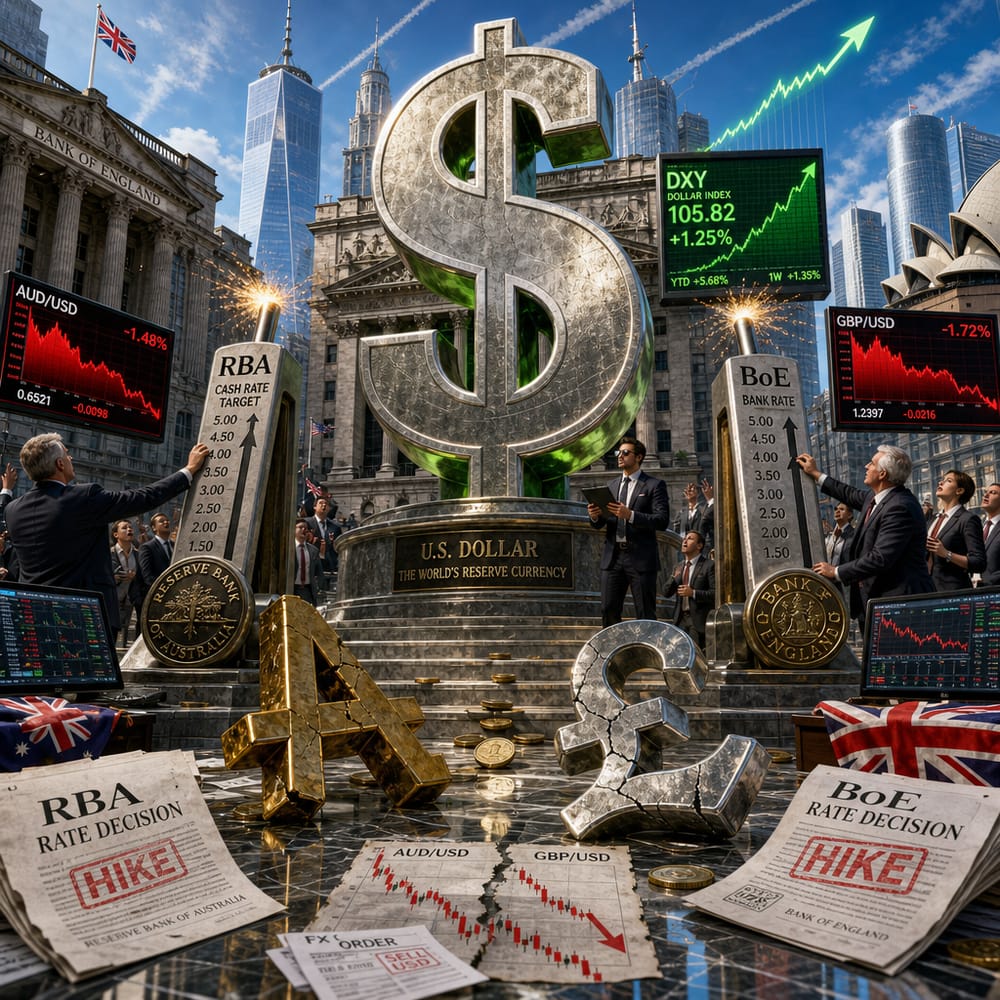
Central banks are supposed to be like ultra-cool superheroes swooping in to save the day. But what happens when they try to flex their muscles and the market just yawns and looks away? The Reserve Bank of Australia (RBA) and the Bank of England (BoE) have recently found themselves in just such a predicament. They've both hiked interest rates — a classic move to boost their respective currencies — yet both the Australian dollar (AUD) and British pound (GBP) have been taking a dive against their arch-nemesis: the U.S. dollar (USD).
The theory is simple: higher interest rates should make a currency more attractive. Investors get all starry-eyed because they see better returns on their money, which should push demand and, subsequently, the value of the currency up. But alas, the market rarely follows the playbook.
So why did the rate hikes fizzle? Well, while the RBA and BoE were cranking up their rates, the U.S. dollar was busy hitting the gym. Thanks to a robust U.S. economy that just refuses to quit, the USD has been bench-pressing market expectations and flexing its muscles all over the currency market. Interest rates in the U.S. remain high, backed by solid economic fundamentals, which continues to lure investors into the warm, cozy embrace of the greenback.
Add to that a little geopolitical drama and some U.S. fiscal policy moves, and you’ve got yourself a currency powerhouse. The U.S. economy is showing resilience that's making even the Terminator blush. Job growth looks solid, inflation is relatively tame, and while AI stocks are throwing a temper tantrum, other sectors are chugging along just fine.
Meanwhile, across the pond in the UK and down under in Australia, things are a bit more, let's say, nuanced. The UK economy is still dancing on the post-Brexit fault line, and the RBA is grappling with the aftershocks of property market jitters. These issues don't exactly scream confidence to international investors.
Now, what about the implications of this currency tango? Central banks are in a tough spot. They've got a toolkit, but when the U.S. is stealing the spotlight, that toolkit starts to look like a rusty old wrench. Rate hikes are one of the few levers they can pull, but when those hikes don't move the needle, it might be time to rethink strategy.
This could mean central banks might have to get creative, looking beyond the boring old playbook of rate hikes. They might need to focus on strengthening economic fundamentals, thinking long-term infrastructure investments, or even fiscal policies that can complement their monetary efforts.
For retail investors, this currency conundrum is just another chapter in the never-ending saga of market unpredictability. It underscores the importance of diversification across assets and geographies. Relying solely on one currency or one country’s economy is like placing all your bets on a single hand of poker — thrilling, but risky.
So, as the RBA and BoE ponder their next moves, and as investors continue to flock to the mighty U.S. dollar, remember: markets are anything but predictable. Always keep your investment portfolio as nimble as a gymnast, ready to perform a split-second somersault when the unexpected happens. Because in the world of finance, the only constant is change.
This article is for informational purposes only and is not investment advice. Always do your own research or consult a licensed financial professional before making investment decisions.
© Copyright 2024. All Rights Reserved.
© Copyright 2024. All Rights Reserved.