

Rate Expectations Recalibrated: Fed Policy Hits FX Markets
Sunday, August 16, 2026
RATE EXPECTATIONS RECALIBRATED: FED POLICY HITS FX MARKETS
Fed officials sipping their morning coffee this week might have choked on their lattes. New economic data has reshuffled expectations faster than a Vegas card dealer, leaving the forex markets spinning in a storm of volatility. If you’ve been snoozing on the latest economic numbers, let me wake you up: the U.S. economy is flexing its muscles, and the Fed is ready to hit the rate-hike gym harder than ever.
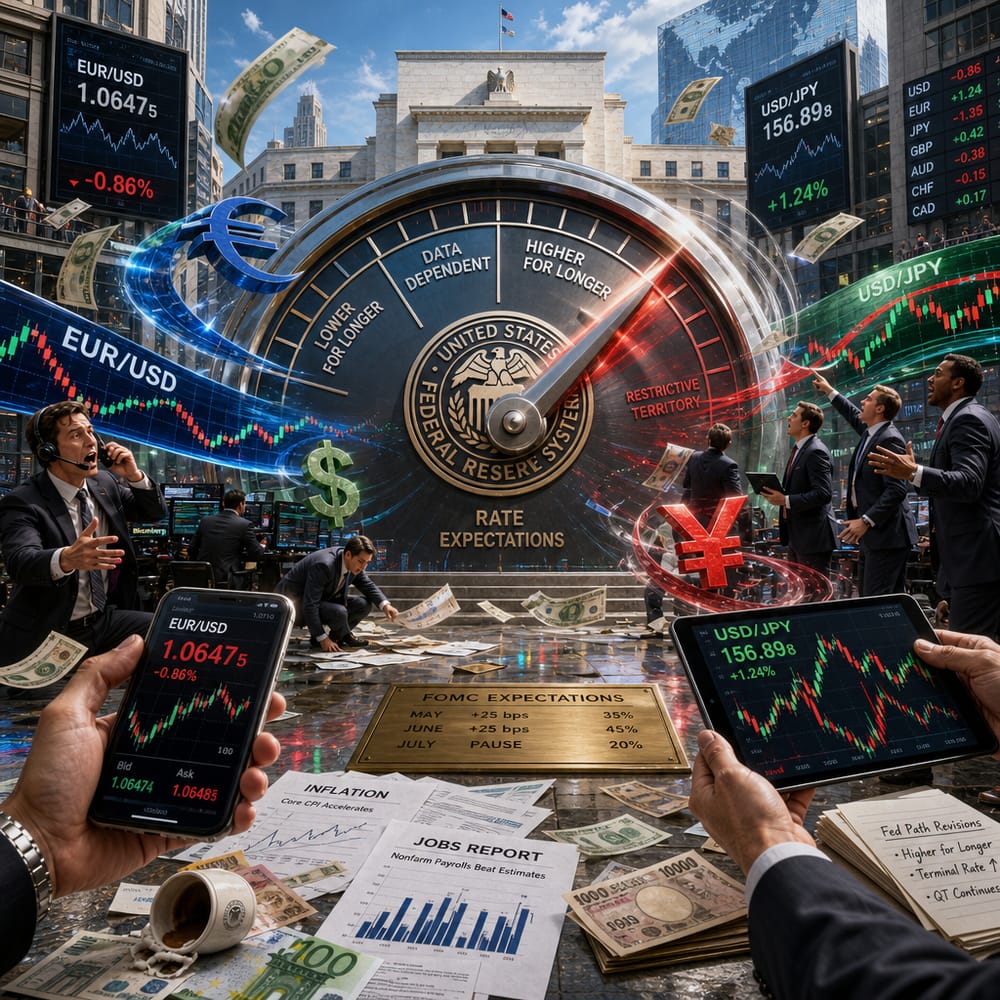
For those who don't keep a framed picture of Jerome Powell on their nightstands, let me translate: When the Fed talks rates, the currency markets listen. They listen intently, like a dog waiting for the word "walk." And with the recent recalibration of rate-hike expectations, forex pairs like EUR/USD and USD/JPY are dancing to the Fed's new tune.
HOW RATE EXPECTATIONS IMPACT CURRENCY PAIRS
So, what happens when the Fed hints at hiking rates? Think of the U.S. dollar as the popular kid in school. When the Fed suggests it might hike rates, it's like telling the school the popular kid just got a shiny new car. Everyone wants to hang out with him, and similarly, everyone wants to hold dollars. This demand typically pushes up the value of the greenback against other currencies.
The Euro and Yen, meanwhile, find themselves in quite the pickle. The EUR/USD pair struggles as the dollar flexes, causing the Euro to do the financial equivalent of a sad trombone. The same story plays out for USD/JPY; the Yen has about as much luck standing up to the dollar as a paper bag in a hurricane.
TRADING STRATEGIES IN LIGHT OF RECALIBRATED EXPECTATIONS
For savvy traders, recalibrated rate expectations are an opportunity dressed in market turmoil. It's time to roll up sleeves and rethink strategies. Are you a night owl watching the forex rollercoaster at 3 a.m.? Then you might want to swing trade—that is, hold positions for several days or weeks to capitalize on currency shifts. With the dollar on a vigorous jog upwards, shorting the Euro or Yen could be the play of the century.
But, if caffeine-fueled nights aren't your thing, consider dollar-cost averaging into forex ETFs. This strategy might save you from pulling out your hair when the market plays its favorite game of “Guess the Next Move.” Remember, it’s all about balancing risk and reward, much like eating tacos before a marathon.
FOREX MARKET VOLATILITY
Speaking of marathons, traders are in one now. As the Fed's whispers of rate hikes turn to shouts, the forex market becomes a dizzying carnival ride. Volatility doesn’t just haunt traders—it launches fireworks in their faces. But savvy investors know volatility isn’t a monster to fear; it’s a beast to tame.
With higher volatility, risk management becomes your trusty steed. Embrace adjustable stop losses. Diversify like you’re at a buffet full of exotic options. Don’t be the trader who overdoses on one currency and ends up with a stomachache. Play it smart: use forex options to hedge against the chaos, ensuring you don’t wake up to a portfolio that looks like it went twelve rounds with Mike Tyson.
THE BOTTOM LINE
So, what’s the takeaway, folks? The Fed’s recalibrated rate expectations are shaking up the forex market like a cocktail in a Bond film. Currency valuations are seeing wild fluctuations, impacting how traders and investors engage with these markets. Traders with a finger on the pulse—and an eye on risk management—could find this an opportune time to adjust strategies.
Currency trading isn't just about numbers; it's about reading the economic tea leaves and strategizing accordingly. Whether you're going short, diversifying, or packing up for a long-term play, remember: in the ever-spinning world of forex, adaptability is your best friend. Keep your eyes on the Fed, your wits about you, and maybe, just maybe, that forex volatility rollercoaster will turn out to be the ride of a lifetime.
This article is for informational purposes only and is not investment advice. Always do your own research or consult a licensed financial professional before making investment decisions.
© Copyright 2024. All Rights Reserved.
© Copyright 2024. All Rights Reserved.