

President Trump's AI Accord: A New Era of Self-Regulation
Wednesday, September 30, 2026
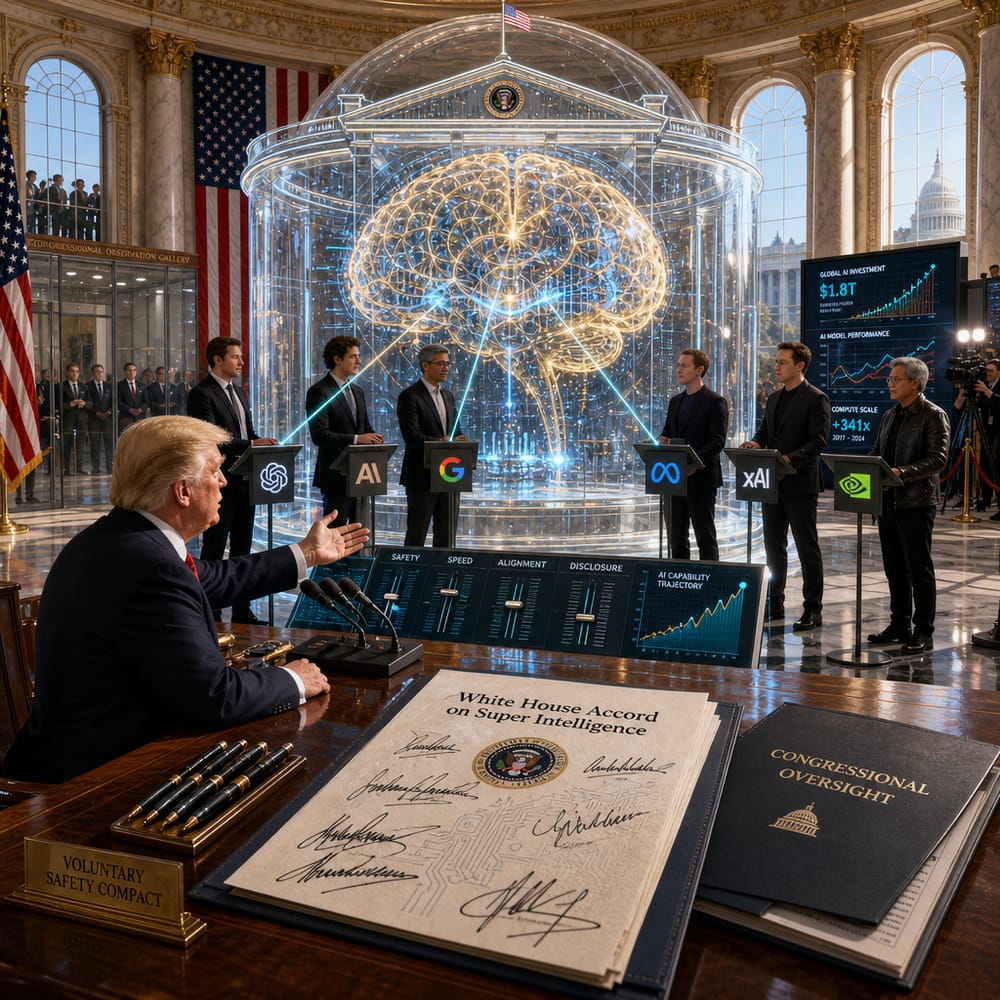
Move over, Aesop; the real fables worth telling these days are about artificial intelligence and self-regulation. Picture this: a room full of tech royalty, an extravagant White House backdrop, and a voluntary commitment that reads more like a gentle suggestion than a directive. That, my friends, sums up the latest development in the AI world — President Trump's "White House Accord on Super Intelligence."
This isn't your typical piece of legislation. Nope, this one's special. It's a voluntary compact aimed at keeping the tech heavyweights — the likes of Google, Meta, OpenAI, and a few other wizards of Silicon Valley — in check as they dabble with artificial intelligence. The goal? To self-police their own AI development and, in turn, potentially delay those pesky legislative oversight attempts that keep rearing their heads in Congress.
The storyline spins a compelling web: “Hey, we’ve got this. No need to worry about AI running amok,” say the tech giants. For investors, this move might sound like a dream wrapped in a stock option. Why? Because less regulatory fear often means smoother sailing on Wall Street. With the threat of stringent government oversight lessened, mega-cap tech stocks and cloud platforms could see a shinier forecast.
But here’s the burning question: Is self-regulation in the tech world the knight in shining armor it appears to be?
Let's take a stroll through the pros and cons. First, the good stuff. For tech companies, being in control of their destiny is, in essence, corporate nirvana. They can innovate without big brother breathing down their necks, reducing the uncertainty that comes with potential government crackdowns. And let's not forget the potential boost in investor confidence — a reduction in perceived regulatory risks could mean happier traders and smiling shareholders.
Now, let's flip the coin. The risk of self-regulation is as glaring as a neon sign in downtown Vegas. Critics argue that it's akin to letting the fox guard the henhouse. Without external checks, there's a slippery slope toward AI misuse or even downright negligence. After all, if history has taught us anything, it’s that unfettered corporate discretion doesn’t always pave the golden path.
And here’s a curveball: Could this set a global precedent? The U.S., with its laissez-faire approach, might just create a ripple effect. Other countries could eye this self-regulatory accord and think, “Why not give it a whirl?” On the geopolitical chessboard, this could shift the dynamics of AI governance worldwide.
Now, if you’re tracking key players in this unfolding drama — think names like Nvidia, Anthropic, Google, and xAI — their stocks are worth keeping an eye on. A relaxed regulatory landscape might just sprinkle a bit of fairy dust on their performance forecasts.
Yet, amid this regulatory see-saw, the AI sector's undercurrents remain steady. Companies like OpenAI are diving headfirst into the personal agent market, setting off a new digital gold rush. It's all about creating AI that can handle everything from booking your holidays to managing your emails. Meta's been riding this wave too, seeing its stock spike by 29% in September alone — talk about surfing the AI tide.
But let’s not jump the gun. While Wall Street might be all sunny skies right now, the storm clouds of public scrutiny could gather faster than you can say "algorithm." AI is, after all, the Frankenstein of this generation. Its potential to disrupt and redefine entire sectors is both its charm and its curse.
So, dear retail investors, keep your eyes peeled and your portfolios ready. The roads of AI and self-regulation are open, and they’re paved with both opportunity and uncertainty. The allure of tech stocks might be tempting, but remember to tread with the wisdom of experience and the vigilance of a hawk. In the fast-evolving AI saga, one thing’s for sure: the plot twists have only just begun.
This article is for informational purposes only and is not investment advice. Always do your own research or consult a licensed financial professional before making investment decisions.
© Copyright 2024. All Rights Reserved.
© Copyright 2024. All Rights Reserved.