

Potential Short-Squeeze in Russell 2000 Amid Bearish Positioning
Thursday, November 26, 2026
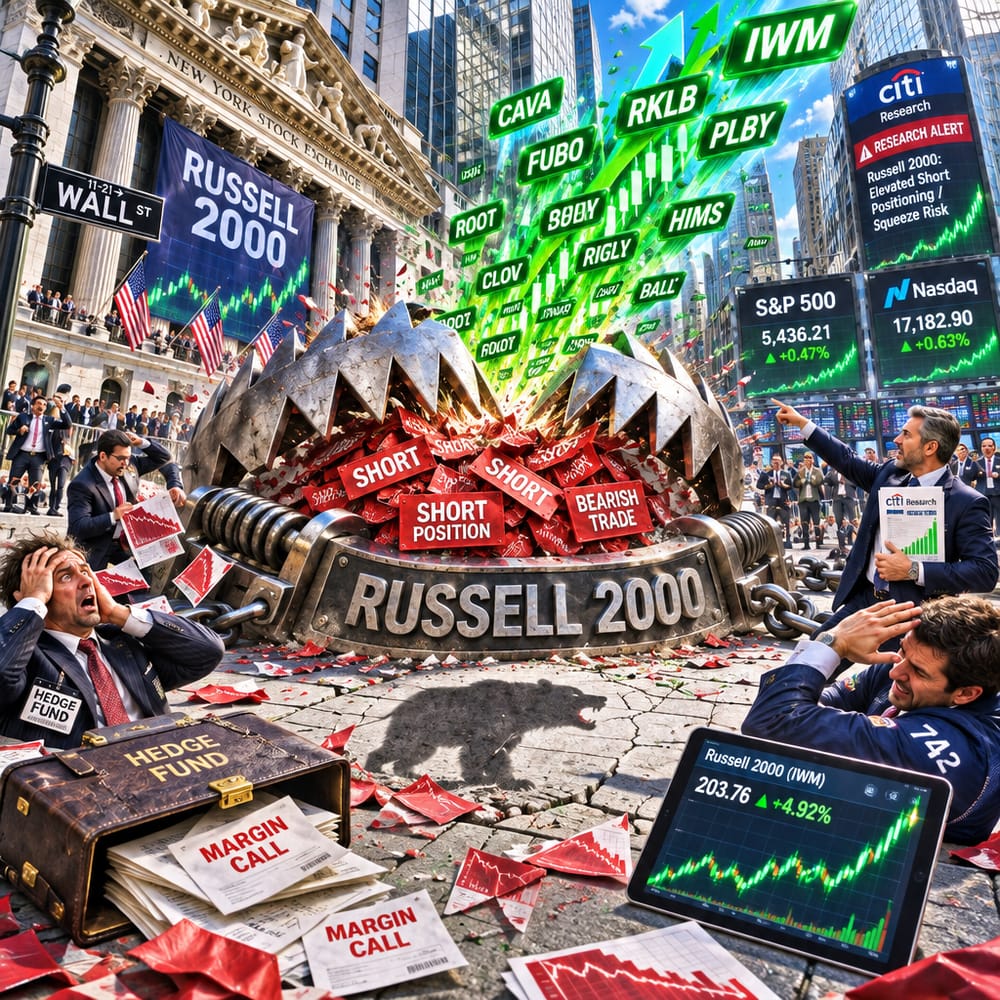
POTENTIAL SHORT-SQUEEZE IN RUSSELL 2000 AMID BEARISH POSITIONING
Hold onto your hats, folks, because Wall Street's about to get a little wild. Citigroup has thrown a curveball with its latest warning: the Russell 2000, that scrappy index of small-cap stocks, might just be gearing up for a short-squeeze extravaganza. If you're not familiar with the term, a short-squeeze is a trader's nightmare—or dream, depending on which side of the trade you're on. Essentially, it's a rapid price increase in a stock or index primarily due to short-sellers (betting on a price decline) being forced to buy back shares as the price rises, sending the price even higher. It's like a domino effect but with dollar signs.
So why are folks in a twist about this? Well, the Russell 2000 is currently home to some seriously elevated short positions. This is a polite way of saying that a lot of people are betting against these stocks, expecting them to fall. But if too many people bet on that same outcome, we might see a fast and furious reversal, where all those shorts suddenly have to flip and buy. Cue the fireworks.
Now, this isn't just a spectacle for the financially curious. There's a potential payday here for traders savvy enough to spot the opportunity. The Russell 2000 has been acting like a rebellious teenager lately, diverging from its larger siblings like the S&P 500 and Nasdaq. While these big boys have been playing it cool, small-caps have been getting the cold shoulder from investors, making them ripe for a surprise rally.
RISKS AND OPPORTUNITIES IN SMALL-CAP SHORT-SQUEEZE
So, what does this mean for you, the everyday investor? Picture this: if the short-squeeze hits, the Russell 2000 could see a rapid upward swing, and fast moves can mean big bucks. But hold on—this isn't just a get-rich-quick scenario. The risks are as real as the rewards. Timing is everything. Jump too soon, and you might find yourself on the wrong end of the squeeze.
For those eyeing the opportunity, now's the time to channel your inner detective. Look for the small-cap stocks with the highest short interest—these are the ones that might pop first in a squeeze. But remember, the markets are fickle, and what goes up in a frenzy can just as easily come crashing down once the dust settles.
THE SENTIMENT GAP: SMALL-CAPS VS. LARGE-CAPS
There's also an intriguing psychological game at play. Investor sentiment is like fashion—what's in today might be out tomorrow. Currently, small-caps aren't exactly the belles of the ball. They're considered riskier than large-caps, which are the cherished darlings of cautious investors. The S&P 500 and Nasdaq are viewed as safer havens, blessed with the clout of mega-corporations like Apple, Microsoft, and Amazon.
But here's the twist: as the sentiment pendulum swings, small-caps could become the next darlings if they start to rally. When investor confidence shifts, it can create a chain reaction where everyone wants a piece of the action, further inflating prices and reinforcing the squeeze.
This divergence in sentiment presents a classic case of underdog volatility versus the stable juggernauts of the investment world. It's a story as old as time—David and Goliath, but with stock charts.
WHAT THIS MEANS FOR YOUR PORTFOLIO
If you're thinking of diving into this potentially turbulent sea, make sure your life vest is on. Diversification is key. Consider balancing any new small-cap positions with more stable large-cap holdings to weather the waves. And keep a close eye on market indicators—bearish sentiment and high short interest can signal potential squeezes, but they're risky footholds.
Ultimately, the potential short-squeeze in the Russell 2000 is a reminder of the ever-evolving landscape of market sentiment. It's a lesson in the power of perception, the importance of timing, and the value of keeping a close watch on the undercurrents that can turn the market tide in an instant.
So, as you scroll through your financial news feed, sipping your morning coffee, remember: in the world of investing, surprises can come out of nowhere. And sometimes, it’s the smallest caps that pack the biggest punch.
This article is for informational purposes only and is not investment advice. Always do your own research or consult a licensed financial professional before making investment decisions.
© Copyright 2024. All Rights Reserved.
© Copyright 2024. All Rights Reserved.