

Positioning Snapshot: Dollar Sentiment Extremes While Commodity FX Diverges
Tuesday, August 11, 2026
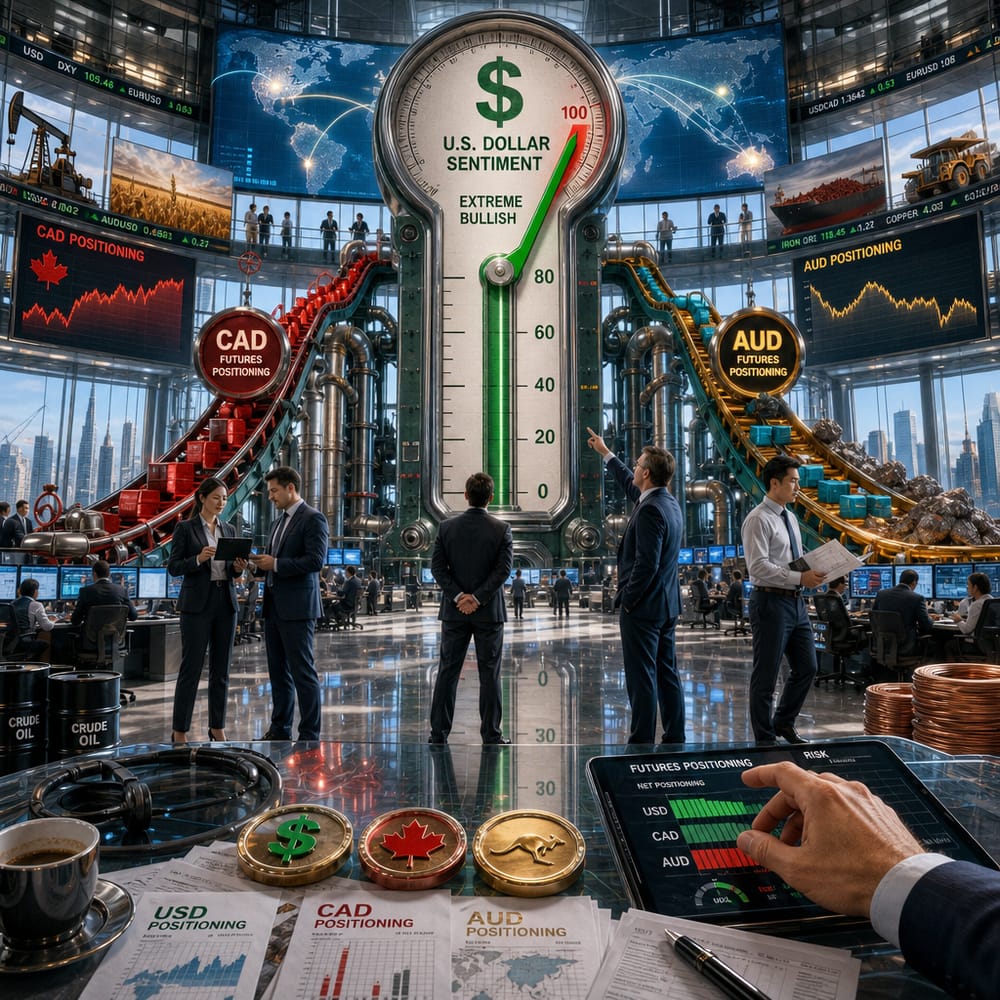
THE DOLLAR DRAMA: A TALE OF EXTREMES AND CONTRADICTIONS
If currencies could speak, the U.S. dollar might be on the verge of yelling, “Plot twist!” As if the dollar's life were a soap opera, it's inching toward sentiment extremes, standing at the cliff's edge of unpredictability. Meanwhile, up north and down under, the Canadian dollar (CAD) and the Australian dollar (AUD) are writing their own stories, diverging wildly in their futures positioning. So, what gives?
Welcome to the grand stage of global finance, where the U.S. dollar is the prima donna, commanding attention and inspiring strong opinions. Currently, the market's chatter has elevated that sentiment to one of extreme optimism. You can almost hear the cheers: "Go, greenback, go!" But seasoned market players know that extreme sentiment often precedes a plot twist — a potential reversal.
Let’s break it down: Why is the dollar behaving like an over-caffeinated stock trader? For starters, it’s soaking in the glow of its status as the world’s reserve currency, bolstered by global economic uncertainties. With geopolitical rumblings — hello, U.S.-Iran peace talks — and shifts in global power dynamics, investors often seek solace in the dollar’s stability. But as any good party host can tell you, too much excitement can lead to a hangover. When sentiment hits an extreme, any hiccup, like a sudden interest rate tweak or a less-than-stellar economic report, could send the dollar stumbling down the stairs.
Meanwhile, the commodities corner is hosting its own drama. Our buddies, the Canadian and Australian dollars, are sipping different cocktails and eyeing different horizons. The CAD, closely tied to oil, is taking a cautious step forward, influenced by more stable crude oil prices. It’s like wearing a life jacket in a swimming pool — just in case. The AUD, on the other hand, is channeling its inner wild child, more influenced by China’s unpredictable economic maneuvers and its own commodity exports.
So, how might these divergent paths play out? It’s all about the global economic weather. If commodity prices rise, driven by global demand or geopolitical tensions, the CAD and AUD might just throw a celebratory barbecue. Conversely, if global growth stumbles, these currencies might find themselves at the mercy of market mood swings.
Yet, there's more to this plot. Consider the speculative flows across major FX pairs — the behind-the-scenes market maneuvers that could tip the scales. Institutional investors, the FX market’s puppet masters, are keenly watching for any cracks in the dollar’s armor. A hint of weakness, and they might shift their bets, turning the dollar’s sentiment story on its head.
A potential trigger for change in dollar sentiment could be central bank decisions. If the Federal Reserve hints at pausing rate hikes or adjusting its monetary policy, the dollar might drop its bravado. And let’s not ignore the ripple effects of geopolitical peace talks — any progress could reduce the flight-to-safety demand for the dollar.
As for our commodity-loving currencies, they're keeping a watchful eye on global trade dynamics. A stronger global economy might see these currencies soaring, while trade tensions or slowing demand could have them singing the blues.
In a world where economic narratives are as volatile as a high school romance, understanding these positioning trends is like having a crystal ball — imperfect, but incredibly insightful. Retail investors, this is your cheat sheet to currency drama. It’s less about predicting the exact plot twist and more about being ready when the story shifts.
So here’s the takeaway: The dollar’s riding high but with risks looming, and commodity currencies are on divergent paths, ready to react to global cues. Keep your eyes peeled on market moves, central bank whispers, and geopolitical developments. Because in the grand opera of finance, the stars of this show are just warming up for their next act.
This article is for informational purposes only and is not investment advice. Always do your own research or consult a licensed financial professional before making investment decisions.
© Copyright 2024. All Rights Reserved.
© Copyright 2024. All Rights Reserved.