

Persistent Risk-Off Sentiment as Yields Touch 2007 Highs
Wednesday, September 30, 2026
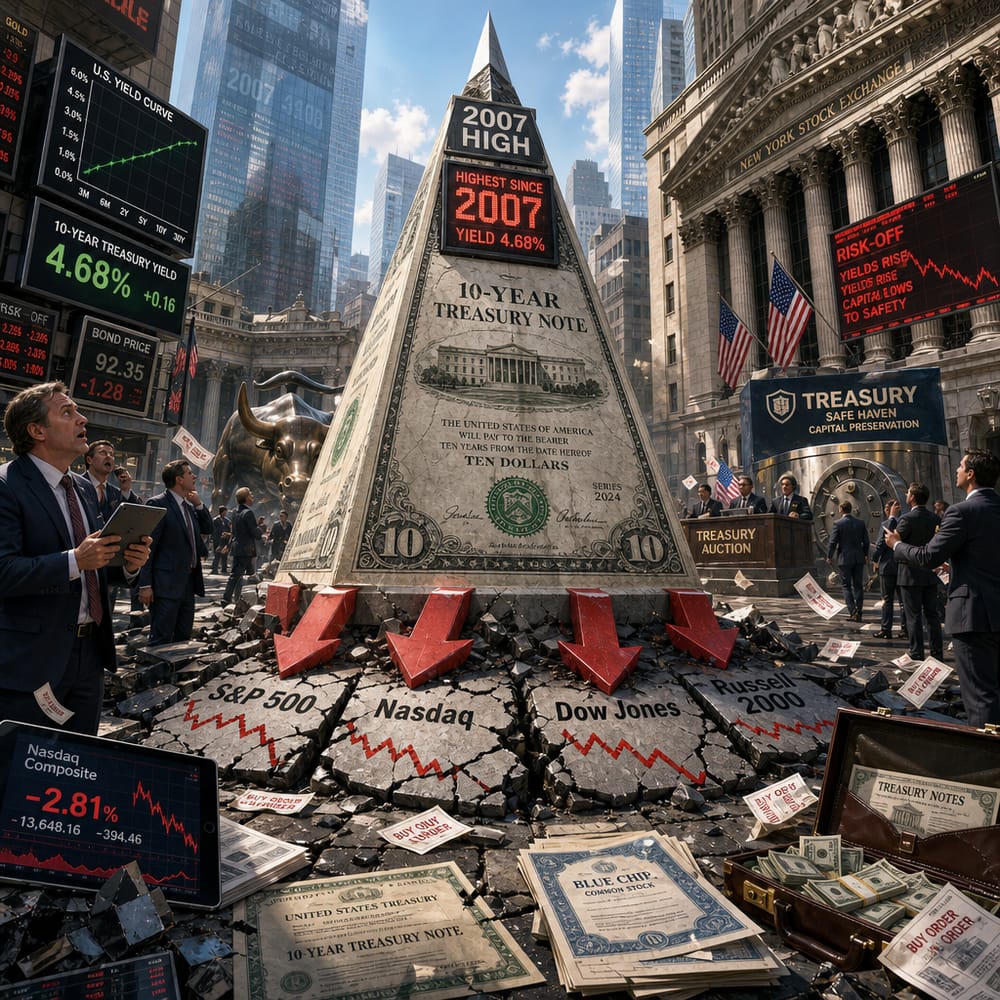
THE RISK-OFF RUMBLE: WHY RISING YIELDS ARE MAKING INVESTORS NERVOUS
Remember the year 2007? The iPhone had just hit the scene, everyone was obsessed with MySpace, and the 10-year Treasury yield was scaring people silly. Fast forward to today, and the yield on the 10-year Treasury has once again hit levels we haven’t seen since those heyday days of yore. Investors are huddling under the risk-off umbrella, and market indices are feeling the drizzle. Here's why this matters and what you should keep in mind.
Now, you might be scratching your head, wondering what all this hoopla about Treasury yields and risk-off sentiment really means. Don't worry, I've got you covered. Let's break it down.
First, a little bond primer. The 10-year Treasury yield is the interest rate the U.S. government pays to borrow money for 10 years. It's a big deal because it sets the bar for rates on everything from mortgages to corporate loans. When these yields rise, borrowing costs climb right after them, and that's where things start to get interesting.
Yields at 2007 levels signal that borrowing is going to get pricier. For companies, this translates into higher costs to fund their growth. Picture a CEO rubbing their temples, trying to figure out how to finance that state-of-the-art factory or revolutionary tech development without breaking the bank. Expensive borrowing often means ditching those grand plans or scaling them down, which can slow economic growth and, you guessed it, spook investors.
For equity markets, high yields are like garlic to a vampire. Rising yields typically compete with stocks for investor attention. Why gamble on the volatility of the stock market when you can earn a solid return from a "risk-free" government bond? This shift in investor preferences can lead to sell-offs across major indices like the S&P 500, Nasdaq, and Dow. They’re all feeling the pinch as investors scramble to lock in those juicier yields.
Let's not forget about the small guys. The Russell 2000, which tracks smaller-cap stocks, is particularly vulnerable. These companies are often more sensitive to changes in borrowing costs because they rely more heavily on debt to fuel their growth. Imagine a scrappy startup that's been living off credit — rising yields can feel like a punch to the gut, as their cost of debt just got more expensive. Investors seeing this tremble on the horizon may decide it's time to step back from the riskier small-cap territory.
So, what should you, the savvy retail investor, be thinking about all this? For starters, consider the implications of those rising yields. It's not just about interest rates going up; it's about confidence going down. Higher yields can be a red flag for economic uncertainty, hinting that the road ahead may be bumpy. This can prompt a broader reassessment of what we’re willing to pay for stocks, squeezing valuations as investors demand a higher return for taking on more perceived risk.
While yields have taken a breather following some softer-than-expected inflation data, the overarching trend is up. The Fed's preferred inflation gauge showed core inflation at 3.0% in August, suggesting things aren't as fiery as some feared. But don't let a little bit of cooling inflation lead you to toss your sweater — the economic landscape remains uncertain.
If you're a stock market aficionado, consider how rising yields might reset the playing field. Look for companies with strong balance sheets — those that won’t be sweating bullets over refinancing debts. And keep an eye on sectors that might feel the pinch harder, like tech, which is often driven by growth narratives and can be particularly sensitive to rate hikes.
The bottom line? While the 10-year Treasury yield’s flirtation with 2007 levels may be sending shivers down Wall Street's spine, it's also a call to action. This is not the time to bury your head in the sand. Keep an eye on the data, watch how companies react, and don’t forget that, in every upheaval, there’s opportunity — if you know where to look.
This article is for informational purposes only and is not investment advice. Always do your own research or consult a licensed financial professional before making investment decisions.
© Copyright 2024. All Rights Reserved.
© Copyright 2024. All Rights Reserved.