

Persistent Dollar Softness Into Jackson Hole
Saturday, August 22, 2026
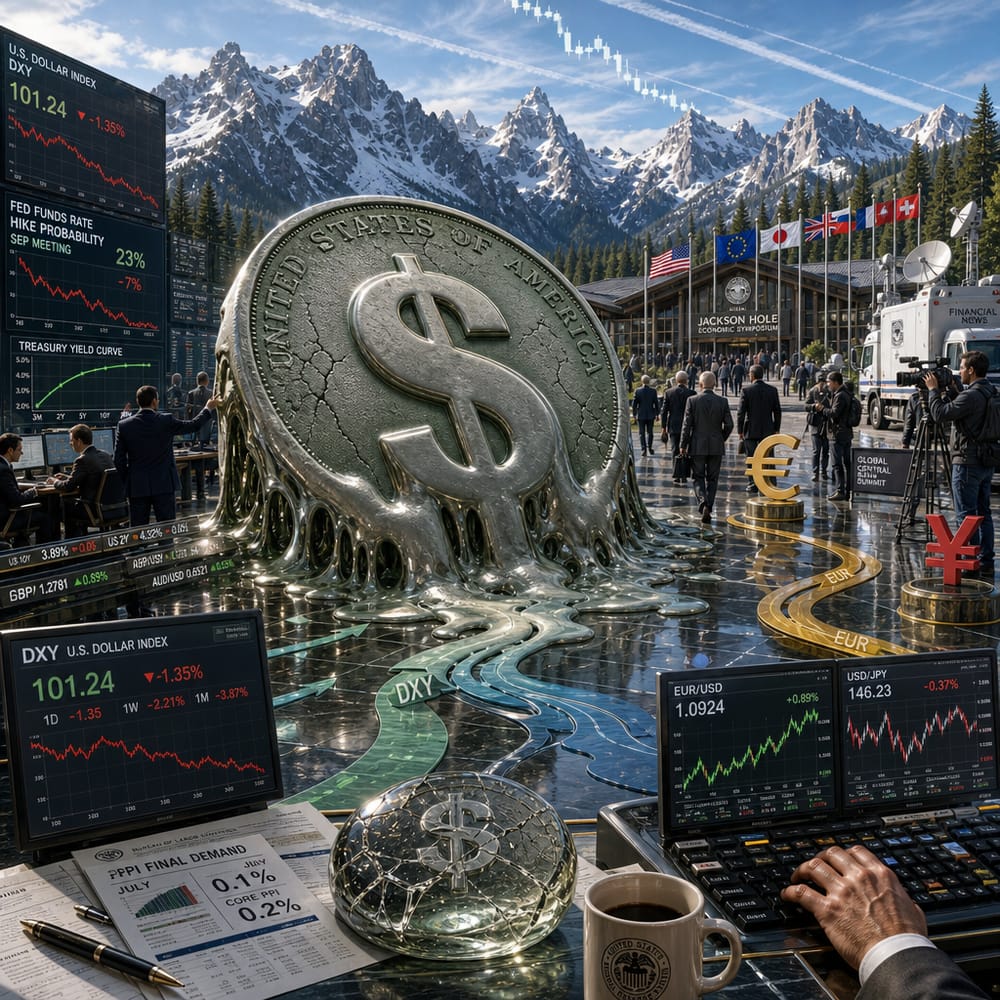
JACKSON HOLE AND THE DOLLAR DANCE: WHY SOFTNESS IS THE NEW STRONG
The U.S. dollar might be putting on its best Luke Skywalker impression right now, wandering around looking a little lost and uncertain. All eyes are on the Federal Reserve and their upcoming meeting at Jackson Hole — the financial world's equivalent of the Jedi Council. But instead of lightsabers, they're wielding interest rates.
So what’s got the dollar doing the cha-cha with the euro and yen, rather than its usual solo tango of strength? Well, let's dive into the juicy details.
A few days back, producer price index (PPI) data waltzed onto the scene, and it was softer than a marshmallow left out in the sun. Why does that matter? Lower-than-expected PPI suggests inflation isn’t galloping away like an untrained racehorse, which in turn makes a Fed rate hike seem as likely as my cat winning a chess tournament.
When interest rates rise, so does the dollar. Investors flock to U.S. assets for higher returns, like bees to honey. But if the rates stay put or even drop, as the recent PPI results suggest might happen, the dollar has less gravitational pull. Instead, it floats gently downstream, much like that leaf you put in your Instagram story last fall.
This dollar softness is affecting global currency exchanges like a splash of cold water on sleepy faces. For investors glued to the forex markets, it’s essential to know that a weaker dollar means imports cost more, but exports get more competitive. This is why investors play the guessing game: will the Fed give us an encore of rate hikes this year, or will they let us down easy like a bad prom date?
For those of you tracking the numbers: the U.S. Dollar Index (DXY), the benchmark that measures the dollar against a basket of other currencies, has been feeling a little woozy. Meanwhile, the EUR/USD and USD/JPY are dancing around like they’re at a middle school sock hop. These currency pairs are like the barometers in a financial storm, showing investors how mighty or meek the dollar is feeling on any given day.
But let’s talk implications. A softer dollar doesn’t just mean your European vacation might cost a smidge more this year. Its movements ripple through the globe, affecting everything from trade balances to multinational company profits. A weaker dollar often means cheaper American goods abroad, potentially boosting companies like Boeing or Apple who sell their wares in euros or yen. Conversely, it makes imported cars, electronics, and even that bottle of French wine pricier for folks stateside.
Now, before you start worrying that the U.S. economy is going to tip over like a poorly designed Jenga tower, remember: a softer dollar isn’t just a curse. It’s also an opportunity. For emerging markets that have debts in dollars, a little currency relief lets them catch their breath. It also gives U.S. manufacturers a competitive edge abroad. In short, it’s all about perspective.
The upcoming Jackson Hole meeting is the next big episode in this financial drama. Will we see plot twists and cliffhangers, or just a soothing lullaby of “no changes here, folks”? Investors around the world are tuned in, awaiting any hint from the Fed about where interest rates might head next. Because as the rates go, so goes the dollar, and as the dollar goes, so goes a chunk of the world’s economic fate.
So, whether you're a forex trader, an international business owner, or just someone who likes to keep tabs on the dollar’s escapades, remember: the story’s far from over. The Fed’s decisions will continue to guide the dollar’s journey, and with it, the financial stability of economies worldwide.
In the meantime, keep your eyes on the DXY, your ears open for Fed whispers, and maybe, just maybe, consider that trip to Europe before the dollar decides to beef up again. After all, in the world of finance, timing is everything. And who knows? By the time you’re sipping espresso in a Parisian café, the dollar might just be back to its muscle-bound self, ready to take on the world once more.
This article is for informational purposes only and is not investment advice. Always do your own research or consult a licensed financial professional before making investment decisions.
© Copyright 2024. All Rights Reserved.
© Copyright 2024. All Rights Reserved.