

OpenAI Revenue Revisions and the AI Sell-Off
Saturday, October 10, 2026
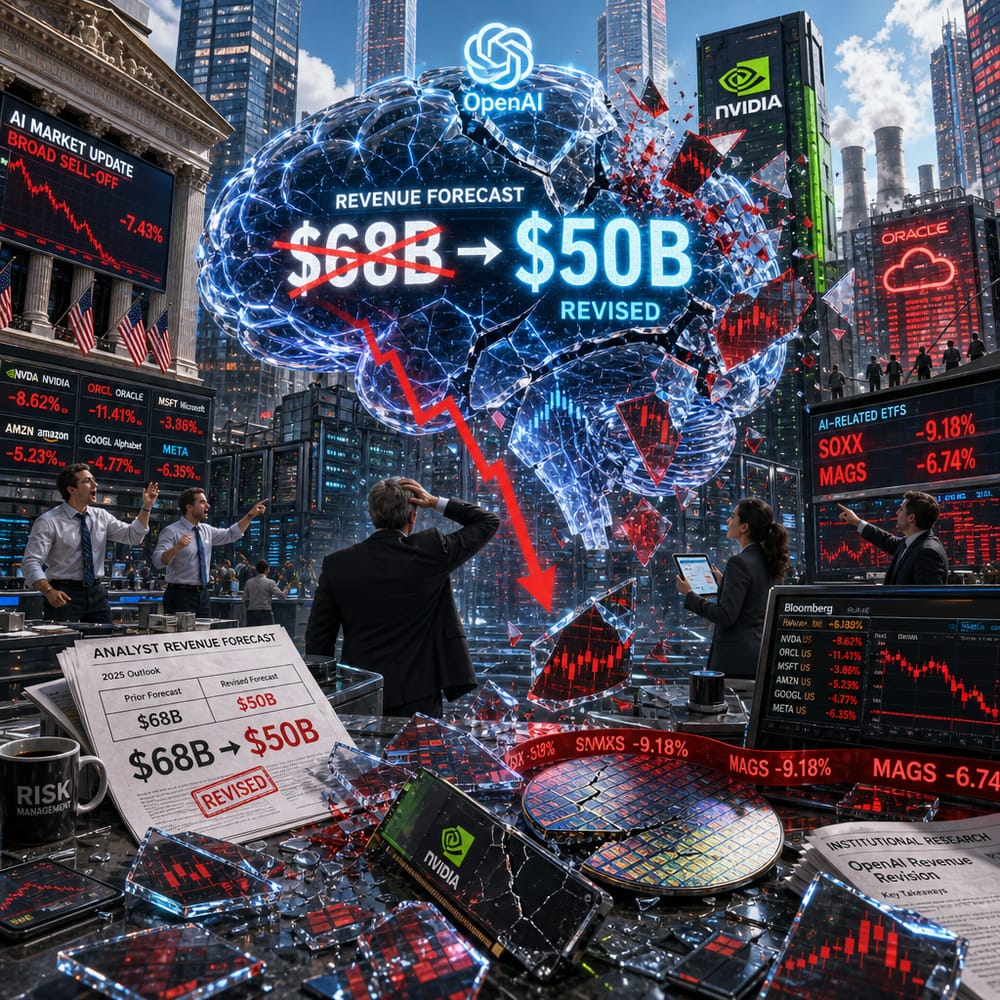
OPENAI'S REVENUE REVISION ROCKS THE AI MARKET
When a tech giant like OpenAI sneezes, the rest of the AI world catches a cold—and that's putting it lightly. Last week, OpenAI revised its projected revenue from a jaw-dropping $68 billion to a more modest $50 billion, and the ripples have turned into waves, sending AI-linked stocks into a nosedive. Investors are scrambling, megacaps are wobbling, and chipmakers are clutching their wallets. So, what on earth just happened?
First things first, what triggered OpenAI’s revenue revision? Word on Wall Street is that the initial $68 billion estimate was fueled by sky-high expectations and a little too much of that Silicon Valley optimism. Maybe they overestimated the appetite for AI-powered everything, or perhaps they hit a speed bump with product rollouts. Whatever the reason, it's a classic case of tech expectations running hotter than a mid-summer sidewalk.
OpenAI's adjustment wasn’t just a number on a piece of paper—it was a catalyst for chaos. Investors reacted like cats in a room full of rocking chairs. The shockwave hit mega-cap tech stocks first, with companies like Nvidia feeling the burn. Nvidia, famed for powering AI's muscle with its chips, found itself in a financial sauna, as stocks took a dive. Its role as the poster child for AI hardware made it especially vulnerable to jittery investor sentiment.
The semiconductor sector, represented by ETFs like the iShares Semiconductor ETF (SOXX), wasn’t spared either. Chips may be the brains behind our smart gadgets, but investors suddenly felt like they'd been short-circuited. The sell-off underscored the precarious balance these sectors walk between boom and bust based on AI's fortunes.
But let’s not just stick with the tech titans—this is a family affair. Oracle, whose cloud services are the backbone for many AI applications, also found its stock in a downward dog position. Investors seemed to question if the AI cloud is a little more smoke than substance.
It's a tough pill to swallow, especially for those who piled into AI-focused funds like the Roundhill Magnificent Seven ETF (MAGS), banking on the next big leap in AI. The revision has put a question mark on whether the AI sector was overinflated, like a bubble-blowing contest gone wrong.
So, what does this mean for future AI investments? Well, it's no longer a tech gold rush where you can just throw a dart at anything AI-related and watch the returns roll in. Investors might need to put on their detective hats and scrutinize each AI play individually. Understand the business model, the revenue streams, and the real-world applications—because pouring money into AI just got a lot more nuanced.
The volatility we've seen highlights AI's current dilemma: tremendous potential tangled up with equally monumental uncertainty. Have investors been on an AI sugar high? Possibly. But let's not forget that this isn't AI’s first rodeo. Any seasoned investor knows tech revolutions come with growing pains. Remember the dot-com bubble? It was a wild ride, but look where the internet is now.
Yet, the larger question looms: Is this a temporary pullback or the beginning of a larger recalibration? For anyone with skin in the AI game, these are the questions lingering late at night. Is it time to buy the dip or brace for further tremors?
In investing, as in life, fortune favors the bold—but also the well-informed. If you’re still keen on AI, this might be your moment to sift through the rubble for hidden gems. And for those sitting on the sidelines, waiting for the smoke to clear might be the safest bet.
Ultimately, OpenAI's revenue revision has thrown a cold bucket of reality on the red-hot AI market, forcing everyone to reassess what's priced into their AI dreams. Whether this recalibration proves to be a minor adjustment or a dramatic reset remains to be seen. In the meantime, keep your eyes peeled and your portfolios prepared—because in the world of AI, the only constant is change.
This article is for informational purposes only and is not investment advice. Always do your own research or consult a licensed financial professional before making investment decisions.
© Copyright 2024. All Rights Reserved.
© Copyright 2024. All Rights Reserved.