

On-Chain Metrics: Difficulty Adjustment, Miners’ Revenue & Hashrate Trends Through August
Saturday, August 15, 2026
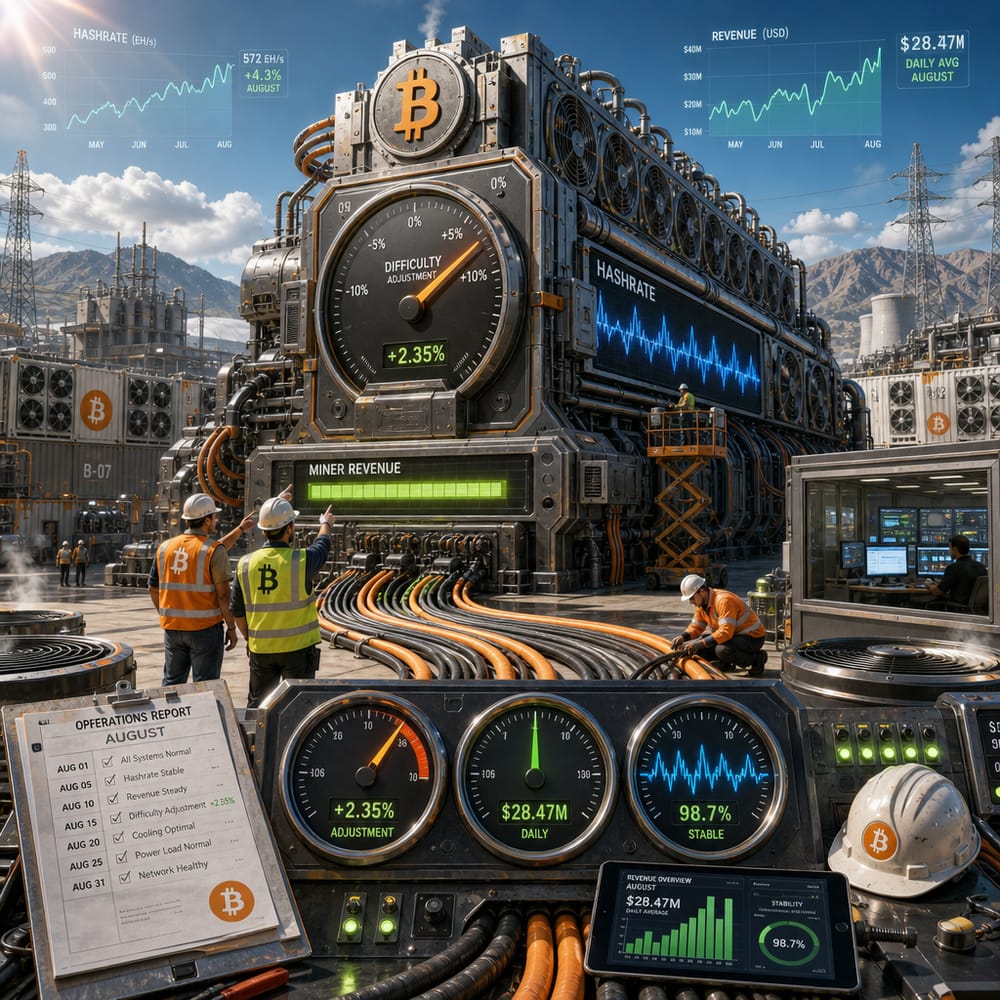
IF YOU WANT TO UNDERSTAND BITCOIN, LOOK AT THE MINERS
If the Bitcoin network were a rock band, its miners would be the drummers — keeping the beat alive in the background while everyone else is focused on the superstar vocalist, Bitcoin's price. But if you're smart — and I know you are — you'll pay attention to those drummers and the rhythm of the network. Because when it comes to cryptocurrency, understanding the beat can make you money.
Enter the latest on-chain metrics, our backstage pass to what’s really happening with Bitcoin. Recent data shows a slight uptick in mining difficulty, miner revenues holding steady, and the hashrate — a fancy way of saying the total computing power being used to mine and process transactions — cruising along like a steady drumroll. But why should you care about these arcane details if you're not in the mining business? Because they tell you a lot about Bitcoin's health, its decentralization, and where the price might be headed.
UNDERSTANDING THE MINING MAESTRO
First up, let's talk about mining difficulty. In simple terms, this is how hard Bitcoin's network is working to mine new blocks. A slight increase in difficulty means that the network is becoming more secure. Why? Because it takes more computational power to solve those cryptographic puzzles that result in new Bitcoin being minted. This keeps bad actors at bay and the network secure. It's like adding more security checkpoints at a concert — it might slow down entry, but it ensures everyone inside is legit.
Now, let's riff on miner revenue. Despite the increase in mining difficulty, miner revenues are holding steady. This is crucial because it signals the economics of mining are still attractive. Miners are covering their costs and keeping some profit, which means they won’t be exiting the stage anytime soon. If miner revenues were dropping, we’d be hearing loud alarm bells. It would be like a band losing its drummer mid-tour — chaotic and problematic.
A steady hashrate is also a good sign. It indicates that miners aren't fleeing the network. Instead, they're doubling down, adding more machines and power to the network's symphony. A rock-solid hashrate means there's decentralization since a diverse group of miners is participating. This keeps any single actor or group from taking over, akin to ensuring no band member overshadows the entire ensemble.
MINER PROFITABILITY AND NETWORK SECURITY
But let’s get to the heart of why these stats matter to you, the investor. If miner profitability stays strong, it means the network is secure, and confidence in Bitcoin remains high. No one wants to invest in a collapsing house of cards, right? On the flipside, if miner profits were to dwindle, it might lead miners to shut down operations, weakening the network's security and shaking confidence.
When it comes to decentralization, more miners mean a more resilient network. It's like having a diverse lineup of artists at a music festival. If one act cancels, the show goes on. So, a high hashrate and stable miner revenues are your indicators of a steady and decentralized network, both essential for Bitcoin's long-term success.
THE RIPPLE EFFECT: PRICE MOVEMENTS
Now, let's talk returns. While these metrics don't tell you directly if Bitcoin's price will go up or down, they do help create an investment thesis. If miners are sticking around and the network is secure, it's a good sign for Bitcoin's future. Investors tend to feel warmer and fuzzier about assets that don't keep them up at night.
In practical terms, higher mining difficulty and a stable hashrate can signal potential upward momentum in Bitcoin prices. If the network is thriving, it's usually a precursor to increased investor confidence, which can drive price appreciation. But remember, Bitcoin is as unpredictable as a rock star’s antics, so don't invest your life savings based on one metric alone.
BOTTOM LINE: FOLLOW THE BEAT
To sum up, these on-chain metrics are like your backstage all-access pass to understanding Bitcoin’s current state. Mining difficulty, miner revenues, and the hashrate offer insights into the network's security, decentralization, and potential future price movements. They’re your signals in the noise, your beat to follow in the cryptocurrency cacophony.
So next time you're considering an investment or simply watching the price rollercoaster, think about the drummers — the miners — and the rhythm they keep. It might just give you the edge you need in your next crypto move. Keep listening, stay informed, and remember: in the world of Bitcoin, knowledge is power, and forewarned is forearmed.
This article is for informational purposes only and is not investment advice. Always do your own research or consult a licensed financial professional before making investment decisions.
© Copyright 2024. All Rights Reserved.
© Copyright 2024. All Rights Reserved.