

Nvidia’s Epic Evolution: From Gaming Roots to AI Empire
Monday, June 23, 2025
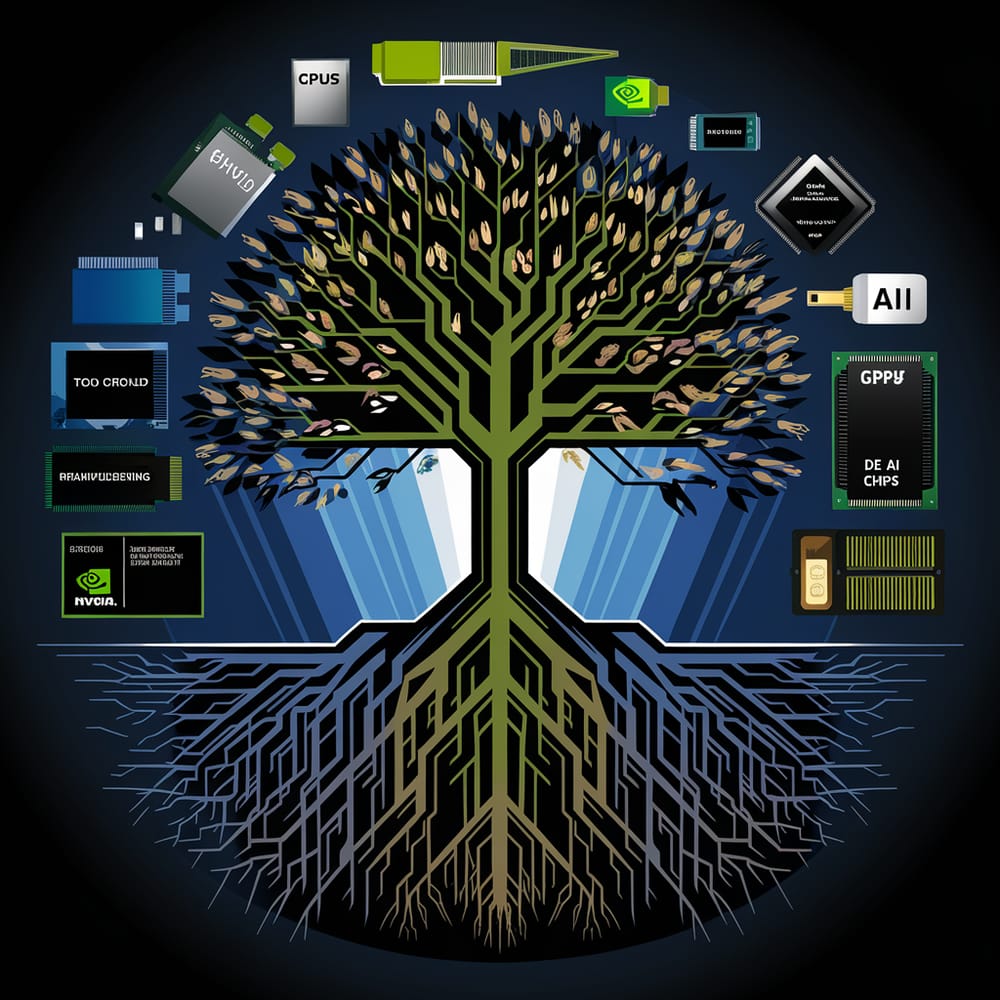
What started in 1993 as a scrappy startup on the verge of collapse is now the crown jewel of global tech. Nvidia has transformed from a niche graphics card designer into a $3.6 trillion behemoth powering everything from video games to the AI revolution—and it's just getting started.
The Almost-Failure That Sparked a Tech Titan
Nvidia’s early years were rocky. Its first chip, the NV1, flopped. Sega pulled out of a key partnership. Half the staff was laid off. Internally, they had a running motto: “We’re 30 days from going out of business.” And yet, a $5 million investment from Sega kept them alive—just long enough to deliver their breakout hit, the RIVA 128, in 1997.
Then came GeForce 256 in 1999—the chip that coined the term “GPU” and changed the game by enabling parallel processing. This technology didn’t just make video games prettier; it unlocked massive computing power, laying the groundwork for the AI future to come.
A Bold Bet Called CUDA
In 2006, Nvidia launched CUDA, a platform that let developers use GPU power for more than just graphics. For years, Wall Street shrugged, as CUDA lacked clear commercial payoff. But behind the scenes, Nvidia was investing billions. That long game paid off in 2012, when two students trained a groundbreaking neural network—AlexNet—on Nvidia GPUs. Suddenly, the world saw GPUs not just as gaming gear, but as AI accelerators.
AI Goes Mainstream—and Nvidia Rides the Wave
By 2016, Nvidia doubled down with the DGX-1, its first AI supercomputer. It became the backbone for major players like Microsoft, Google, and Amazon, and especially OpenAI, which used Nvidia chips to build ChatGPT. As generative AI went viral, Nvidia’s chips became the most sought-after components in tech.
With each quarterly earnings report, Nvidia broke new records. In early 2024, it posted the largest single-day market cap gain in history—twice. Its AI-focused Blackwell chip line crushed expectations, and the company’s 10-for-1 stock split only fueled the rally. By mid-2024, Nvidia had surpassed both Apple and Microsoft to become the world’s most valuable company.
Setbacks, Stock Splits, and Silicon Dominance
Of course, it wasn’t all smooth. Legal battles, chip shortages, and export bans—like the 2025 block on its H20 chip to China—have challenged Nvidia. But the company has kept innovating. Its newer Blackwell Ultra chip debuted with 1.5x the performance of its predecessor. And despite losing $589 billion in market cap in one day after a Chinese rival’s low-cost AI model announcement, Nvidia bounced back, signaling its resilience.
From Destiny to $4 Trillion?
Nvidia’s market cap sits around $3.6 trillion, and some analysts believe it could be the first company to reach $4 trillion. It’s not just a chipmaker anymore—it's a cornerstone of the AI infrastructure boom, playing a pivotal role in projects like Trump’s $500B Project Stargate.
CEO Jensen Huang says it best: “It’s destiny meets serendipity.” What looked like a video card company has become the engine room of modern computing—and maybe the future of everything.
© Copyright 2024. All Rights Reserved.
© Copyright 2024. All Rights Reserved.