

Nvidia Below $200: Is the AI Bellwether Losing Momentum?
Friday, June 26, 2026
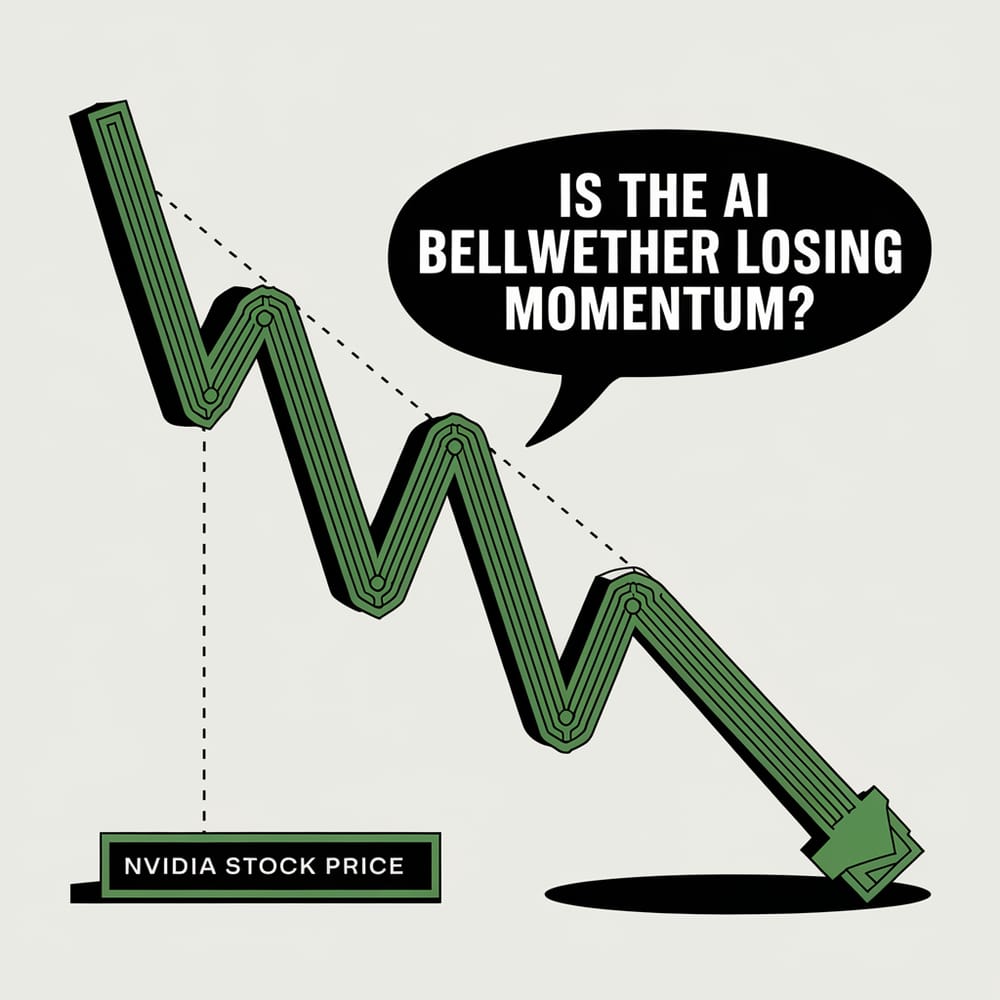
The ultimate market leader that was supposed to usher in an endless era of generative AI dominance has hit a sudden wall. Heading into late June, Nvidia's drop below the critical $200 threshold sent shockwaves through the semiconductor ecosystem, pulling down peers like AMD and Broadcom alongside it. For a stock that had functioned as a one-way escalator of tech prosperity, it has been a sobering reality check.
The scale of the retreat
The numbers are striking. Nvidia’s slip under the psychological $200 level marks a sharp correction from its recent 52-week high of $236.54, pulling its massive multi-trillion-dollar market capitalization under near-term pressure. The broader semiconductor landscape has shared the pain, with the VanEck Semiconductor ETF (SMH) and iShares Semiconductor ETF (SOXX) sliding in lockstep as institutional managers aggressive trim exposure. When the main engine of global market liquidity breaks a vital round-number floor, it threatens to stall the momentum of the entire technology sector.
The technical break left an immediate mark on the chip aisle. Nvidia slid toward the $194 level, registering a multi-day decline that rapidly eroded near-term bullish momentum. The velocity of the drop forced secondary AI server and data-center component plays like Broadcom and AMD to trade heavily into the red as well. It served as a stark reminder that extreme concentration in a single structural bellwether can amplify volatility in both directions, fueling exponential upswings when money aggregates and deepening sector-wide pain when the tide goes out.
Why investors are pulling back
Crucially, Nvidia’s current weakness is entirely valuation-driven, not demand-driven. The underlying appetite for high-performance AI servers and specialized data-center silicon remains historic. Instead, investors are grappling with near-term multiple compression. Fears have mounted over component supply constraints, particularly regarding skyrocketing high-bandwidth memory (HBM) costs, which threaten to ripple through hardware margins. Combined with circulating rumors that OpenAI may delay its blockbuster public listing until 2027, institutional asset managers have found the perfect macro excuse to lock in astronomical year-to-date profits and rotate capital away from extreme growth multiples.
Signs of stabilization
It is not all one-directional downside. Even as Nvidia's share price endures short-term technical damage, the foundational pillars of the AI trade remain fully intact. Capital expenditure (capex) budgets from mega-cap cloud hyperscalers—including Microsoft, Alphabet, Meta, and Amazon—continue to scale aggressively, with billions dedicated directly to securing Nvidia's Blackwell architecture. Furthermore, institutional "dip-buyers" are actively looking to defend intermediate support zones between $190 and $195, treating the valuation cooldown as a healthy, long-awaited entry window rather than the structural demise of the technology.
What it means for AI investors
The episode underscores a key truth: even the most powerful secular growth stories are eventually bound to technical cycles and valuation gravity. Up until now, the chip sector traded almost exclusively on future promise and unconstrained upside. Moving forward, a definitive trend reversal will require Nvidia to confidently reclaim the $200 level on heavy volume, alongside a broader stabilization of the semiconductor indexes. Investors can no longer rely on momentum alone; analyzing capital allocation efficiency and margin sustainability is now mandatory.
The bottom line
Nvidia crossing back under $200 is a dramatic reminder of how quickly sentiment can shift in a hyper-extended tech ecosystem. Yet, with demand fundamentals structurally sound and capex pipelines firmly filled, the pullback reflects a necessary valuation reset rather than a permanent peak. As always with hyper-growth tech, volatility cuts both ways, and position sizing matters more than ever.
This article is for informational purposes only and is not investment advice. Semiconductor equities and high-growth technology stocks are subject to extreme market volatility and financial risk. Always do your own research or consult a financial professional before making investment decisions.
© Copyright 2024. All Rights Reserved.
© Copyright 2024. All Rights Reserved.