

Nvidia's Volatile Week: Market Reactions and Credit Concerns
Saturday, November 28, 2026
NVIDIA'S VOLATILE WEEK: MARKET REACTIONS AND CREDIT CONCERNS
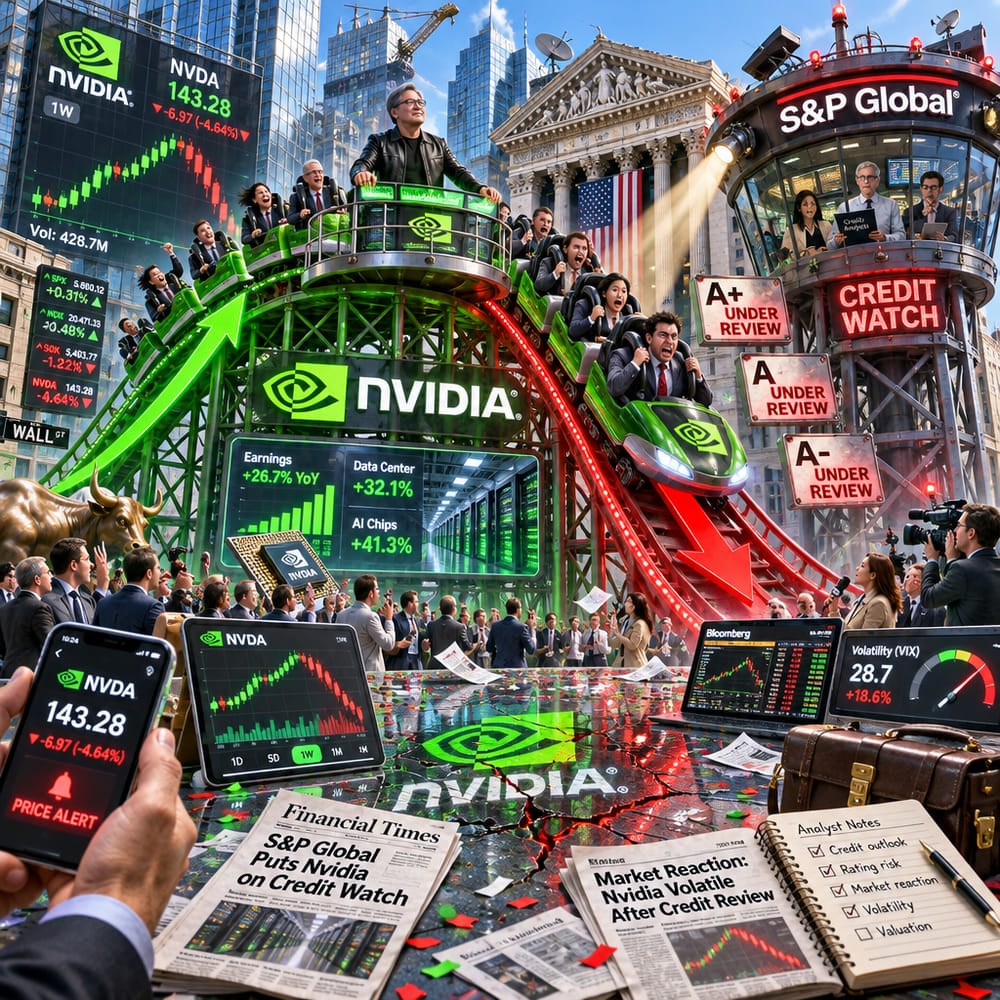
Buckle up, folks, because Nvidia just took us all on a rollercoaster ride that'll make your head spin faster than a GPU fan on full blast. One minute, the tech giant's stock is skyrocketing to stratospheric heights thanks to the triumphant return of its once-disgraced CEO, Jensen Huang. The next, it's plummeting like a glitchy video game character leaping off a cliff. And just to keep things spicy, S&P Global decided to place Nvidia's credit rating on watch. If that's not enough to get your adrenaline pumping, I don't know what is.
Now, let's break this down before we all get whiplash. In the wake of a scandal that saw Huang stepping down faster than you can say "RTX 3090," Nvidia's board pulled a surprise plot twist, reinstating him as CEO. Investors initially cheered, sending stock prices soaring as if Huang himself had personally cranked up their clockspeed. But just as we were all ready to call it a comeback, Nvidia's stock did a nosedive, leaving everyone clutching their portfolios and wondering what the heck is going on.
Enter S&P Global, stage left. The credit rating behemoth decided to put Nvidia's credit rating on a watchlist, which is basically the financial equivalent of sending it to the principal's office. This move suggests that Nvidia’s creditworthiness might not be as solid as a perfectly mined block of Ethereum, and that’s got implications that ripple far beyond their Santa Clara HQ.
So what does this mean for Nvidia in the short term? A whole lot of uncertainty, that's what. Investors are already a bit jittery, watching Nvidia's stock bounce around like popcorn in a hot pan. The credit watch has them even more anxious, potentially leading to higher borrowing costs for the company if the rating actually gets downgraded. And let’s be real—more expensive debt is not what you want when you’re trying to keep the firepower for innovation blasting at full throttle.
Long-term, this credit watch could lead to some serious soul-searching for Nvidia. They’ve got to prove that they’re not just a tech wizard but also a financial grown-up who can handle the rough-and-tumble of corporate governance and market expectations. If they manage to ace that, they could restore investor confidence and maybe even see their stock stabilize. If not, we might see a cooling of enthusiasm that mirrors the chilly reception of a buggy software update.
Now, let's zoom out a bit and ask, what does all this mean for other semiconductor companies? Well, when the big dog starts limping, others notice. Nvidia is a heavyweight in the semiconductor world, and its troubles could cast a shadow over the entire sector. If Nvidia's credit woes start looking contagious, or if investors start worrying that other chipmakers might have similar skeletons in their corporate closets, we could see a ripple effect where investor appetite for risk in the sector shrinks faster than a silicon wafer under a magnifying glass.
But here's the kicker: the semiconductor industry is nothing if not resilient. It's a sector that thrives on rapid change and razor-thin margins, and while Nvidia’s saga may cause some turbulence, it also creates opportunities. Smaller or less scrutinized companies might seize the moment to swoop in with innovations or strategic partnerships that sidestep Nvidia's current vulnerabilities.
Investors should keep their eyes peeled, not just on Nvidia's next moves but across the whole sector. Because in the high-stakes game of semiconductors, today’s debacle can be tomorrow’s triumph—or a lesson in what not to do.
So, what's the takeaway here? The market, much like a good processor, is always in motion. Nvidia’s rocky week is a reminder that even the tech giants can stumble, and that when they do, the reverberations can be felt far and wide. Keep your investment strategies nimble, your eyes on both current trends and future possibilities, and you just might come out ahead in this wild semiconductor race.
This article is for informational purposes only and is not investment advice. Always do your own research or consult a licensed financial professional before making investment decisions.
© Copyright 2024. All Rights Reserved.
© Copyright 2024. All Rights Reserved.