

Nvidia’s Strength Fuels Midweek Tech Rebound—Even as Small-Caps Lag
Sunday, August 30, 2026
Nvidia’s Strength Fuels Midweek Tech Rebound—Even as Small-Caps Lag
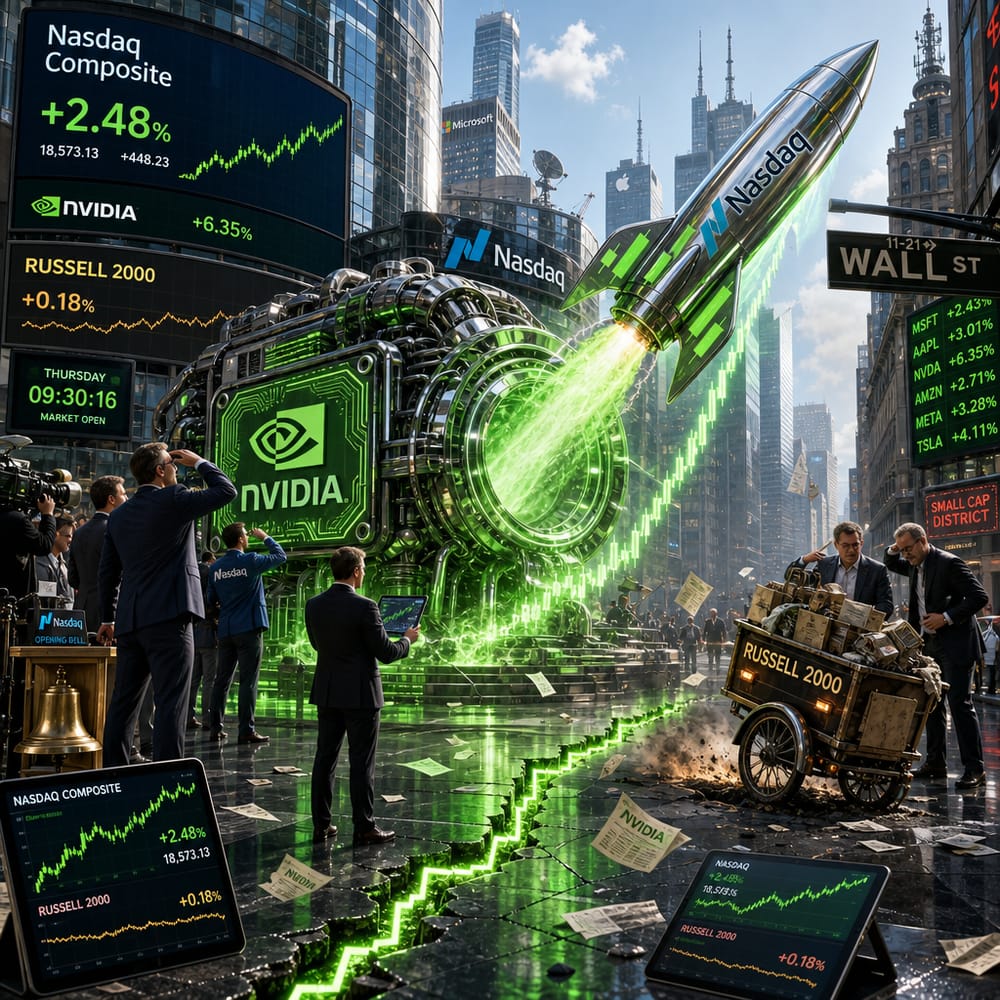
When the stock market feels like a rollercoaster ride you didn’t sign up for, it’s nice to know there’s a tech giant keeping everyone from losing their lunch. Enter Nvidia, the chipmaker that’s single-handedly lifting the Nasdaq like it’s bench-pressing a feather. If the Nasdaq is soaring while the Russell 2000 is feeling more like a grounded paper plane, you’ve got yourself a story of tech dominance versus small-cap vulnerability. So, what’s the scoop behind this market melodrama?
Nvidia isn’t just coasting on the fumes of past glory. Its recent performance is more like a symphony of cutting-edge tech, strategic maneuvers, and a dollop of investor enthusiasm. If you’re wondering why Nvidia’s been the belle of this market ball, look no further than its latest quarterly results. Bursting with robust demand for its semiconductors, especially as the AI boom continues to explode, Nvidia’s showing it knows how to make the most of being in the right place at the right time.
The company’s chips are the backbone for more than just gaming. They power data centers and are the unsung heroes in the evolution of AI. And as AI’s potential stretches beyond sci-fi dreams into tangible tech innovations, Nvidia’s got a front-row seat—and a lot of skin—in this game.
Now, let’s step back and see how this tech leadership affects the overall market health. Spoiler alert: it’s not as sunny as Nvidia’s stock chart. While tech darlings like Nvidia and its peers are buoying the Nasdaq, the Russell 2000, the index that’s home to small-cap stocks, is having a bit of a rough go. In the past week, small-caps have struggled, shackled by market conditions that don’t favor their size and scale.
When tech giants lead the charge, it can make the stock market look healthier than it really is—like putting lipstick on a pig. The concentrated strength in tech could be masking vulnerabilities elsewhere. For instance, small-caps are often more volatile and sensitive to economic shifts. When they lag behind, it’s like your car’s check engine light blinking after you’ve already hit the highway. It’s a red flag that could signal broader issues in sectors tied to domestic growth and consumer spending.
So, what’s got the small fries in a tizzy? Interest rates, inflation concerns, and geopolitical headwinds (hello, Iran) are putting pressure on these smaller companies. Unlike the behemoths of tech, small-caps don’t exactly have the financial muscle to weather such storms with ease. Rising Treasury yields, a topic that Fed Chair Kevin Warsh tiptoed around in his Jackson Hole remarks, are a thorn in the side of these companies, impacting their borrowing costs and potentially stifling growth.
The divergence between these indices highlights an age-old market truth: not all segments are created equal. Investors are leaning on the tech sector to bolster returns, as it’s perceived to be less tethered to the vagaries of the traditional business cycle. However, this heavy reliance questions market stability. If tech were to take a hit or see a correction, it could send ripples across the market pond, washing away gains and confidence.
Meanwhile, for those bullish on Nvidia, it’s worth remembering that even the brightest stars can eventually dim. While Nvidia continues to ride high, the market remains a wild animal. Keep an eye on those small-caps and the broader economic signals as they might just provide the breadcrumbs to where the market is truly heading.
In this era of tech supremacy, it’s easy to get swept up in the glamour of the Nasdaq’s ascent. But remember, the stock market is a delicate dance of many partners—not all of whom are dressed for a gala. As investors, keeping a balanced perspective will help navigate these tumultuous waters, irrespective of whether Nvidia (or its tech comrades) continue their winning streak.
This article is for informational purposes only and is not investment advice. Always do your own research or consult a licensed financial professional before making investment decisions.
© Copyright 2024. All Rights Reserved.
© Copyright 2024. All Rights Reserved.