

Nvidia’s Slide Continues Amid Analyst Backlash and Export Fallout
Saturday, November 14, 2026
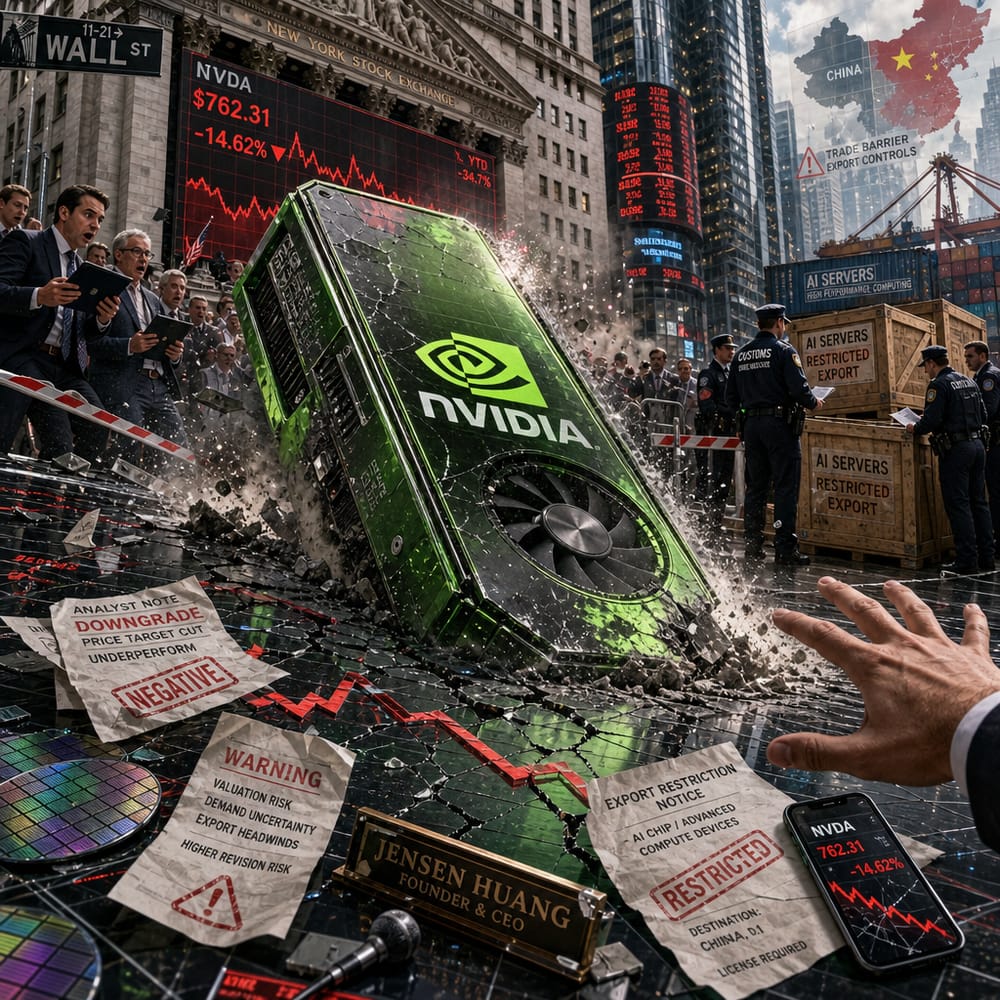
THE RISE AND FALL OF JENSEN HUANG: NVIDIA’S SLIPPERY SLOPE
It’s not every day that a corporate titan takes a nosedive off the mountain of tech supremacy. Yet, here we are, watching Nvidia’s former CEO Jensen Huang – once a beacon of Silicon Valley’s brightest ambitions – step down amid a scandal that leaves the AI industry gasping for breath.
Jensen Huang’s abrupt exit is sending shockwaves through the tech world. But what's at stake here isn’t just one man's legacy; it’s a question of Nvidia’s future and the entire AI sector’s trajectory.
Huang’s resignation is like a scene straight out of a Hollywood drama: allegations of espionage, a tangled web of extramarital affairs, and a dash of geopolitics for good measure. With Huang out, Nvidia has appointed Colette Kress, the company’s CFO, as interim CEO. While Kress has the financial smarts to keep the ship steady for now, investors are left wondering whether she can steer Nvidia out of these stormy waters.
THE IMPLICATIONS OF A LEADERSHIP CHANGE
Let’s not kid ourselves; replacing a visionary like Huang is no casual game of musical chairs. Under his leadership, Nvidia did more than just produce graphics chips. It became a cornerstone of the AI boom, partnering with data centers, investing in startups, and solidifying its role as a financial backer in the AI ecosystem.
Without Huang, Nvidia’s relationships with these AI heavyweights might face a reckoning. Will Kress, or whoever the board lands on next as CEO, be able to maintain these crucial alliances? The smooth transition of power is pivotal. Otherwise, Nvidia could see its ecosystem fragment, sending ripples through the AI industry that depend on its chips and investments.
EXPORT RESTRICTIONS: A MONKEY WRENCH IN THE SUPPLY CHAIN
As if the leadership saga wasn’t enough, Nvidia is also grappling with export restrictions to firms linked to China. These restrictions could seriously mess with Nvidia’s global supply chain. Given that a substantial chunk of Nvidia’s revenue streams from markets in Asia, tighter export controls could mean fewer chips crossing borders and hitting the shelves.
Such restrictions not only put a dent in Nvidia’s sales figures but also complicate its relationships with Chinese partners. While the company has not stated specific contingency plans, it needs to find alternative markets or risk losing a significant piece of its revenue pie.
ANALYSTS’ TAKE: WHAT DOES THE FUTURE HOLD FOR NVIDIA?
So, what do the Wall Street wizards think about all this? Analysts are split, like a banana at a sundae party. Some are ringing the alarm bells, suggesting Nvidia’s stock is heading for a rocky ride. Others believe the company’s formidable portfolio of technology and patents could buffer its stock from taking too hard a hit.
But caution is the word of the day. With Nvidia set to report its third-quarter earnings soon, investors are waiting with bated breath to see how the company’s performance aligns with the swirling storm of leadership and geopolitical challenges.
Jensen Huang might have been Nvidia’s kingpin, but his story underscores an essential truth about tech industries: no one is indispensable. While Nvidia’s leadership is in limbo, and export issues are tying up its supply chains, the broader AI industry is watching closely. The sector has relied on Nvidia not just for hardware but as a financial and strategic partner.
As Nvidia ventures into this new era, potential pitfalls remain. The company’s ability to navigate through them will determine whether it maintains its place at the forefront of global tech innovation or slips down the ranks.
So, dear reader, as we sit with our popcorn and watch this drama unfold, one thing is certain: there will be no dull moments in the world of Nvidia. Whether it emerges stronger or scathed is a tale only time will tell. But for now, that roller coaster isn’t stopping anytime soon. Buckle up.
This article is for informational purposes only and is not investment advice. Always do your own research or consult a licensed financial professional before making investment decisions.
© Copyright 2024. All Rights Reserved.
© Copyright 2024. All Rights Reserved.