

Nvidia's Export Restrictions on AI Chips
Thursday, November 26, 2026
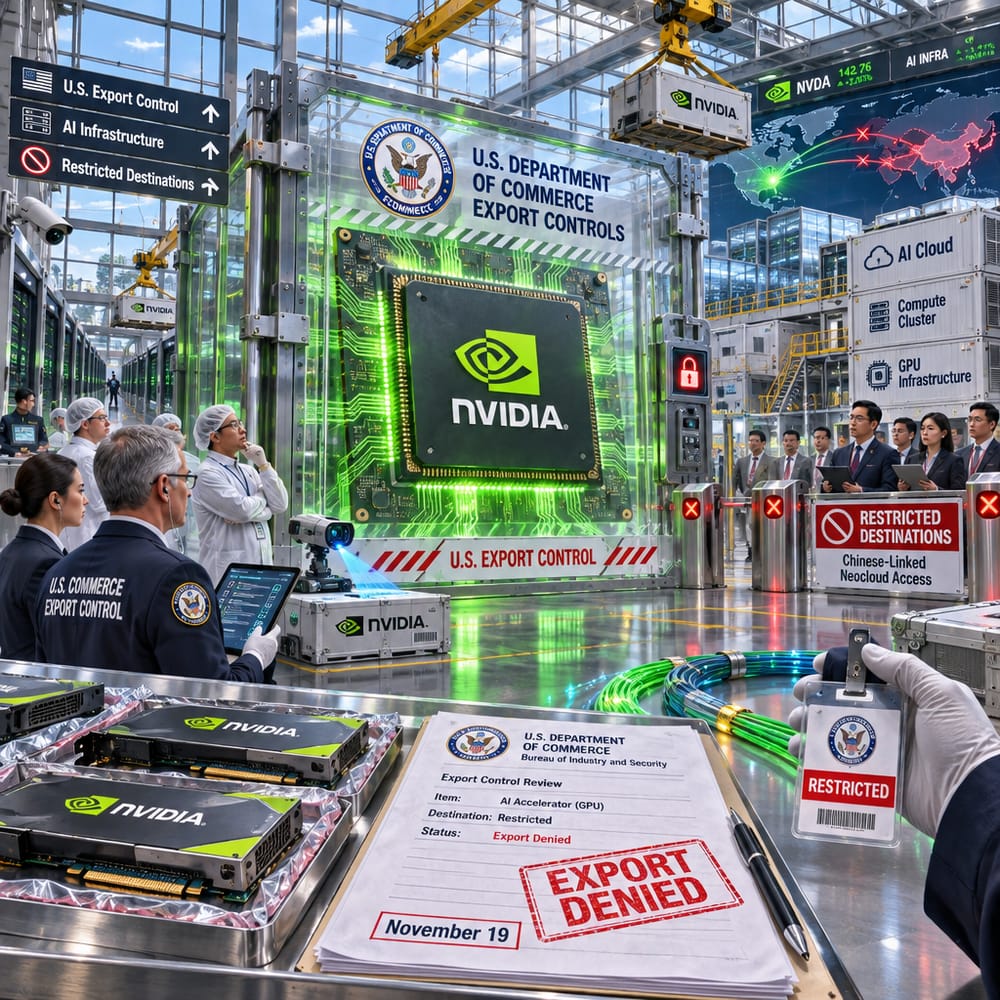
HEADLINE: Nvidia's AI Chip Dilemma: When Tech Meets Geopolitics
Move over Hollywood drama, there's a new plot twist in the tech world, and it’s hotter than a jalapeño on a Texas sidewalk. It’s the saga of Nvidia, the tech titan known for its AI chips, and the U.S. Department of Commerce, which just slammed the brakes on Nvidia's party in China by blocking the export of its cutting-edge chips. Why does this matter? Because it’s not just a tech story — it’s a geopolitical thriller with revenue streams hanging in the balance.
For those who haven't been keeping score: Nvidia's AI chips are like the crown jewels of their industry. Everyone wants them, especially as artificial intelligence keeps booming like a never-ending fireworks show. But as of November 19, a new rule is keeping those chips out of Chinese hands. This isn’t just a simple embargo; it’s a move that strategically targets China’s burgeoning tech infrastructure, specifically what are known as "neoclouds" — essentially cloud services tied to Chinese interests.
Imagine throwing a party, and just as it's getting good, someone pulls the plug on the music. That’s probably how Nvidia feels right now. The U.S. is cracking down on any loopholes that might have allowed Chinese companies to rent access to these chips abroad, which means Nvidia's lucrative tech won't be making its way to the world's biggest consumer market anytime soon. This rule is the latest in a series of tech cold war maneuvers between the U.S. and China — a rivalry that’s getting more intense than a game of Hungry Hungry Hippos.
The financial implications for Nvidia are massive. The company has been riding high on the AI wave, and China was a big customer. Now, Nvidia faces the challenge of rerouting its strategies and possibly losing a chunk of its revenue. It’s akin to a blockbuster film losing its international release — sure, it can still make money, but not the kind of box office numbers it was hoping for. Investors are watching closely to see how Nvidia navigates this hiccup. The outcome will shape not only its market position but also its stock, which has already seen wild swings this year.
But let's zoom out a bit — because this isn’t just about one company. The implications stretch across the tech landscape like a spiderweb. AI infrastructure providers, other semiconductor manufacturers, and data center operators are watching these developments with bated breath. Who stands to gain or lose as a result of these restrictions? It’s a high-stakes game of chess, and the board just got a lot more complicated.
Geopolitically, this is yet another chapter in the U.S.-China saga that’s been unfolding faster than you can say “trade war.” The U.S. is making it clear: it wants to lead the AI arms race. This isn’t just about commercial dominance; it’s about national security. If AI is the future, whoever controls the chips, quite literally, controls the game. By restricting Nvidia, the U.S. seeks to slow China's progress in AI, ensuring that if anyone’s going to have the last word in AI, it’s Uncle Sam.
What does this mean for the broader tech competition? The U.S. is doubling down on its tech policies, trying to ensure that its companies maintain an edge. But China’s not going to take it lying down. The country is already investing heavily in developing its own semiconductor industry, determined to reduce its reliance on foreign technology.
In the short term, expect volatility. Nvidia might have to pivot its sales strategy, perhaps focusing more on other regions or sectors less affected by these restrictions. In the longer term, this might accelerate China's efforts to bolster its own tech capabilities, possibly leading to a more fragmented global tech ecosystem.
In the end, this is more than just a business story. It’s a tale of power, control, and technological supremacy. The coming months and years will decide how Nvidia and its peers adapt to this new reality. For now, it’s a tightrope walk between innovation and regulation, with Nvidia smack dab in the middle.
So there you have it – the market’s latest cliffhanger. Keep your popcorn ready, because if tech diplomacy is this generation's cold war, we’re far from the credits rolling. Welcome to the AI age, where chips are the new gold, and the stakes couldn’t be higher.
This article is for informational purposes only and is not investment advice. Always do your own research or consult a licensed financial professional before making investment decisions.
© Copyright 2024. All Rights Reserved.
© Copyright 2024. All Rights Reserved.