

Nvidia's Earnings Aftermath: Resignation Fallout and Options Price Action
Sunday, November 22, 2026
Nvidia's Earnings Aftermath: Resignation Fallout and Options Price Action
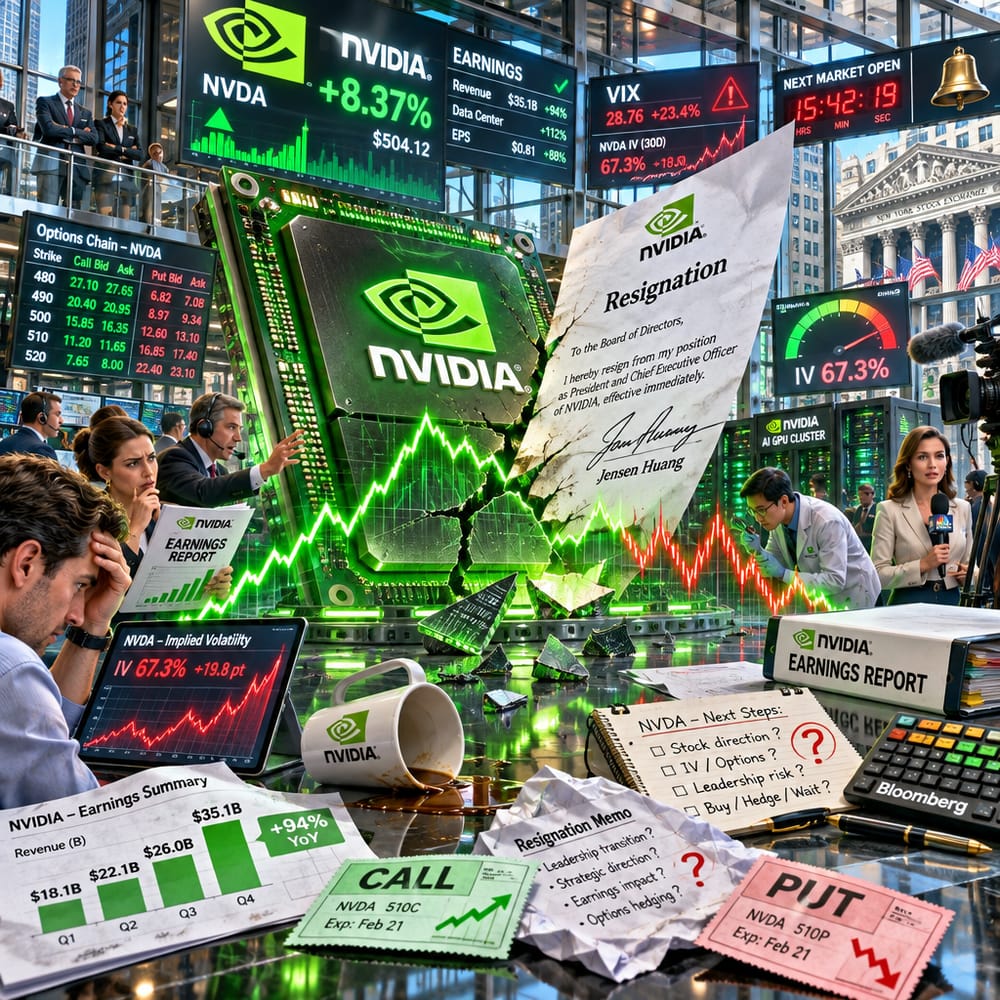
Buckle up, folks. Nvidia just dropped a bombshell that feels like a plot twist straight out of a Silicon Valley thriller. Fresh off the back of a stellar earnings report, which sent its shares soaring like a rocket, Nvidia's iconic CEO, Jensen Huang, has decided to ride off into the sunset. And if you think that’s just a corporate reshuffle, think again. This move has the potential to shake up the tech giant's trajectory and possibly the entire AI chipmaking sector.
Why does this matter? Let's untangle this high-stakes game of chess. Nvidia, the face of cutting-edge AI technology, is at a crossroads. With Huang's departure, the company's strategic direction could pivot, turning a well-oiled machine into a wild card. Investors and analysts alike are left scrambling to predict how this leadership shakeup might impact Nvidia's future innovations and competitive edge in a market that’s as fierce as a Shark Tank pitch session.
Huang, a tech visionary whose fingerprints are all over Nvidia’s rise to AI supremacy, is to Nvidia what salt is to the sea. His resignation has thrown a curveball, not just at the company, but at the options market as well. They're bracing for a wild ride, anticipating an 8% move in Nvidia's stock. But is this volatility justified, or are we all just caught up in the post-Huang hysteria?
The options market, essentially Wall Street’s version of a crystal ball, seems to think there’s plenty of turbulence ahead. But let's put this into context. Nvidia, already a high flyer in the stock market, has been the belle of the ball, outshining its peers in the AI chip sector. It's not just about making tech that's faster, better, stronger. It's about staying ahead in a race where every millisecond counts. And without Huang at the helm, the company might find itself in uncharted waters.
But before we jump ship, let's take a look at Nvidia’s risk/return trade-off in the grand scheme of things. Compared to its peers in the AI chipmaking arena, Nvidia has consistently delivered blockbuster returns. We're talking about the kind of returns that make retail investors do a happy dance. However, with Huang out, Nvidia's boardroom might feel like a game of musical chairs, with uncertainty over who will steer the ship through the turbulent tech seas.
To figure out if Nvidia still holds the golden ticket, we need to compare it to its sector siblings. Companies like AMD and Intel are playing catch-up, trying to nibble at Nvidia's market share. Yet, they too face their own set of strategic and operational challenges. The key question here is: Without Huang, can Nvidia maintain its first-mover advantage and keep those impressive margins?
Amidst all this corporate drama, there's a silver lining. Nvidia's fundamentals remain robust, with their recent earnings shining as brightly as ever. The company has a treasure trove of AI-driven products and services that continue to sell like hotcakes. And let’s not forget the booming demand for GPUs (graphics processing units), which Nvidia practically owns the patent on, metaphorically speaking. Investors looking to capitalize on Nvidia’s potential might view this turmoil as a chance to buy the dip — if they have the stomach for the ride.
So, what's the takeaway for the everyday retail investor, scrolling through their feeds and trying to make sense of this financial soap opera? It's time to gird your loins and keep a close eye on Nvidia's next moves. The company's strategic direction is now more unpredictable than a reality TV show, and the options market might not be too far off in expecting a rollercoaster ride. Huang’s departure is a game-changer, no doubt, but whether it spells doom or opens new doors for Nvidia is a story still in the making.
Invest wisely, stay informed, and remember: In the world of tech investing, fortune favors not just the bold but the well-researched.
This article is for informational purposes only and is not investment advice. Always do your own research or consult a licensed financial professional before making investment decisions.
© Copyright 2024. All Rights Reserved.
© Copyright 2024. All Rights Reserved.