

Nvidia's Circular Financing Strategy Raises Concerns
Monday, August 10, 2026
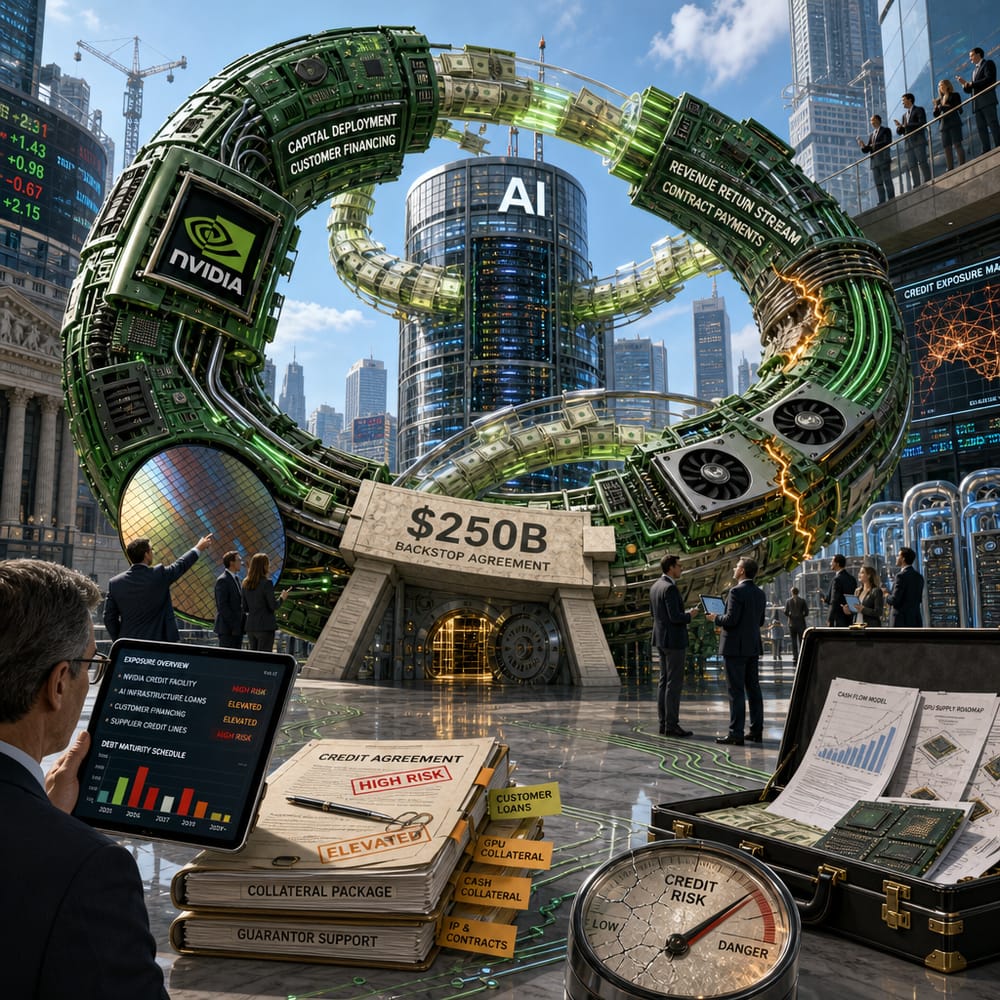
NVIDIA'S CIRCULAR FINANCING STRATEGY RAISES CONCERNS
Guess what? The tech titans are at it again. Nvidia, the company that’s in everyone’s tech portfolio—or at least on their wish list—is playing a high-stakes game of financial daisy chain. Their latest move? A jaw-dropping $250 billion backstop for OpenAI. But hold onto your GPUs, because this isn't just another Silicon Valley bromance. It’s a peek into the risky world of circular financing, and it could make or break Nvidia’s financial future.
THE CURIOUS CASE OF CIRCULAR FINANCING
You might be wondering what the heck circular financing is. Think of it like this: imagine you’re loaning your buddy money to buy your stuff. Sounds a bit convoluted, right? Nvidia is essentially creating a financial merry-go-round, where they’re pumping massive amounts of money into OpenAI, which in turn gobbles up Nvidia’s hardware like it's candy.
On paper, this seems like an ingenious way to boost sales figures and keep the money rolling within a cozy circle of partners. But here’s the kicker: it's a financial dance that could spiral into chaos if any of the players trip up. If OpenAI can’t deliver on its lofty AI promises or struggles to turn a profit, Nvidia isn’t just out a few chips—they're looking at significant financial exposure.
WHAT’S AT RISK?
Nvidia’s financial wizardry might inflate their revenue numbers, but it also stacks the decks with a healthy dose of risk. The tech industry is notorious for its boom and bust cycles, and circular financing could amplify these fluctuations. A hiccup in AI advancements, a competitor’s breakthrough, or a sudden market shift could send this carefully balanced house of cards tumbling down.
But let's not just point fingers at Nvidia. This kind of financial strategy isn't new—it's just a high-tech twist on credit exposure. Large sums of credit swirling around and propping up revenue figures can lead to a precarious financial position. And if Nvidia’s AI ambitions face delays or setbacks, the impact on their bottom line could be compounded by their interconnected financial commitments.
THE IMPACT ON FINANCIAL STABILITY
No one likes to talk about the downside, but we have to ask: how sturdy is Nvidia's financial structure in the long run? Should OpenAI or other partners face headwinds, Nvidia could find themselves caught in a financial squeeze. It’s like betting all your chips (no pun intended) on your buddy’s poker hand—risky, to say the least.
Furthermore, Nvidia’s strategy might raise eyebrows on Wall Street. Creditors and investors could become wary of the potential for inflated valuations unsupported by tangible cash flow. If investors start to perceive Nvidia’s balance sheet as a high-risk gamble, it could lead to a downturn in stock price and growing skepticism about the company’s financial practices.
THE BIGGER PICTURE
While this strategy might seem like Nvidia is playing with fire, the company might argue that it's a necessary gamble in an increasingly competitive AI landscape. Partnering closely with OpenAI and other frontier AI labs allows Nvidia to remain at the cutting edge, pushing boundaries that could define the next decade of technology.
And let’s face it—Nvidia has been on a roll. Their chips are the brains behind everything from gaming to self-driving cars. However, even the mightiest tech giants are not immune to the consequences of over-leveraging and creating complex financial webs.
At the end of the day, Nvidia’s bold move into circular financing might be a masterstroke of strategic genius or the beginning of a cautionary tale for tech finance textbooks. Only time will tell whether Nvidia’s gamble pays off or if the tech giant finds itself entangled in its own financial wiring.
For now, perhaps we should all keep a close watch on their next quarterly earnings call—and maybe have a popcorn standby. This dramatic story is far from over, and the stakes are as high as an overclocked GPU.
This article is for informational purposes only and is not investment advice. Always do your own research or consult a licensed financial professional before making investment decisions.
© Copyright 2024. All Rights Reserved.
© Copyright 2024. All Rights Reserved.