

Nvidia's CEO Reinstatement Raises Regulatory Eyebrows
Wednesday, November 25, 2026
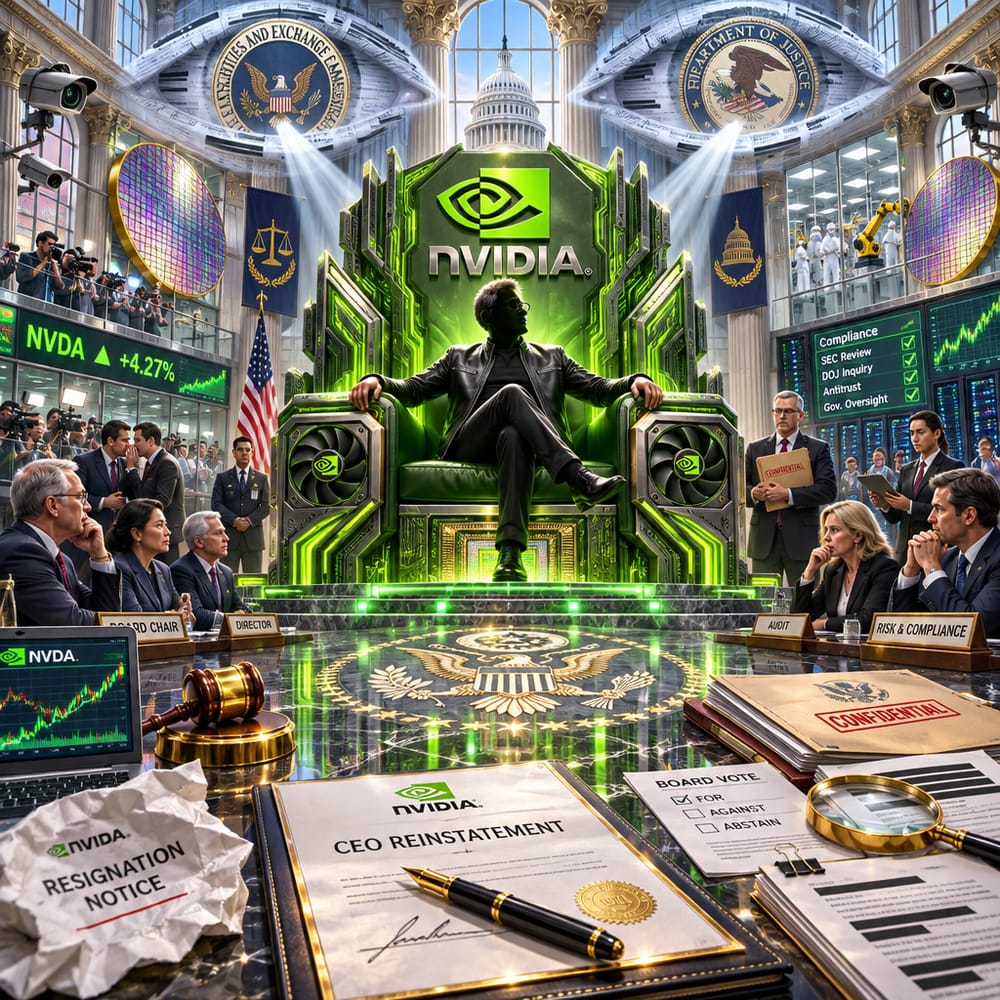
NVIDIA'S CEO REINSTATEMENT RAISES REGULATORY EYEBROWS
When Jensen Huang stepped down as CEO of Nvidia for what felt like the blink of an eye, everyone had a collective “wait, what?” moment. Just as quickly, he was back at the helm, like a tech-world Lazarus called back to life by forces greater than a mere mortal’s resignation could break. But this isn’t just some Silicon Valley soap opera. No, this is a tale woven with strings pulled from high places — the kind with governmental power and enough market influence to make Wall Street do a double take.
Let’s not sugarcoat it: Jensen’s sudden departure rattled the markets. Nvidia’s stock plunged like a stone, shedding a gut-wrenching 28% in the aftermath of his exit. As if that wasn’t enough drama, all this unfolded against a backdrop of growing regulatory scrutiny and some good old-fashioned government intervention. Yes, the Trump administration, fresh off its own adventures, felt Huang was too big to fire, fearing an economic domino effect that could level the playing field (and not in a good way).
So, what’s the deal with Jensen’s game of musical chairs? Huang’s brief exit was reportedly a move prompted by a scandal that seemed to have swept through Nvidia’s top echelons like wildfire. The details are murky, but you can bet your last dollar that it involved more than just a few raised eyebrows at the SEC. With AI being as central to Nvidia as a processor to a computer, there were fears that any shake-up could shake the entire tech market. And when that news hit the airwaves, investors reacted as you’d expect — fleeing the scene faster than you can say “sell-off.”
Tech stocks worldwide have been on a rollercoaster lately, with Nvidia at the epicenter of a market skydive, proving just how intertwined the fate of a single company can be with broader economic health. The tech rout has been brutal, as Nvidia’s premarket antics showed with a rough 4.5% drop, while its European cousins managed to hang on by their fingernails.
But here’s where things get really spicy. The government’s hand in reinstating Huang suggests a bold new world where Uncle Sam isn’t just a distant overseer but a player ready to shuffle CEOs like a deck of cards when the stakes are high. It raises a question: Should the government intervene in corporate governance? It's a debate as old as capitalism itself, but in an era where AI leads the charge, the stakes have never been higher.
For investors, Huang’s reinstatement is a double-edged sword. On one hand, his return is a stabilizing force: a reassuring nod that it’s back to business as usual for Nvidia. On the other, it underscores a growing concern about just how much influence external bodies can wield over corporate decision-making. And that, dear friends, is both a comfort and a curse.
What does this mean for Nvidia’s stock? The immediate impact was a sigh of relief that sent shares crawling back up, but the longer-term implications hang in the balance. Nvidia’s journey through AI’s turbulent seas depends on not just their tech prowess but their ability to navigate regulatory waters, which are now teeming with sharks.
And let’s not forget the broader picture. The tech sector, already feeling the heat from tariffs and global economic tensions, now has to ponder a future where government intervention could become part of the playbook. For other CEOs watching this saga unfold, it’s a reminder to keep their corporate houses in order, lest they find themselves in a similar bind.
As the dust settles, Nvidia’s tale serves as a wake-up call for anyone invested in tech stocks. Be ready for more regulatory scrutiny. Be wary of the government’s new role in the boardroom. And most importantly, buckle up — because the road ahead promises to be anything but smooth.
So, if you're an investor, watch this space. And if you're just here for the corporate intrigue, well, it seems like there will be plenty more where that came from. Jensen Huang’s return might just be the opening act in a drama that’s far from over.
This article is for informational purposes only and is not investment advice. Always do your own research or consult a licensed financial professional before making investment decisions.
© Copyright 2024. All Rights Reserved.
© Copyright 2024. All Rights Reserved.