

Nvidia's CEO Probe Ignites "Key Man" Risk Debate
Tuesday, November 10, 2026
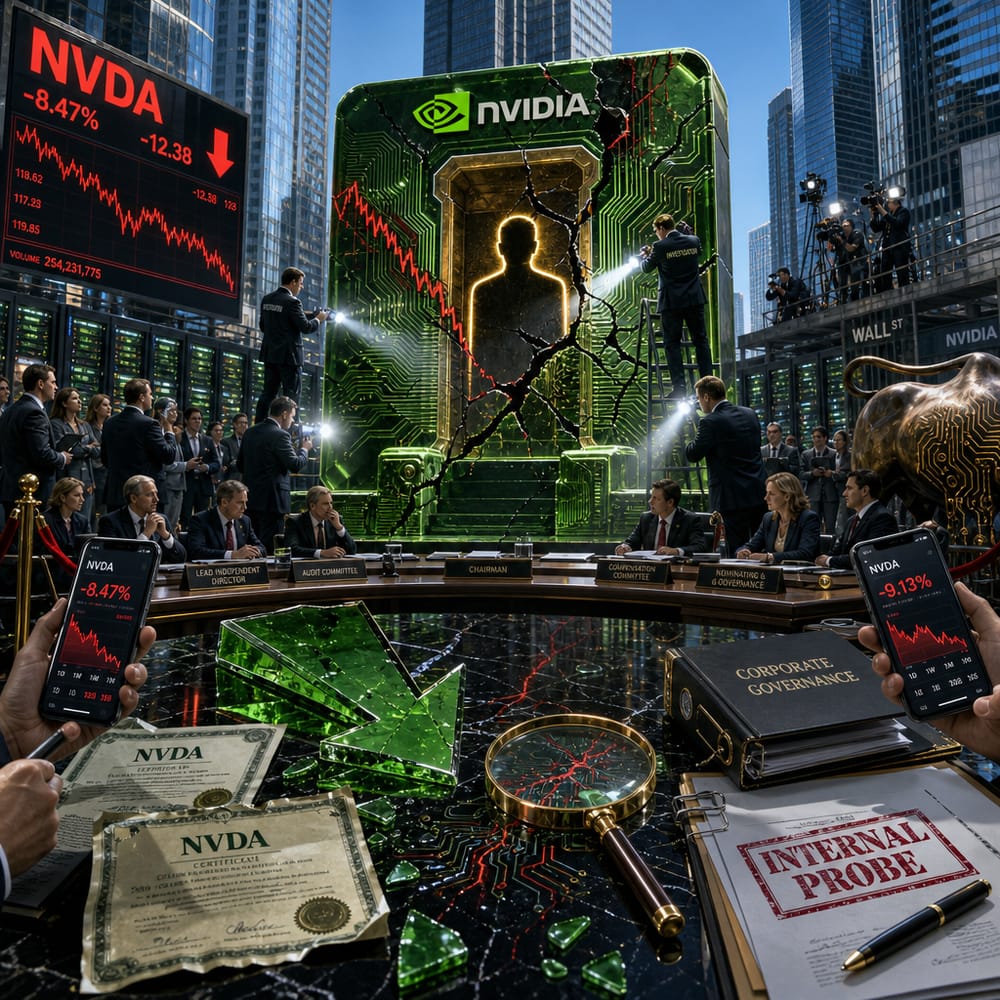
Imagine being the captain of a ship navigating through stormy seas, only to discover that your compass might have a mind of its own. This is the scenario Nvidia finds itself in after announcing an internal investigation into their CEO, Jensen Huang. The plot twist? Huang allegedly had an affair with someone accused of spying for China. The fallout? Nvidia’s stock took a nosedive, dropping 4% while the rest of the market was busy celebrating a robust rally. This raises a big question about key-man risk, a fancy term for what happens when a company relies too heavily on one person—and that someone suddenly becomes a liability.
Nvidia, the tech behemoth known for powering your favorite high-end graphics and AI wonders, now finds itself in a quandary about whether it can survive without its charismatic leader. Huang, who’s been the face of Nvidia since day one (that’s 33 years, in case you’re counting), is not just any CEO; he’s the Steve Jobs of the AI chip world. Without him, suddenly the future seems a bit hazy, like looking through VR goggles that are a tad out of focus.
So why does this matter to you, the everyday investor, scrolling through your news feed amid cat videos and viral dance challenges? Well, key-man risk isn’t just a Wall Street buzzword; it's an Achilles' heel for companies like Nvidia. When a company is so tightly coupled with its leader, the risk isn’t just about who’s steering the ship, but whether the ship can sail at all if the captain misses the boat.
But let's not get ahead of ourselves. The investigation is still fresh, and Huang has denied knowing that his alleged paramour was a spy. Though the scandal might feel ripped from the pages of a spy novel, the implications are all too real. Investors are jittery, and institutional confidence, the kind that really moves the market, is seemingly on thin ice.
The stock’s tumble is a wake-up call. It’s a signal to Nvidia’s board and its investors that maybe it’s time to stop relying on the executive equivalent of a superhero. Analysts are already buzzing about how this situation might reset their expectations for Nvidia’s future. Can the company, which has been synonymous with Huang, recalibrate and refocus without him at the helm? Or will it falter like other tech giants that have struggled in the absence of their iconic leaders?
The market reaction tells us that shareholders are skittish about the uncertainties this probe brings to light. Nvidia isn’t the first company to face such a dilemma, and it surely won’t be the last. But it highlights an industry-wide problem: tech companies need to spread their leadership more evenly to mitigate the risks tied to any one person. A single point of failure is a risk too big to ignore when billions of dollars are on the line.
So how can Nvidia tackle these governance concerns? First, by strengthening its bench of top executives and making sure the company can thrive without its founding CEO. Building a strong succession plan isn’t just Corporate Governance 101; it’s the masterclass. Transparency with shareholders about this plan could be the first step to regaining trust.
Secondly, Nvidia must ensure its corporate governance is as robust as its GPUs. That means putting measures in place that can catch risks before they become full-blown crises. This isn’t just about ticking boxes but instilling a culture of checks and balances where no single individual, however talented, holds the keys to the entire kingdom.
In a world where tech darlings can soar to Mars or plummet to the Marianas Trench, managing key-man risk is more crucial than ever. For Nvidia, this is a pivotal moment to prove that it’s not just a one-man show. Can it rise to the challenge? Investors will be watching closely, and you might want to take notes, too. After all, even the mightiest tech giants need a little help from their friends—and a little less drama from their CEOs.
This article is for informational purposes only and is not investment advice. Always do your own research or consult a licensed financial professional before making investment decisions.
© Copyright 2024. All Rights Reserved.
© Copyright 2024. All Rights Reserved.