

Nvidia's Blockbuster Q2 Earnings and Bold Fiscal 2028 Guidance
Thursday, August 27, 2026
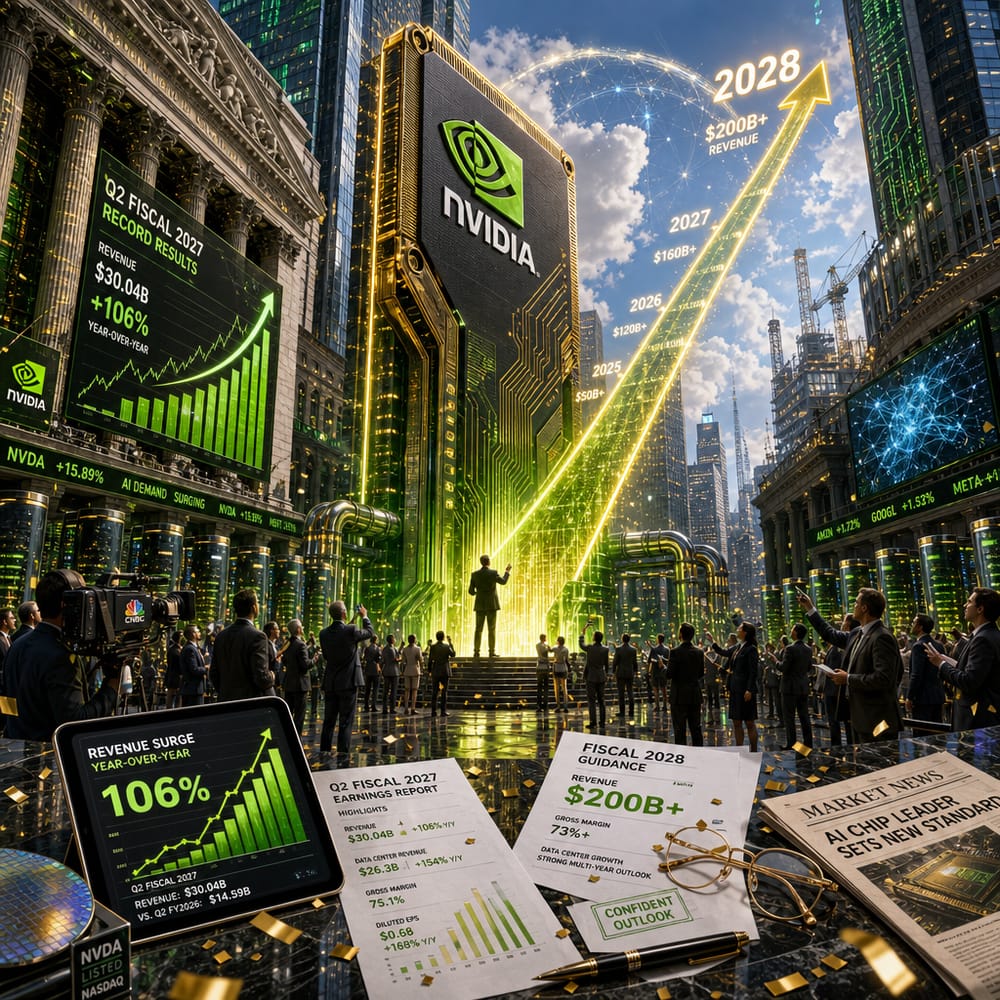
NVIDIA'S BLOCKBUSTER Q2 EARNINGS AND BOLD FISCAL 2028 GUIDANCE
Stop the press, folks! Nvidia just turned the dial up to 11 with its jaw-dropping Q2 earnings report. While most of us were barely wrapping our heads around AI as a buzzword, Nvidia was busy making it rain green on Wall Street. The chip behemoth announced a staggering 106% revenue climb from the same quarter last year. Yes, you read that right—a full-on, triple-digit surge. And as if that wasn't enough to make stockholders giddy, they're now broadcasting a bold 70% growth forecast for fiscal 2028. That's a lot of zeroes and a lot of confidence. So what's fueling Nvidia's unyielding optimism, and how are investors reacting to this high-octane ride?
DRIVING FORCES BEHIND NVIDIA'S OPTIMISTIC GUIDANCE
Let’s break down the secret sauce behind Nvidia's big numbers. At its core, Nvidia’s success hinges on what everyone’s been buzzing about: artificial intelligence. CEO Jensen Huang might as well have written a love letter to AI, pointing out the insatiable demand that's driving the company’s fortunes. According to Huang, demand is "much greater than 70%," but there’s only so much product they can churn out. In simple terms, Nvidia is like the hottest nightclub in town—you can’t get in because it’s packed, but that doesn’t stop anyone from trying.
This AI boom isn’t just a flash in the pan. It’s a full-blown digital revolution, and Nvidia is selling the pickaxes. With AI applications sprawling into every industry you can think of—from healthcare to your smart fridge—Nvidia's hardware is what makes the magic happen. It’s the reason why tech giants are scrambling to grab Nvidia’s state-of-the-art chips, and it's why Nvidia feels confident in its future.
INVESTOR REACTION TO NVIDIA'S LONG-RANGE FORECAST
Now, let's talk about the stock market reaction. When Nvidia speaks, investors listen. This time, they did more than just listen—they practically threw a party. Nvidia shares jumped 7.2% in premarket trading, breaking the curse of its stock dropping post-earnings in previous quarters. It’s as if investors suddenly realized "Wait, this AI thing is here to stay, and Nvidia’s the gatekeeper."
The ripple effect didn’t stop there. Other chip stocks like Micron, Marvell, and AMD (Advanced Micro Devices) decided to join the party, seeing their own share prices rise. It’s a sign that the market is not just buying into Nvidia’s narrative, but the broader story of AI’s growing prominence.
The optimism is so contagious, even the neocloud firms (think cloud computing’s cooler, trendier cousin) like Nebius and CoreWeave saw a respectable rise. It’s the kind of market enthusiasm that suggests Nvidia’s guidance is not just reshaping investor expectations but rewriting the entire playbook on how they value the AI sector.
THE BIGGER PICTURE
Nvidia's moonshot forecast is a clarion call to investors: the AI wave is not just on the horizon, it’s crashing over us. But how sustainable is this? For long-term investors, the focus will likely be on how Nvidia plans to navigate potential challenges like supply chain constraints and geopolitical hurdles—hello, tariffs! The semiconductor sector, already juggling complex global supply chains, isn't immune to trade tensions that could throw a wrench in the works.
Yet, if Nvidia continues to innovate and ride the AI wave, its stock could remain the darling of tech portfolios everywhere. As retail investors, the takeaway might just be to keep your eyes peeled on AI trends and how Nvidia capitalizes on them. The market is betting big that these aren’t just lofty projections but achievable goals grounded in concrete demand.
So stay tuned, because if Nvidia has taught us anything, it's that the future is not just bright—it's downright electrifying. Time to see if they can keep the lights shining that brightly for fiscal 2028 and beyond.
This article is for informational purposes only and is not investment advice. Always do your own research or consult a licensed financial professional before making investment decisions.
© Copyright 2024. All Rights Reserved.
© Copyright 2024. All Rights Reserved.