

Nvidia’s AI Financing Push: From Chips to Capitol Hill
Sunday, August 30, 2026
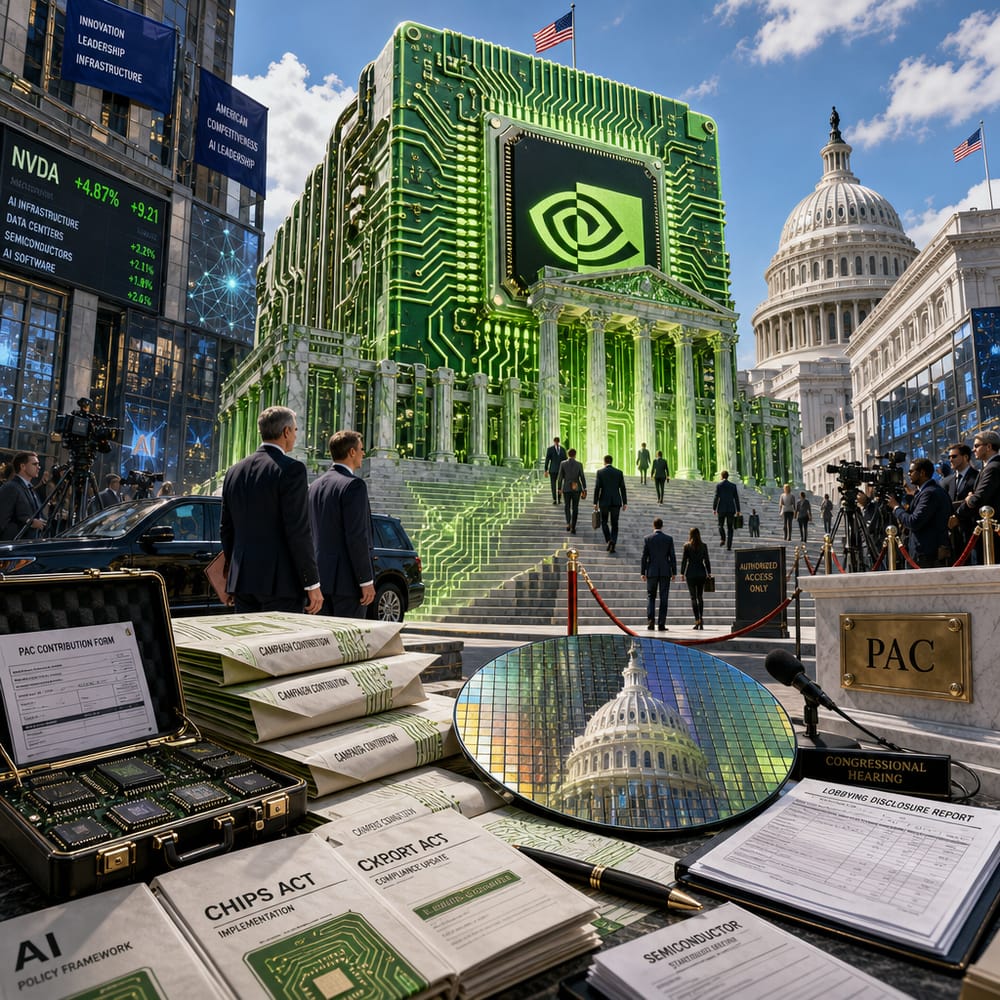
Nvidia’s AI PAC: Silicon Valley's Political Power Play
Forget about keeping your eyes on the road—Nvidia wants you to steer your gaze towards Capitol Hill instead. Yes, the tech behemoth that put "graphics processing unit" into our collective vocabulary has now turned its focus to the political arena, forming its own political action committee (PAC). Why? Because influencing AI and semiconductor regulations is apparently the new black.
So, what’s cooking in Nvidia’s legislative kitchen? For starters, Nvidia isn't just playing around with abstract mathematical models. The primary objective of their PAC is to influence policy decisions that directly affect the AI and semiconductor sectors. The tech giant is not subtly sliding into the political scene; it's strutting in, drawing attention to the growing interplay between Silicon Valley and policymaking. Considering that AI is on the edge of becoming as ubiquitous as cat videos, Nvidia’s timing couldn’t be better.
Now, you might be asking: How exactly does a PAC help Nvidia? Picture this: laws and regulations are the speed bumps on the fast track to tech innovation. By setting up a PAC, Nvidia can now legally pour money into political campaigns and candidates that align with its goals. This isn’t just about keeping the bus between the lanes. It’s about having a say in where the road goes next, especially when it comes to AI and semiconductor policies.
What might this mean for future AI and semiconductor regulations? It’s a classic case of tech courting power to shape the field in its favor. Nvidia isn’t just another player on the tech stage—it's playing chess while others are still learning checkers. By nudging key policymakers, Nvidia can help craft regulations that could smooth the path for AI advancements while dodging the typical bureaucratic landmines.
But let’s not just paint a rosy picture here. There are risks and trade-offs for Nvidia in upping its political presence. On the upshot, having a hand in shaping regulations can safeguard the company from unfavorable laws that could stifle innovation or ramp up operational costs. On the flip side, getting too cozy with politics can sometimes backfire. It could invite scrutiny, not to mention stir the pot with competitors who aren't too thrilled about Nvidia calling the shots from behind the scenes.
The potential benefits for Nvidia are juicy, but let's not forget about the looming risks. As Nvidia gets more tangled up in the political web, it could face backlash from stakeholders who prefer tech companies to focus on, well, tech. Then, of course, there’s the danger of regulations that are too favorable, leading to antitrust worries. If Nvidia is perceived as having too much influence, it could end up under the microscope of regulators looking to keep the playing field level.
In essence, Nvidia’s PAC is a bold move, but not without its pitfalls. For retail investors watching from afar, this could mean both opportunity and uncertainty. If Nvidia’s lobbying efforts succeed, it could accelerate their growth and investor returns. But if things go awry, it could complicate their market positioning or spark regulatory challenges.
So, Nvidia is not just a titan of the tech industry—it's now a burgeoning power player in the political space. Whether this new venture will be a game-changer or a gamble, only time will tell. But one thing is certain: Nvidia's move to the political front lines marks yet another chapter in the ever-evolving story of tech's influence on our world. For investors and tech aficionados alike, it's a story you'll want to watch unfold.
This article is for informational purposes only and is not investment advice. Always do your own research or consult a licensed financial professional before making investment decisions.
© Copyright 2024. All Rights Reserved.
© Copyright 2024. All Rights Reserved.