

Nvidia’s $500B AI Infrastructure Financing Backdrop: Validates Capex—but Dilution Pushes Stock Lower
Thursday, August 13, 2026
Nvidia Wants Half a Trillion Dollars for AI. Here’s Why You Should Care.
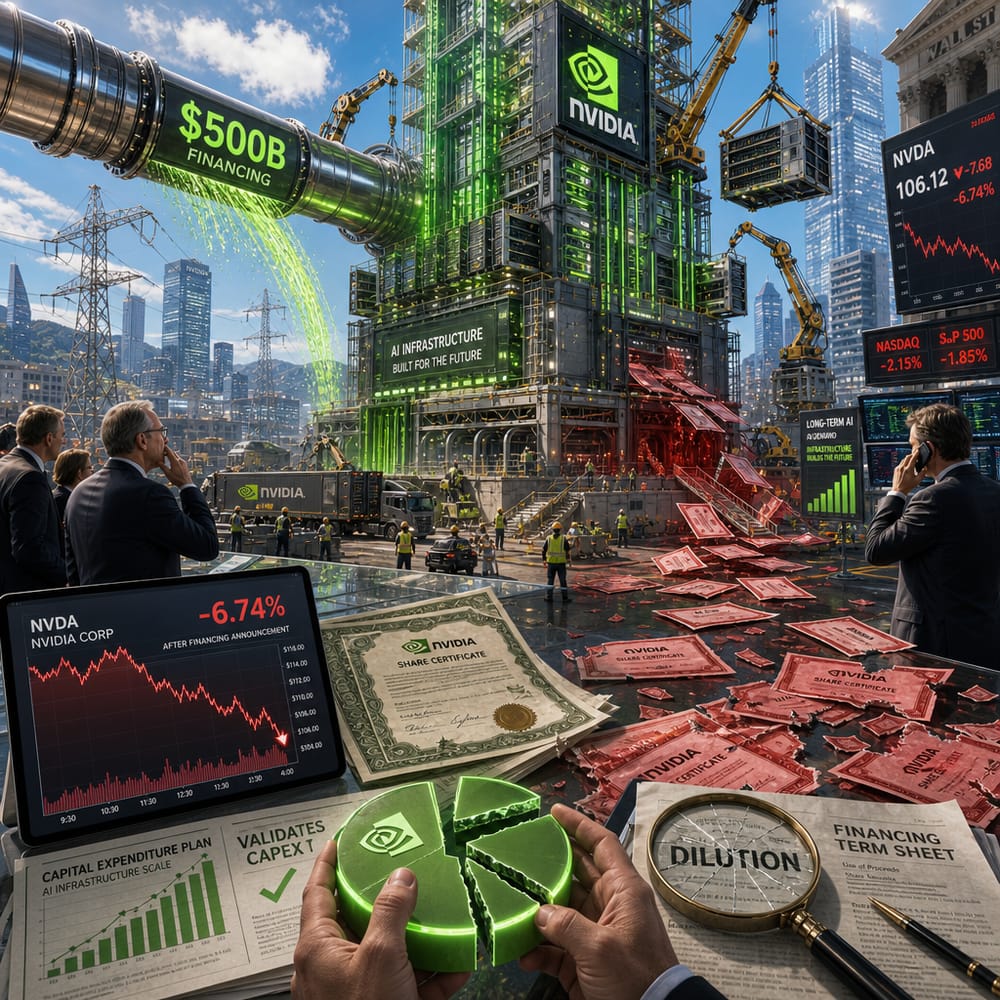
Alright, folks, buckle up. Nvidia just announced plans to raise a staggering $500 billion to amp up its AI infrastructure, and let’s just say the stock market is not jazzed. Shares dipped faster than your Wi-Fi during a Netflix binge. So, what’s the deal? Is Nvidia playing chess while the rest of us play checkers, or are they just up to some serious financial shenanigans?
First, let's talk about why Nvidia is in beast mode with AI. You know those fancy graphics cards that gamers and Bitcoin miners salivate over? Well, Nvidia’s putting that same tech prowess into artificial intelligence, and it’s not just for fun. They’re planning to build a mega AI empire, and they need a Scrooge McDuck amount of cash to do it. In simple terms, the company wants to be the Amazon of AI infrastructure—pumping out servers and tech that'll make Silicon Valley look like child’s play.
So, what’s the upside to this jaw-dropping capital raise? For Nvidia, the potential payoffs could be huge. Imagine cornering the market on AI tech—supplying the brains behind everything from self-driving cars to smarter-than-your-average-bear thermostats. With this kind of cash, Nvidia could potentially widen the moat around its AI kingdom, keeping competitors at bay long enough to solidify its dominance.
But hold your horses—there’s a plot twist. This financial move comes with a not-so-glamorous catch: stock dilution. In layman's terms, Nvidia plans to issue more shares to raise this mountain of money, meaning your slice of the Nvidia pie just got thinner. If you’re an investor, that’s a bit like ordering a large pizza and finding out it’s been cut into 16 teeny slices instead of 8 hearty ones. Simply put, more shares mean each one is worth less.
Now, you might be wondering, will Nvidia's ambitious capital raise make it the undisputed king of AI? That’s the billion-dollar question. On one hand, this move could supercharge its market position, allowing it to outpace rivals and snag some enviable contracts. On the other hand, too much spending can lead to risky overextension. Remember, not all that glitters is gold—sometimes it’s just overpriced silicon.
Investors are understandably jittery. The idea of being diluted doesn’t exactly make anyone’s day, especially given Nvidia’s already sky-high stock price. But it's a classic high-risk, high-reward scenario. If Nvidia plays its cards right, this could be a game-changer for the company and its shareholders. However, if things go south, it might end up as a cautionary tale in MBA case studies on overzealous expansion.
Let’s not forget the long-term implications for shareholders. In the short run, the stock drop might seem like a bad dream. But here's the kicker: if Nvidia succeeds in its AI ambitions, the company could see exponential growth, potentially rewarding patient investors. However, if the strategy falls flat, expect some serious seatbelt-wearing for the bumpy ride ahead.
So, what's an everyday investor supposed to do while Nvidia’s playing a financial game of thrones? Well, keep an eye on how this cash infusion plays out. Are they using it to fuel innovation and expand market share, or does it end up being a bloated budget with little to show for it? Some may choose to stay the course, believing in Nvidia’s vision, while others might decide to hedge their bets or diversify their portfolios.
In the end, Nvidia’s gamble on AI infrastructure could either be a masterstroke or a misstep. What we do know is this: the tech giant’s $500 billion move has set the stage for an epic showdown in AI supremacy. Whether you’re a shareholder or just an intrigued observer, this is one financial drama that promises to keep us all on the edge of our seats.
This article is for informational purposes only and is not investment advice. Always do your own research or consult a licensed financial professional before making investment decisions.
© Copyright 2024. All Rights Reserved.
© Copyright 2024. All Rights Reserved.