

Nvidia Halts AI GPU Exports to Southeast Asia
Friday, November 27, 2026
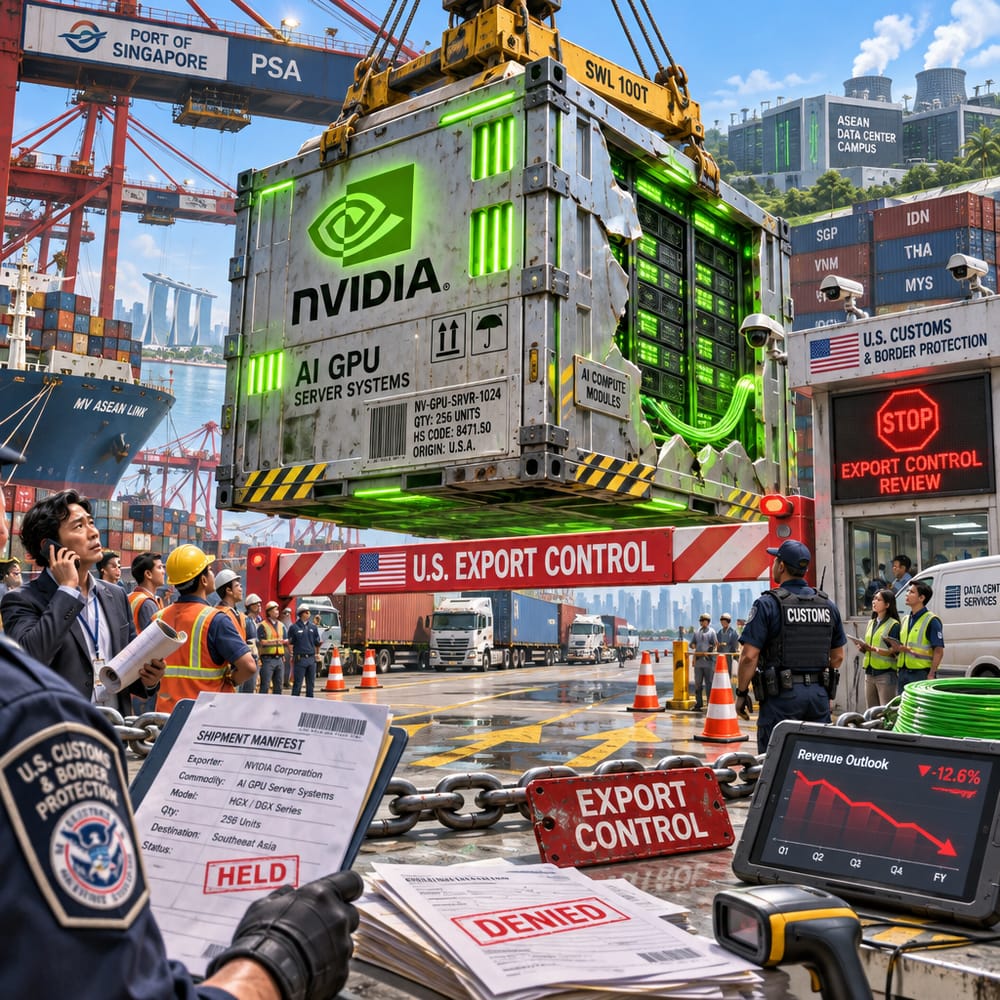
NVIDIA PUMPS THE BRAKES ON AI GPU EXPORTS TO SOUTHEAST ASIA: WHAT IT MEANS FOR YOU
Nvidia has just thrown a wrench into the global tech works, and it's not just a software update. The semiconductor behemoth has abruptly put the kibosh on shipping its AI GPUs—those magical processing units that make your smartphone smart and your fridge nearly self-aware—to data centers in Southeast Asia. Yep, the U.S.'s tightened export controls just turned Nvidia's international shipping lanes into a geopolitical chessboard. So what's the big deal, and why should you care? Stick around and let's delve into this tech industry shake-up that's got everyone from Silicon Valley to Singapore buzzing.
First, let's talk money. We're diving headfirst into Nvidia's bottom line because, let's face it, that's where it really hurts. This export halt is putting a damper on Nvidia's international revenue stream. Think of it as the economic equivalent of a surprise cold shower. With Southeast Asia being a hotbed for data centers and digital expansion, missing out on that market is like leaving money on the table at a tech banquet.
How does this impact Nvidia's financial performance? Well, NVIDIA's earnings report might soon look less like a high-flying tech success story and more like a chapter out of "Financial Challenges 101." The company could face a dip in revenue projections as it loses out on a rapidly expanding market that craves its high-powered AI GPUs. And while Wall Street loves a comeback, this is a hiccup that could make investors a tad jittery.
Now, if you're in Southeast Asia, this halt isn't just a headline—it's a potential roadblock to digital evolution. AI development in the region might hit a speed bump without Nvidia's tech prowess fueling the engines. Data centers, which are essentially the brains behind the vast digital expansion, could find themselves in a supply crunch. It's like trying to power a rocket with a lawnmower engine—doable, but far from optimal.
As for the broader tech industry, Nvidia's move is a glaring signal of how geopolitical tensions are reshaping the very silicon foundations these companies stand on. The semiconductor world has been no stranger to scrutiny, and this is a reinforcement of the idea that where a chip's made—and where it ends up—matters as much as its specs.
So, what are the long-term implications? Imagine a world where tech companies need a political science degree just to navigate international supply chains. Other tech giants are surely watching Nvidia's situation like hawks—no one wants to be caught off guard by similar export bans. It's a wake-up call to diversify supply chains and possibly even rethink where they manufacture and ship their products.
While U.S. tech stocks have recently shown some resilience—hello, record-breaking Dow and Nasdaq gains—this is a reminder that growth isn’t always a straight line up. The tech sector is notoriously volatile, a thrilling rollercoaster of innovation, scandal, and market shifts. Nvidia’s current challenge is a testament to the industry's tightrope walk between global demand and regulatory oversight.
In conclusion, Nvidia's export pause isn't just a company issue—it's a case study in how the tech landscape is being drastically altered by policy. For retail investors, it’s a peek into the complex dance of tech and geopolitics. And for tech companies, it's a stark reminder that thriving in this environment means more than just having the best chips—it’s about playing a long game where strategy and adaptability are just as crucial as innovation.
So, whether you’re an investor pondering Nvidia's next move or just someone who loves their gadgets, keep an eye on this space. The semiconductor race is heating up, and the players involved are strategists as much as they are engineers. And in this game, the chips are way up. Keep scrolling, because you never know what twist is coming next.
This article is for informational purposes only and is not investment advice. Always do your own research or consult a licensed financial professional before making investment decisions.
© Copyright 2024. All Rights Reserved.
© Copyright 2024. All Rights Reserved.