

Nvidia Governance Fallout Deepens Market Risk
Saturday, November 14, 2026
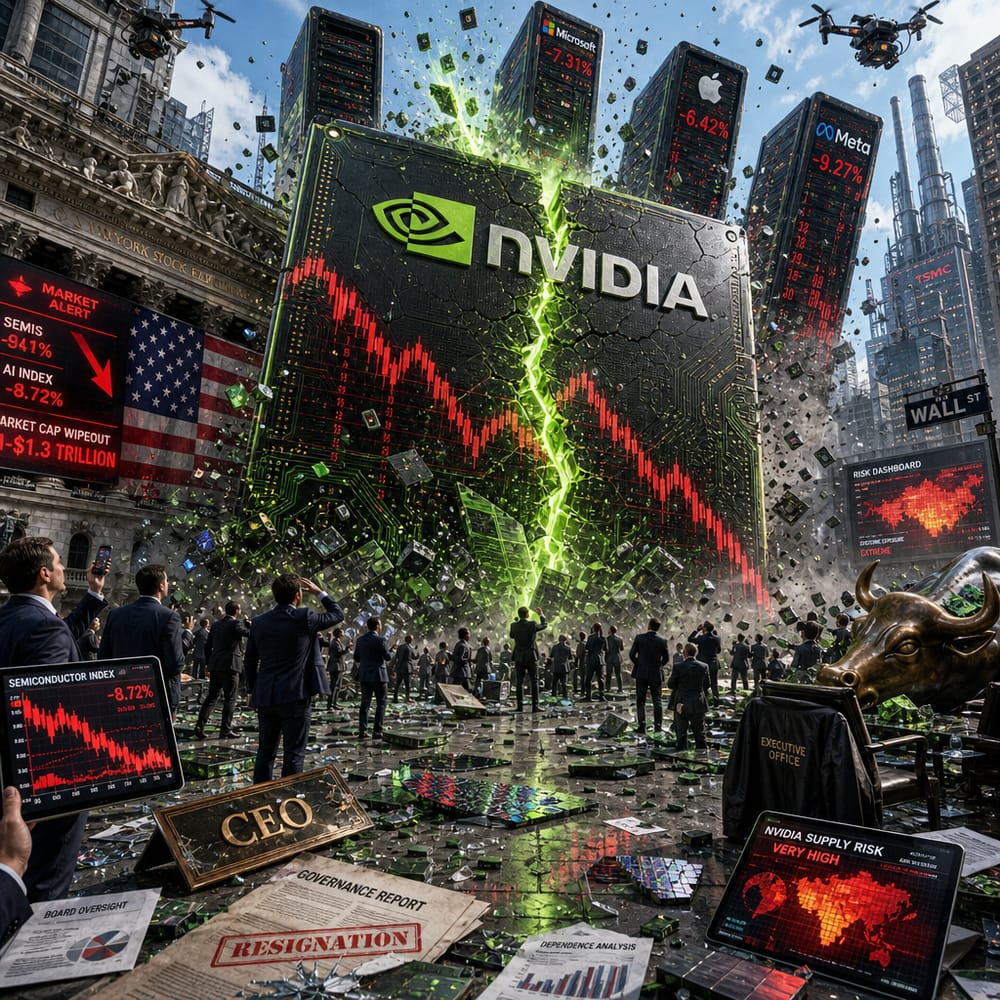
Nvidia’s CEO Jensen Huang Resigns: What Does It Mean for Your Portfolio?
Heads up, tech investors: the semiconductor giant Nvidia has just been hit by a seismic shift. Jensen Huang, the rockstar CEO who helped steer the company to its current heights, has resigned. And as you might expect, Wall Street is having a bit of a meltdown. Nvidia's stock took a nosedive, shaving a significant chunk off its market cap. The departure has left everyone asking: what's next for Nvidia and, more importantly, what does it mean for your portfolio?
THE LEADERSHIP VACUUM
First, let's talk about why this is a big deal. Jensen Huang is basically the Tom Brady of the tech world — except instead of leading a football team, he was quarterbacking one of the biggest players in artificial intelligence and semiconductors. He co-founded Nvidia back in 1993 and has been its CEO ever since. Under his watch, Nvidia transformed from a graphics card company into a powerhouse in AI, gaming, and data centers. His departure is akin to Steve Jobs leaving Apple—it's that significant.
So, when a figure like Huang steps down, the market starts asking questions. Big questions. Investors are worried about how the leadership change will affect Nvidia's strategy and performance. Will the new leaders preserve the magic formula Huang developed, or will they take the company into unpredictable waters?
THE RIPPLE EFFECT
Leadership changes in big tech often have a domino effect. The tech industry is like a finely tuned orchestra, and when one maestro steps away from the podium, it can throw the entire ensemble into chaos. Nvidia wasn't just cruising along; it was leading the charge in AI and dominating the semiconductor space. Any stumble could send ripples across these sectors and beyond.
For investors, the question of concentration risk comes into sharp focus. Mega-cap tech stocks have been the darlings of the stock market, and Nvidia has been one of the crown jewels. This concentration means that when one of these giants stumbles, the effects are felt far and wide. The AI and semiconductor sectors are on high alert, with everyone from startups to industry titans watching closely.
A LOOK AHEAD
Now, what's the long-term play here? Nvidia's interim CEO, Colette Kress, has some big shoes to fill. If she can reassure investors and maintain Nvidia's trajectory, the company might come out stronger. Nvidia's foundational technologies in AI and their dominant position in graphics processing can still be powerful growth engines.
However, investors are understandably cautious. The tech industry is littered with companies that failed to adapt after losing visionary leaders. The focus will be on how Kress manages Nvidia's complex relationships, from regulatory issues to ongoing competition with firms like AMD and Intel.
The resignation also serves as a wake-up call about the risk of over-reliance on big tech. It's a reminder that diversification in your portfolio isn't just a good idea; it's essential. The tech sector's allure is understandable, but it's not immune to shocks.
THE BIGGER PICTURE
This situation also highlights the concentration risk in tech stocks. We love them because they tend to go up and up, but the flip side of that coin is vulnerability. When your portfolio heavily leans towards a few mega-cap stocks, any hiccup can cause a lot of turbulence. With Nvidia's upheaval, it's a good time to reassess how balanced your investments are across different sectors.
Will Nvidia continue its reign, or is this the start of a rocky road ahead? Only time will tell. But for now, stay informed, stay diversified, and keep an eye on those leadership decisions. As always in the world of investing, knowledge and adaptability are your best allies.
In the meantime, if you’re invested in Nvidia or considering diving into the semiconductor pool, keep your ear to the ground. It’s a time to be vigilant and, maybe, a bit adventurous. After all, the stock market waits for no one—and it certainly doesn't pause for a leadership change.
This article is for informational purposes only and is not investment advice. Always do your own research or consult a licensed financial professional before making investment decisions.
© Copyright 2024. All Rights Reserved.
© Copyright 2024. All Rights Reserved.