

Morgan Stanley Identifies Industrials as Best Risk-Reward Trade amid Market Breadth Weakness
Friday, October 09, 2026
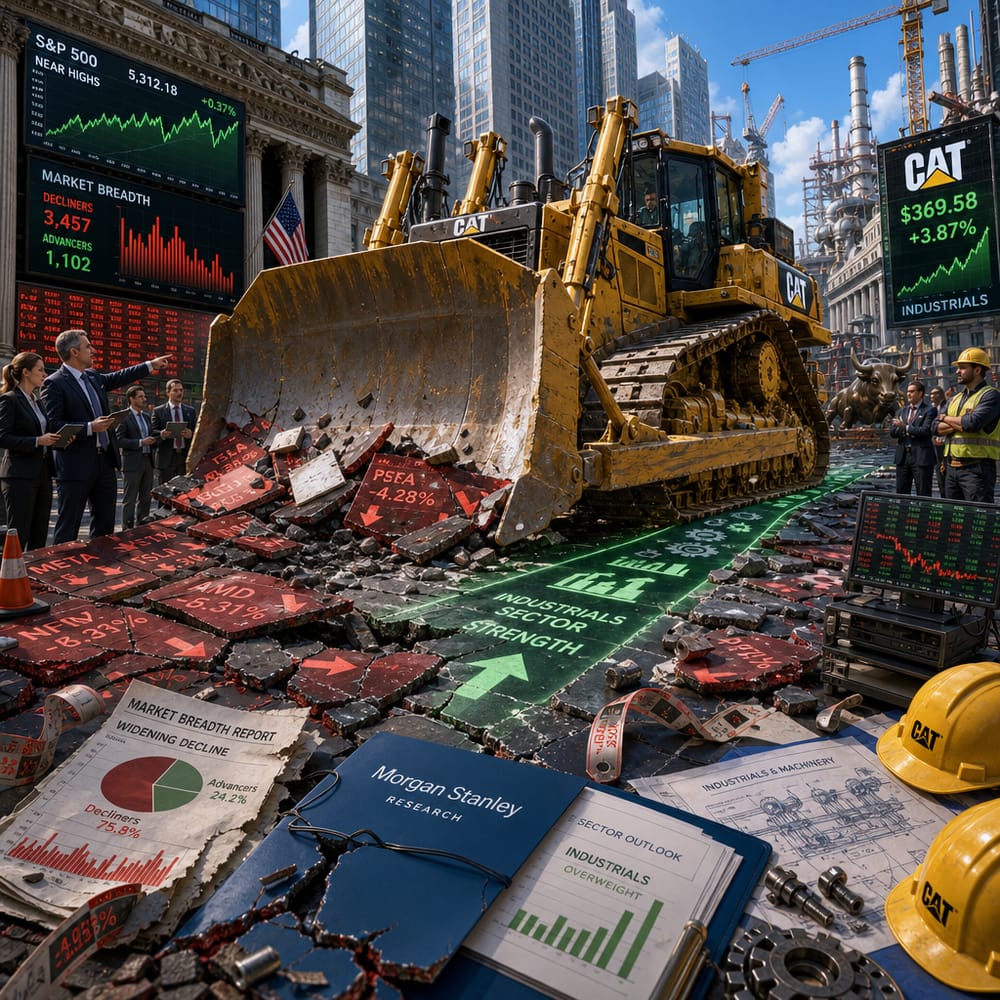
CAT's Out of the Bag: Why Industrials Might Be the Market's Best Bet Right Now
Is the stock market starting to feel like a lukewarm cup of coffee—lacking its usual zing? Blame it on market breadth, or the lack thereof. It's a fancy way of saying that while a few big-name stocks are soaring, most others are stuck in traffic. Enter Morgan Stanley’s latest hot take: industrials are the comeback kids the market desperately needs. They’re not just vehicles of change but the proverbial chariots of fire that could gallop ahead, despite the market's narrow playing field.
What’s the big deal about market breadth? Imagine a party where only a handful of guests are on the dance floor while everyone else clutches their punch cups. That's the broader market today—stock indexes are showing gains, but the number of individual stocks that are actually participating is dwindling. When you have the likes of Apple and Microsoft doing the heavy lifting while others catch their breath, it’s similar to a relay race where only one runner bothers to run. Spoiler: it's not sustainable.
So, why are industrials looking good right now? Picture the U.S. economy as a construction site, and the industrials are the cranes. There's government spending on infrastructure, the need for supply chain rebalancing post-pandemic, and a global shift towards greener technologies. These aren’t just trends; they’re tectonic shifts that industrials are built to capitalize on. From railroads to renewable energy equipment, these sectors are ready to dig into a juicy slice of economic pie.
And where there’s talk of industrials, Caterpillar is the elephant—or should we say, the bulldozer—in the room. The yellow-and-black behemoth isn’t just moving earth; it’s moving mountains in the market. Caterpillar's robust performance amidst peers is like finding a high-performance pickup in a sea of hatchbacks. While others fumble with supply chain bottlenecks and cost pressures, Caterpillar seems to have mastered the art of resilience. It's like the company has a GPS for navigating volatility.
Then there are Caterpillar's peers, the other players in the industrial sandbox. Some might be struggling to build their castles, but those who are managing to keep their heads above the sand are seeing significant gains. Think companies involved in aerospace, defense, and even construction materials. They’re not just following in Caterpillar’s tire tracks; they’re paving new roads.
But let’s not get too caught up in the fanfare. Risks still lurk in the shadowy corners of the market’s industrial sector. Rising interest rates could hit like a surprise speed bump, increasing borrowing costs for companies looking to expand. And let's not ignore the geopolitical puzzle pieces that could shift at any moment, affecting global supply chains like a sudden road closure on your morning commute.
Yet, despite those potential pitfalls, the industrial sector seems primed to not just survive but thrive. The disparity in market breadth is highlighting industrials as a beacon of potential growth. In a world where tech gets the headlines but industrials do the heavy lifting, Morgan Stanley's nod to the sector might be just the ticket retail investors need to diversify effectively.
So, what’s the takeaway? If you’re an everyday retail investor, don’t just watch the tech fireworks—consider adding a little Caterpillar machinery to your portfolio. Industrial stocks could be the hidden gems that offer both stability and potential growth. You’re not just betting on a sector; you’re investing in the backbone of economic expansion. And in markets like these, that’s a bet worth making.
This article is for informational purposes only and is not investment advice. Always do your own research or consult a licensed financial professional before making investment decisions.
© Copyright 2024. All Rights Reserved.
© Copyright 2024. All Rights Reserved.