

Mid-Week Market Weakness Reflects Rising Caution
Thursday, August 20, 2026
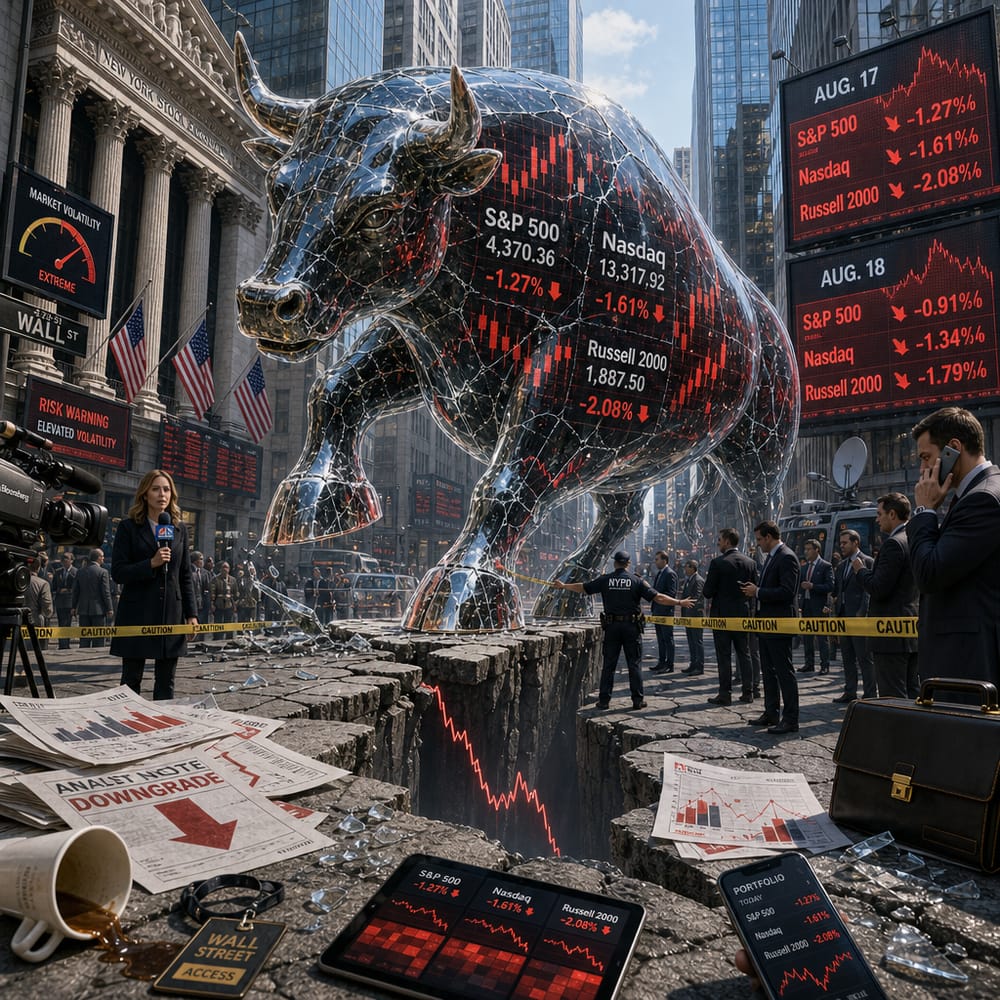
MID-WEEK MARKET WEAKNESS REFLECTS RISING CAUTION
Hold onto your hats and check your seatbelt: Wall Street took us on a white-knuckled ride last week. Like a roller coaster reaching the summit only to dip unexpectedly, the U.S. stock market saw sharp declines on August 17 and 18. As the economy juggernauts on, investors' nerves are starting to fray, and it's time retail investors take notice.
Cue the semi-panicked glances at your portfolio. The S&P 500, Nasdaq, and Russell 2000 are sounding the alarm bells, signaling that the party might just be winding down and it's time to rethink the game plan. But before you go pushing any panic buttons, let's look at what's really going on.
THE ECONOMIC PUZZLE: WHAT’S GOT INVESTORS SHAKING?
First, let's talk about those pesky bond yields that just won't quit. Despite Treasury Secretary Scott Bessent’s best efforts to wave his magic wand and buy back government debt, yields are climbing higher, not lower. This means borrowing money is going to get more expensive, and that could easily snowball into less consumer spending and tighter corporate budgets. In other words, it's the financial equivalent of realizing you have a hole in your umbrella right as rain clouds roll in.
Wall Street analysts aren't exactly singing show tunes about this, and neither are investors. Rising bond yields are prompting a reality check, slapping us with the harsh truth that higher interest rates might be here to stay longer than your uncle's conspiracy theories at Thanksgiving. And don’t even get us started on the Federal Reserve’s cautious dance around the Treasury's interventions. With the Fed keeping its cards close to the chest, there's not much clarity on whether it'll step in to stabilize things or let the chips fall where they may.
SECTOR SNAPSHOT: WHO'S FEELING THE BURN?
Now, let’s break down how different sectors are faring in these choppy waters. First on the chopping block: Walmart. The retail giant, usually a safe haven in stormy markets, saw its stock take a nosedive. Despite posting decent quarterly sales, their outlook didn't win any popularity contests on Wall Street. When big players like Walmart start to wobble, it’s a pretty clear indicator that the entire retail sector might be in for a rough ride. Consider this your heads-up to potentially brace for impact.
But not every sector is playing the blues. Tech, in its usual style, is attempting to dodge bullets Matrix-style, though not without a few grazes. Case in point: Nvidia, which is fielding denials of a report about rolling out a new AI chip in China. Investors, understandably skittish, need reassurance that geopolitical tensions won’t singe their high-flying tech portfolios.
On the flip side, Hyundai is hitting the accelerator in the U.S. with plans to boost production in Georgia. This bold move, even with the market's current turbulence, shows how some sectors still see growth opportunities on the horizon.
WHAT DOES THIS MEAN FOR YOUR PORTFOLIO?
Alright, so what’s a retail investor to do in the face of what feels like financial musical chairs when the music might stop at any second? The key is to not let fear drive your decisions. Instead, understand that market downturns are part of the game, and sometimes, a little caution now can prevent a lot of heartache later.
It might be the right time to tighten up your portfolio, focusing on sectors that demonstrate resilience or potential for growth despite the broader economic gloom. Keep an eye on tech and consider the potential in sectors like domestic manufacturing, as companies like Hyundai double down on their U.S. strategies.
Finally, while it’s always tempting to follow the crowd, remember that panic-selling during market dips can lock in losses rather than allowing you to recover when the market bounces back — because it almost always does.
So, as the economy unfolds like a complex drama, retail investors should prepare for the plot twists—but also remember that every good story has its ups and downs. As always, consult with a financial advisor to ensure your strategy aligns with your goals and risk tolerance. And maybe, just maybe, enjoy the thrill of the ride.
This article is for informational purposes only and is not investment advice. Always do your own research or consult a licensed financial professional before making investment decisions.
© Copyright 2024. All Rights Reserved.
© Copyright 2024. All Rights Reserved.